

DFS 2.0 explained: How operators can tap into the future of fantasy sports

Updated 12 Jan 2026•Published 12 Jan 2026
Overview
The fantasy sports industry is evolving quickly, and DFS 2.0 is leading the charge.
This new generation of daily fantasy sports goes beyond traditional formats, giving players the opportunity to go head-to-head with the house through fast, engaging predictions on individual player performances.
With strong appeal for casual fans and mobile-first users, DFS 2.0 is carving out a distinct place in the U.S. sports betting market and beyond.
This article breaks down the opportunities DFS 2.0 offers operators, as well as the compliance challenges they must navigate to succeed in this space.
What is DFS 2.0?
DFS 2.0 refers to a new type of daily fantasy sports game where players compete against the house rather than against each other. They make predictions on how individual athletes will perform, such as whether a player will score more or fewer points than a set line.
This contrasts with the traditional daily fantasy sports format, often now referred to as DFS, where participants draft an entire team and earn points based on the team’s overall performance.
Using the term “DFS 2.0” is important to clearly separate these newer formats from traditional DFS and from sports betting, since there are significant legal differences between them.
DFS 1.0 vs. DFS 2.0
Here are the key differences between traditional DFS and the newer DFS 2.0 format:
| Feature | DFS 1.0 (Traditional DFS) | DFS 2.0 (Modern DFS) |
|---|---|---|
| Opponent Type | Other players (peer-to-peer) | The house |
| Gameplay Format | Draft a full team within a salary cap | Make individual player predictions (e.g., over/under) |
| Scoring | Points based on full team performance | Points or payouts based on individual predictions |
| Time Commitment | Season-long or full-day contests | Single-event, quick-entry contests |
| Skill Level Required | Higher: Requires strategy and research | Lower: Designed for simplicity and speed |
| Target Audience | Experienced fantasy sports players | Casual sports fans and mobile-first users |
| Legal Classification | Fantasy sports under traditional DFS regulations | Legally distinct model, often allowed where sports betting isn’t yet permitted |
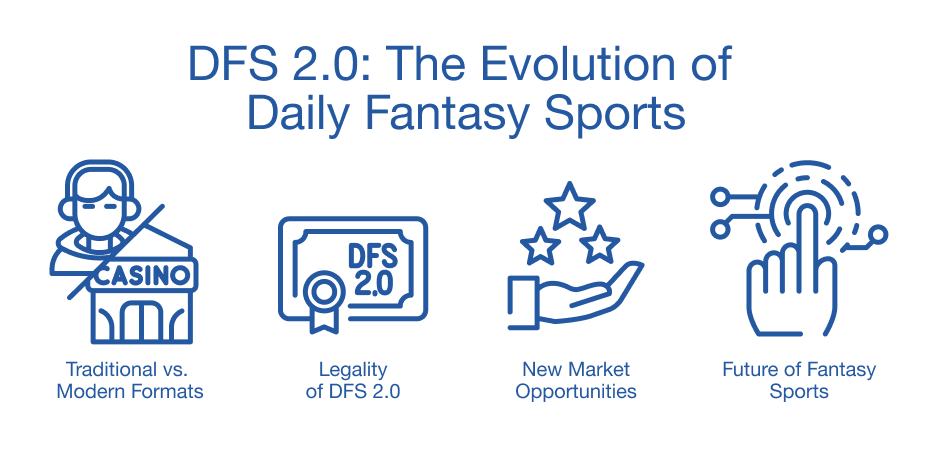
Is DFS 2.0 legal?
The legality of DFS 2.0 varies widely by jurisdiction and often falls into a regulatory gray area. Unlike traditional daily fantasy sports, DFS 2.0 introduces new gameplay mechanics. Options to wager directly on player performance predictions against the house can blur the line between a contest of skill and a form of sports betting.
At the heart of the legal debate around DFS 2.0 is the distinction between skill and chance. If a game is judged to rely primarily on skill, it may be exempt from gambling laws in certain regions. However, if elements of chance play a significant role, DFS 2.0 risks being classified under local gambling regulations.
Here’s the current legal landscape for DFS 2.0 across key markets:
DFS 2.0 legality in the U.S.
In the United States, the legality of DFS 2.0 is highly state-specific. Some states recognize DFS 2.0 as a skill-based contest, particularly where fantasy sports carve-outs already exist in state law.
Other states have either rejected the model outright or classified it as unlicensed sports betting. Operators must carefully navigate this patchwork of interpretations, as enforcement approaches vary significantly from one state to another.
DFS 2.0 legality in Canada
Canada provides limited clarity regarding DFS 2.0. Similar to the U.S., regulation takes place at the provincial level rather than nationally. Some provinces may permit DFS-style contests under promotional contest rules, but significant ambiguity remains.
This is especially true with newer DFS 2.0 formats, which could be considered closer to sports betting than traditional DFS. For this reason, a careful legal review is essential for any operator planning to launch DFS 2.0 platforms in Canada.
DFS 2.0 legality in the rest of the world
Internationally, DFS 2.0 is generally subject to stricter oversight in established gambling markets. In many regions, these contests are likely to be classified as sports betting unless operators can clearly demonstrate that skill predominates.
Because the rules governing sports betting and chance-based competitions differ by country, operators must tailor their approach to each market. Comprehensive regulatory guidance and expert legal counsel are critical before pursuing international expansion.
DISCLAIMER
This information is not intended to be legal advice and is solely extracted from open sources. It should not be relied upon as a substitute for professional legal advice, and Agreegain does not accept any liability for its use.
Can DFS 2.0 be a strategic play for operators?
DFS 2.0 represents a major opportunity for operators, particularly in large markets like California and Texas, where traditional sports betting is not yet regulated.
Key advantages of launching a DFS 2.0 platform in these markets include:
- Access to Underserved Players: Engage sports fans who currently lack access to traditional sportsbooks and betting platforms.
- Faster Time to Market: White-label solutions make rapid deployment possible, allowing operators to launch new brands and gain traction quickly.
- First-Mover Advantage: Building a loyal player base now positions operators for success if and when sports betting is legalized in these states.
- Appeal to Casual Players: DFS 2.0 delivers a simplified, mobile-friendly experience that feels less intimidating than traditional sportsbooks.
Can operators use DFS 2.0 in their existing products?
The short answer is yes, but careful planning is critical to ensure smooth integration with an existing platform.
In regulated U.S. states, some DFS 2.0 providers, such as PrizePicks and Underdog Fantasy, have seen rapid growth by offering simplified, player-prop-style contests that resonate with a broader, mobile-first audience.
According to VIXIO Gambling Compliance’s analysis of state revenue data, PrizePicks captured 43.2% of total reported revenue across four states in the first half of 2023, surpassing the combined 45.2% share of DraftKings and FanDuel in those markets.
Operators can integrate DFS 2.0 into their offerings through two main approaches:
- White-Label Platforms: Best for speed to market and lower upfront investment.
- Proprietary Tech Stacks: Better suited for operators seeking greater control, customization, and differentiation.
Owning the product end-to-end often provides a competitive edge by enabling superior user experiences and deeper player engagement.
That said, every DFS 2.0 product must be designed with compliance in mind from day one, covering game structure, payouts, and promotional practices.
Compliance and best practices for DFS 2.0
Compliance isn’t just a legal requirement—it’s essential for building trust and ensuring sustainable, long-term growth.
To succeed responsibly in the DFS 2.0 space, operators should:
- Conduct Thorough Legal Audits: Both before launch and on an ongoing basis.
- Implement Transparent Terms: Ensure players clearly understand contest rules, entry fees, and payout structures.
- Stay Current: Track evolving case law, regulatory interpretations, and enforcement trends, adjusting offerings as needed.
- Localize Effectively: Adapt products and marketing to align with the legal and cultural requirements of each jurisdiction.
The future of DFS
DFS 2.0 is already transforming the fantasy sports market in the U.S. and abroad, particularly in the space of casual wagering.
As technology continues to advance and player preferences shift, innovation is expected to accelerate in several key areas:
- Personalization and Gamification: Customizing experiences and adding game-like features to increase engagement, retention, and lifetime value (LTV).
- Micro-Predictions and Real-Time Contests: Delivering ultra-fast, real-time prediction opportunities tied directly to live sporting events.
- Hybrid Models: Blurring the lines between fantasy sports, esports, and traditional sports betting to create richer, more diverse platforms.
Final thoughts: Why DFS 2.0 is here to stay
DFS 2.0 is opening exciting new ground at the intersection of fantasy sports and regulated sports betting, particularly across U.S. states. For operators, it offers a powerful opportunity to reach untapped audiences, strengthen brand loyalty, and prepare for future regulatory shifts.
But success in DFS 2.0 requires more than simply launching a new product or building on the legacy of traditional DFS. It demands a strong understanding of local regulations and a commitment to compliance.
Operators who act strategically today won’t just capture growth—they’ll help define the future of fantasy sports and digital wagering. DFS 2.0 isn’t just a passing trend; it’s a long-term opportunity to lead the next wave of innovation across North America and beyond.
Popular blog posts