

The rise of live casinos: A strategic guide for iGaming operators

Updated 6 Feb 2026•Published 6 Feb 2026
Overview
Once considered a niche product, live dealer casinos have become a major driver of the online gambling boom. In 2025, the global online casino market was valued at over $37 billion, with live dealer games accounting for a significant share.
By blending human interaction with advanced streaming technology, live casino platforms bring the atmosphere of a real casino directly to players’ screens. In this article, we break down how they work, how they generate revenue, and why they’re shaping the future of iGaming.
How live dealer casinos operate
Online live dealer casinos, often referred to simply as live casinos, aim to replicate the excitement of a land-based casino in a digital format.
Using high-definition live streaming, real human dealers host games in dedicated studio environments or on actual casino floors, while players watch and interact in real time from their devices.
Advanced software overlays key features—such as player actions, betting options, and game statistics—on the screen, creating a seamless and immersive experience.
Players place bets digitally, interact with the dealer, and watch the action unfold live. This creates a more social and authentic alternative to traditional RNG (random number generator) games like slots.
Live dealer games first appeared in the mid-to-late 2000s, once broadband internet became fast and reliable enough to support high-quality video streaming. Their popularity has skyrocketed in recent years thanks to increasing demand for immersive, authentic, and social online gambling experiences.
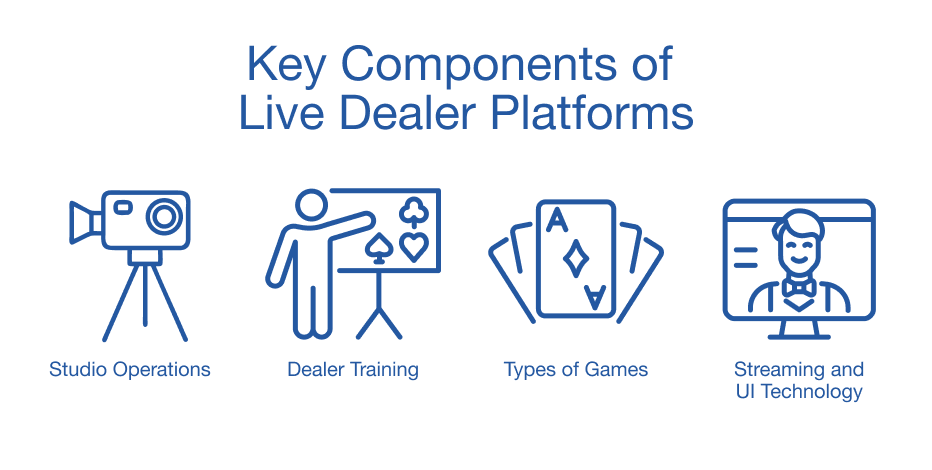
Key components of live dealer platforms
Live dealer casinos are sophisticated operations that depend on a combination of real-time video production, trained personnel, interactive user interfaces, and reliable backend systems. These elements work together to deliver an engaging and authentic gaming experience that bridges the gap between land-based casinos and online play.
Studio operations
Live dealer games are streamed from specialized studios designed to look and feel like traditional casinos. These studios are equipped with professional lighting, HD cameras, soundproofing, and advanced broadcasting equipment to ensure smooth and uninterrupted streaming. Some providers also use green screens and CGI technology to create custom-branded environments for operators.
Dealer training
Dealers are central to the player experience. They are trained not only in the rules and flow of various games but also in customer interaction, managing game pace, and working on camera. Many providers operate in-house dealer schools to ensure consistent, high-quality service that meets both regulatory standards and player expectations.
Types of games
The most popular live dealer games include:
- Blackjack:
The classic card game where players aim to reach 21 and beat the dealer. - Baccarat:
A fast-paced banker-versus-player card game favored by high rollers. - Roulette:
Players bet on where the ball will land on a spinning wheel. - Craps and dice:
Players bet on the outcome of dice rolls, with a dealer managing the action in a high-energy setting. - Game shows:
Interactive, TV-style games such as Crazy Time and Monopoly Live blend gambling with entertainment, hosted by lively presenters in themed studios.
Streaming and UI technology
To deliver a smooth experience, live dealer platforms rely on low-latency streaming that allows players to watch the action in real time with minimal delays. Multi-camera angles, slow-motion replays, and augmented reality overlays enhance the experience.
On the front end, players engage with games through responsive user interfaces that support betting, chat functions, and game statistics. These interfaces are optimized for desktop, tablet, and mobile play, ensuring accessibility across devices.
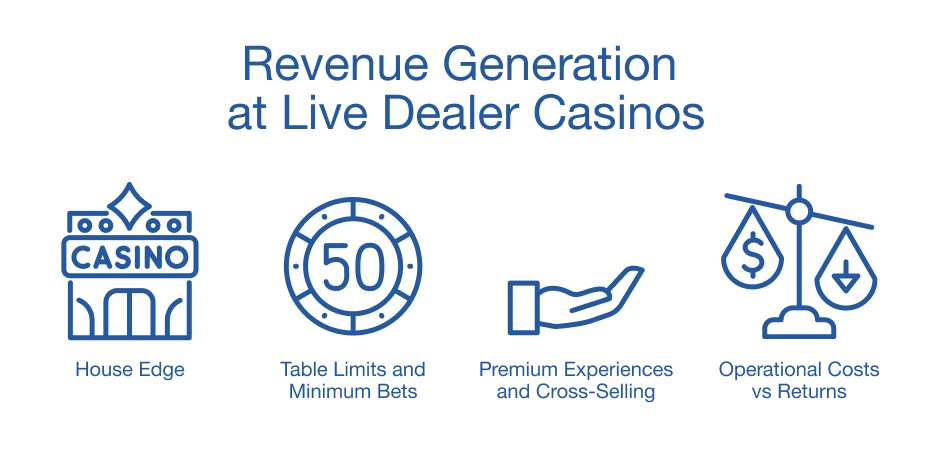
Revenue generation at live dealer casinos
Live dealer casinos operate on a revenue model similar to traditional online casinos but with some unique differences due to the live format and higher operating costs.
Here are the primary ways live dealer casino operators make money:
House edge
Live dealer games are built around a mathematical house edge, ensuring the casino earns predictable profits over time. Whether it’s live roulette, blackjack, or baccarat, the odds are always slightly in the operator’s favor, allowing steady revenue generation.
Table limits and minimum bets
Live dealer games generally carry higher minimum bets than most RNG-based games, such as slots. This helps offset the costs of running studios and staffing.
Operators implement tiered table limits—low, mid, and high stakes—to cater to different types of players and maximize profitability per table.
Premium experiences and cross-selling
Many live casinos offer VIP rooms, private tables, or experiences themed around a sports team. These options attract high-value players and allow operators to command higher stakes and fees.
Cross-selling between verticals is another revenue driver. For example, offering targeted bonuses for linked sportsbooks or slot products helps increase overall lifetime player value (LTV) and retention.
Operational costs vs. returns
Unlike RNG-based platforms, live casinos have substantial expenses, including studio setup, dealer salaries, streaming infrastructure, and compliance.
Despite these high costs, the return on investment can be significant, especially for operators who optimize table occupancy and player engagement.
High-volume platforms—particularly those using shared or white-label studio setups—often achieve strong profit margins once the infrastructure is established.
Market performance: Live dealer casinos vs. slots
Slot games have traditionally dominated online casinos, attracting a wide audience with their simplicity and variety. Ongoing development of themes and mechanics has continued fueling growth.
In recent years, however, live dealer games have become a compelling alternative, offering a more interactive and immersive experience. This reflects changing customer preferences and the growing demand for authenticity in online gaming.
Evolution, the industry’s leading live casino provider, illustrates this trend. In Q2 2024, it reported revenue of €508.4 million, a 15.3% year-over-year increase. Of this, €438.1 million came from live dealer games, representing a 17.8% increase.
By comparison, Evolution’s RNG segment—which includes NetEnt, Red Tiger, BTG, and Nolimit City—grew just 1.4%, contributing 13.8% of total revenue.
These numbers highlight the strategic importance of live dealer products. They show how live casinos can drive revenue while serving as a key differentiator in an increasingly competitive online gaming market.
Pros and cons of live dealer casinos
Live dealer casinos present a strong value proposition for both operators and players, combining the best aspects of land-based gaming with the convenience of online platforms. At the same time, this vertical introduces unique operational challenges and cost factors that set it apart from RNG-based offerings. Here’s a straightforward operator impact matrix outlining the main pros and cons of live casino platforms:
| Aspect | Advantages | Disadvantages |
|---|---|---|
| Player engagement | High: Real-time interaction leading to boosts lifetime value (LTV) | Requires reliable high-quality streaming and support |
| Revenue generation | Often outperforms RNG titles, like slots | Expensive to scale due to fixed player capacity per table |
| Brand differentiation | Branded tables, game shows, VIP setups | Risk of technical issues and inconsistent user experience |
| Operational costs | Supports premium positioning | High expenses for studios, staff, streaming infrastructure, etc. |
| Scalability and compliance | Well-suited for high-stakes players and regional targeting | Complex regulations and jurisdiction-specific licensing |
| Cross-selling opportunities | Smooth funnel to sportsbooks or slots | Requires tailored UX/UI integration |
The future of live dealer casinos
The live dealer casino segment is set for continued growth, fueled by technological innovation and shifting player preferences for more personalized and distinctive experiences. Advances in virtual reality (VR) and augmented reality (AR) are expected to further enhance the immersive nature of live dealer casinos.
In addition, expansion into emerging markets—such as newly regulated regions like Brazil and the Philippines—offers strong opportunities for early adopters.
At the same time, the industry faces a growing range of challenges, including increased regulatory scrutiny, particularly around localization, anti-money laundering (AML), and player protection.
To sustain growth in the fast-evolving live casino market, operators will need a clear strategy that balances innovation with compliance and operational efficiency.
Final thoughts: Embracing the evolution of online gaming
Live dealer casinos are no longer a niche product—they’re a proven revenue driver and a critical pillar in the future of online gaming. As player expectations continue to shift toward authenticity, interaction, and personalization, live casino products give operators a competitive edge that pure RNG titles rarely provide.
The segment’s strong growth trajectory, highlighted by providers such as Evolution, demonstrates its ability to drive both engagement and long-term player value.
However, with this high potential comes significant complexity, and success in this vertical requires more than just technical expertise. Operators need strategic foresight, regulatory adaptability, and major investment in both human and technological infrastructure.
For operators and platforms aiming to future-proof their iGaming offerings, the live dealer segment is no longer just an opportunity—it’s quickly becoming a priority. Those who invest early and execute effectively will be best positioned to lead in an increasingly experience-driven online casino market.
Popular blog posts