

White label casino licensing explained: Who holds the license and why it matters

Updated 15 Jan 2026•Published 15 Jan 2026
Overview
For entrepreneurs looking to launch an online casino brand, securing a license is often one of the biggest hurdles they face. Not only is it complex and time-consuming, but it can also be costly and heavily regulated, depending on the jurisdictions involved.
That’s where white label solutions can provide a game-changing advantage: you don’t need to obtain your own gambling license. You legally operate under the provider’s existing license, allowing you to go live quickly and avoid dealing with complex regulatory procedures.
In this article, we’ll break down exactly how gambling licenses work when you choose a white label model. We’ll also explore the advantages and limitations of this approach and help you determine whether this route is the right move for your brand.
Do I need my own gambling license with a white label casino?
The short answer is no, you don’t.
When you launch an online casino through a white label solution, the license you operate under isn’t yours, it belongs to your white label provider. This means you don’t have to go through the lengthy and often expensive process of obtaining your own gambling license.
Your brand functions as a sub-brand or “skin” of the provider. You use their technical infrastructure, compliance framework, and legal standing so you can focus on entering the market quickly and legally in the jurisdictions where they’re licensed.
This is one of the main reasons many new operators choose the white label model instead of turnkey or self-built online casino solutions.
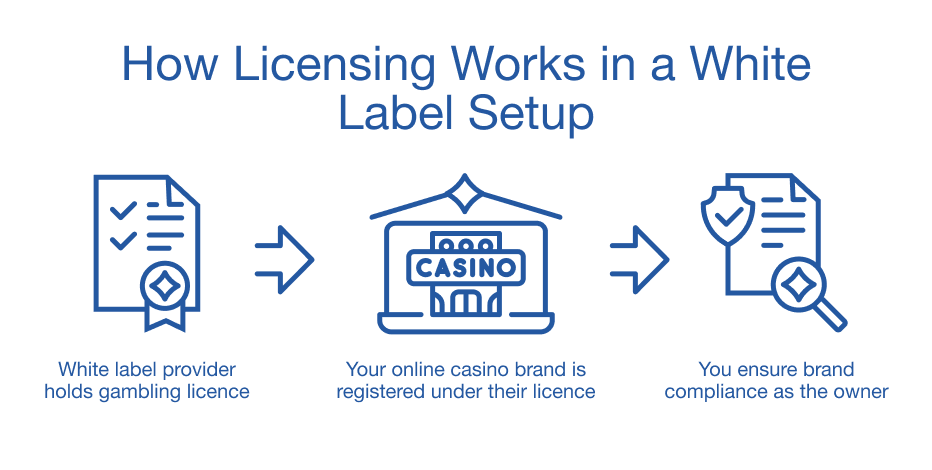
How licensing works in a white label setup
Here’s how licensing works behind the scenes when you use a white label platform to launch an online casino:
- The white label provider holds a gambling license from a recognized jurisdiction such as the Malta Gaming Authority or the UK Gambling Commission.
- This license allows them to offer multiple gambling services and legally operate online casinos under their platform.
- Your online casino brand is registered under their license and operates within its legal framework and compliance requirements.
- The provider is the legal license holder and the official operator in the eyes of the regulatory authority. That means they are ultimately responsible for regulatory compliance, dispute resolution, data protection, and financial security.
That said, you still have compliance responsibilities as the brand owner. For example, you must ensure your marketing follows local rules and regulations and that Know Your Customer (KYC) data is handled properly and in compliance with those rules.
The pros and cons of white label solutions
For entrepreneurs and startups, a white label solution is often the most accessible and cost-effective way to enter the iGaming market. It removes many of the barriers typically associated with launching an online casino, especially the complexities of licensing and compliance.
The pros of white label casinos
- Faster time to market:
With the platform, licensing, and game integrations already in place, you can launch your casino in just a few weeks. Compared to turnkey or self-built casino models, where you must obtain your own license and technology, white label solutions offer a lower barrier to entry. - Lower upfront investment:
White label solutions generally come with lower setup costs. You avoid paying for your own gambling license, technical infrastructure, or legal team, making this an attractive option for brands with limited capital. - Built-in compliance and licensing:
Your operation runs under the provider’s gambling license, which means they’re responsible for most of the regulatory compliance work, including player verification (KYC), anti-money laundering (AML) checks, and responsible gaming tools. - Operational efficiency:
You can focus on growing your brand, marketing, and user acquisition while the provider handles infrastructure, security, payment processing, and platform maintenance. - All-in-one package:
White label providers offer a fully managed, plug-and-play solution that includes:
- Casino software and games from leading providers
- Payment gateway integration
- Customer support
- Hosting and server management
- Optional marketing and CRM tools
This makes it a truly end-to-end service for launching and managing a casino with minimal in-house resources.
The cons of white label casinos
While white label platforms offer convenience, they also come with several limitations that may affect your long-term growth or regulatory flexibility.
- Limited market access:
You can only operate in countries where the provider’s license is recognized. For example, a UKGC license allows access to the UK market but comes with strict compliance requirements and limits your ability to serve unregulated regions.
If your marketing or operations extend beyond the provider’s licensed areas, your account could be suspended or terminated. In some cases, local regulators may impose penalties or pursue legal action. - Reduced control:
White label platforms aren’t fully customizable. While you can design your brand’s look and feel, deeper changes to the user experience, game selection, or platform features are typically limited. - Shared infrastructure risks:
Your site may share resources with other white label brands on the same network. If another operator under the same provider faces legal issues or violates regulations, there’s a small risk it could affect your brand’s stability or reputation. - Harder to scale or pivot:
As your business grows, you may outgrow the limitations of a white label setup. Transitioning to a full license or developing your own platform may require a complete relaunch.
Where can I legally operate under a white label license?
When you launch an online casino using a white label solution, you can only operate in countries where your provider’s gambling license is valid and recognized. This means you can’t freely choose your markets if you go with a white label model. Instead, you’re restricted to jurisdictions that legally allow online gambling under that specific license.
You should carefully review where your provider’s license allows you to operate—and where it doesn’t. Some licenses cover multiple countries, while others are valid in only a few.
For example, if your white label provider holds a license from the Malta Gaming Authority (MGA), you’ll be able to target players in jurisdictions that accept the MGA’s regulatory framework. If they’re licensed by the UK Gambling Commission (UKGC), you can access the UK market, but you’ll also have to comply with the UK’s strict regulations.
Many regulated online casino markets, such as Spain, Italy, and the Netherlands, require operators to hold a local license. This may exclude your white label brand unless the provider is specifically licensed there.
Before signing with a white label provider, make sure to ask for details on:
- The jurisdictions where their license applies
- Countries where you can’t operate under their licensing solution
- How they manage regulatory changes or geo-blocking
Understanding these details is essential, as they’ll have a major impact on your casino brand’s potential reach and growth opportunities.
Moving beyond a white label license
White label solutions can serve as stepping stones into the iGaming market, and that’s exactly how many successful online casino brands got their start.
However, once you’ve built a loyal user base, validated your business model, and established steady revenue, you may feel it’s time to move beyond a white label solution.
You can take the next step by:
- Obtaining your own gambling license
- Building or licensing your own casino platform
- Taking full control of your operations
Some white label providers offer flexible migration paths to help you transition from their ecosystem to your own licensed operation. This allows you to scale responsibly while maintaining continuity with your brand and player base.
Final thoughts: Is a white label license the right fit for your brand?
If you’re asking, “Do I need my own gambling license to launch an online casino?” the answer—if you’re choosing the white label route—is no. This makes white label solutions incredibly appealing for startups and entrepreneurs looking to enter the industry without heavy regulatory burdens.
Like any shortcut, it comes with trade-offs: restrictions on where you can operate, lower profit margins, and less autonomy. For many operators, especially in the early stages, the benefits far outweigh the downsides.
Ultimately, the decision depends on your business goals, target markets, budget, and risk tolerance. White label solutions provide a low-risk way to test and grow a casino brand—and a smart entry point into one of the world’s most profitable digital industries.
Ready to launch your casino brand?
At Agreegain, we offer a fully managed white label solution backed by an internationally recognized gambling license, robust technical infrastructure, and a portfolio of over 10,000 games from leading providers.
Popular blog posts