More ROI, less spend: Unlocking casino growth via smart email marketing

Updated 23 Feb 2026•Published 23 Feb 2026
Overview
Player acquisition often takes center stage in iGaming marketing strategies, but the real engine of long-term growth lies elsewhere: retention. One of the most effective tools for keeping players engaged, loyal, and spending is a channel many operators already use: email.
When done right, email campaigns can re-engage dormant users, drive repeat deposits, and increase player lifetime value. All of this is possible without the steep costs associated with acquisition channels like paid media or affiliate networks.
In this article, we’ll explore how email marketing supports sustainable growth by reducing churn, strengthening loyalty, and unlocking higher margins from your existing player base.
The financial case for retention via email marketing
Alongside acquiring new players, sustainable growth comes from making the most of the players you already have. Email marketing is one of the most cost-effective, high-impact ways to boost player retention, reactivation, and lifetime value.
When executed well, it delivers consistent ROI, strengthens loyalty, and turns casual users into long-term revenue drivers, all without the sizable costs of acquisition.
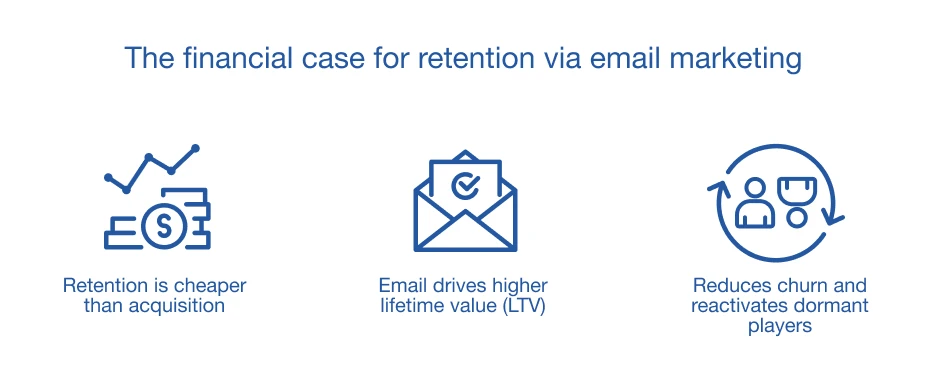
1. Retention is cheaper than acquisition
Industry research consistently shows that acquiring a new customer in any business can cost five to seven times more than retaining an existing one. For online casino operators, there are numerous costs associated with each acquisition, including:
- Paid ads:
Channels such as PPC, social, or display ads are highly competitive and expensive, especially in iGaming, with no guaranteed conversions. - Affiliate fees or revenue share:
Operators pay affiliates $100 to $150 CPA (cost per acquisition) or ongoing revenue share, which cuts into long-term margins. - Sign-up bonuses and no-deposit incentives:
Attractive but costly offers used to encourage registration, often attracting short-term players. - Conversion and onboarding funnels:
Require investment in UX, KYC, and support to minimize drop-off and convert visitors into depositors.
When you combine these factors, each new player can cost anywhere from $100 to $300+, depending on your target market or region. Even with this investment, a significant portion of users churn after claiming the welcome offer, highlighting the importance of strong retention strategies.
- Example:
Sending an email campaign to 10,000 dormant players costs $200 to $500. If just 2% re-deposit $50, that’s $10,000 in revenue, delivering a 20x return.
This is why retention deserves just as much, if not more, attention than acquisition for iGaming operators. Once a player is active on your platform, keeping them engaged costs significantly less than acquiring a new one, and the potential returns are substantially higher.
Here are some of the added benefits of focusing on retention:
- Email marketing:
Personalized, data-driven campaigns cost pennies per user but can deliver ROI as high as 40:1. Compared to the $100+ cost of acquiring a single new player, the value is clear. - Player loyalty:
Loyal players are more likely to trust your brand, deposit regularly, and respond to cross-sell offers such as sports betting or live casino. With smart segmentation and timing, a single player can generate steady revenue for months or even years. - Retention supports acquisition:
Stronger retention increases player lifetime value (LTV), making higher CPAs more sustainable and allowing you to scale acquisition without eroding profitability.
Takeaway for operators:
Player retention isn’t just a support function; it’s a key growth lever. For most operators, it is the most cost-effective path to higher margins and long-term success.
2. Email drives higher lifetime value (LTV)
In a market where acquisition costs are rising, understanding and maximizing player lifetime value (LTV) is essential. LTV represents the total net revenue a player is expected to generate over the course of their relationship with your brand.
The higher your LTV, the more you can afford to spend on acquisition while still maintaining profitability from your existing player base. This, in turn, improves the stability of your business over time.
Several key factors influence LTV:
- Retention rate:
The longer players remain active, the more opportunities you have to generate revenue through repeat deposits, cross-sell opportunities, and promotions. - Player segmentation:
Tailoring experiences based on player value, interests, and behaviors increases engagement and maximizes each player’s revenue potential. - Personalized offers and UX:
Custom bonuses, loyalty tiers, and intuitive site design keep players coming back, increasing both deposit frequency and deposit value. - Cross-sell opportunities:
Offering sports betting, live dealer games, or tournaments increases LTV by driving player activity across multiple verticals.
Let’s see how this could benefit you:
- If your average player deposits $40 per month and stays active for 12 months, their LTV is $480 (12 × $40 = $480).
- With a CPA of $120, that represents a 4x return on investment.
- If you can improve retention by just three months, their LTV increases to $600, without any additional acquisition cost.
LTV connects retention, monetization, and marketing performance into a single, clear financial benchmark. It’s not just another metric to track, but a practical tool for driving revenue growth.
Takeaway for operators:
By increasing LTV, you unlock the ability to scale acquisition with greater confidence, support higher CPAs, and build a more profitable, resilient casino brand.
3. Reduces churn and reactivates dormant players
Even with strong acquisition and onboarding, some players will inevitably churn. With the right retention strategy, however, churn doesn’t have to mean game over. Reactivating dormant players is often one of the most cost-effective ways to drive revenue growth.
Here’s how retention-focused tactics can help reduce churn and bring players back:
- Automated win-back campaigns:
Email or SMS sequences triggered after periods of inactivity can re-engage players with timely offers, reminders, or game updates. - Exit intent and cool-off offers:
Intercept players before they lapse by offering a relevant bonus or incentive when activity drops or just before they become inactive. - Push notifications and in-app messaging:
Real-time prompts can bring players back, especially when tied to exclusive offers, new games, or upcoming tournaments. - Dormant player segments:
Use CRM tools to segment lapsed players by last deposit date, play habits, and value. Tailored offers to these groups consistently outperform generic casino campaigns.
Here’s how this can work in practice:
- Sending a $5 bonus to 1,000 dormant players costs $5,000.
- If just 5% return and deposit $50, that’s $2,500 in deposits, plus longer-term re-engagement value.
- If half of those reactivated players remain active for three or more months, the ROI compounds quickly.
Operator takeaway:
Churn is an inevitable part of running an online casino, but it can be reduced. Proactive retention campaigns that target inactive players can deliver high ROI at a fraction of the cost of acquiring new users.
What makes a player retention email campaign successful?
Not all email campaigns are created equal. While generic email blasts may deliver limited results, truly effective retention emails are targeted, timely, and tailored.
To maximize engagement and ROI, your campaigns should speak directly to the player, using messaging that aligns with where they are in their casino journey. This approach is far more likely to drive action than a generic message sent to your entire database.
Here are three essential ingredients for creating a high-performing retention campaign:
1. Target players based on their journey
Retention emails perform best when they reflect where a player is in their lifecycle, not just what you want to promote. A player who registered but never deposited, for example, is far more likely to respond to a low-risk bonus than to a generic promotion.
Map your campaigns to these key moments in the player journey:
- Welcome series:
Introduce new players to your brand, games, and offers with a structured onboarding sequence. - Engagement nudges:
Send reminders or tips to active players who haven’t deposited recently or haven’t tried specific games. - Reactivation emails:
Target dormant or churned players with time-limited offers or updates on new games and features. - Operator takeaway:
Aligning your messaging with each stage of the player lifecycle increases relevance, improves the user experience, and drives stronger conversions.
2. Segment players for smarter communication
Segmentation allows you to group players by behavior, value, preferences, and demographics so you can deliver more relevant, higher-impact messages. Instead of one-size-fits-all emails, you can speak directly to each player’s interests and habits.
Here are some key segments to consider:
- High-value players:
Reward loyalty with exclusive perks such as VIP-only bonuses, faster withdrawals, personal account managers, or early access to high-stakes tournaments. These tailored benefits help retain your most profitable players and increase their lifetime value. - Bonus chasers:
Identify players who primarily engage when bonuses are available. To protect margins, offer lower-cost incentives with clear wagering requirements or design tailored offers that encourage more sustainable play. - Game preferences:
Use gameplay data to personalize promotions. For example, slot players may respond well to free spins, while live casino players may prefer cashback on blackjack or roulette. Sports bettors can be incentivized with bet boosts or accumulator insurance.
Operator takeaway:
Smart segmentation leads to more personalized messaging, higher engagement rates, and stronger ROI from every email campaign.
3. Understand what players actually want
Effective retention comes from understanding player expectations and what motivates them to return. The key is identifying which of the following factors matter most to your audience:
- Popular incentives:
Free spins, reload bonuses, loyalty points, and cashback remain proven motivators for casino players. Use them strategically based on player behavior data to drive deposits, engagement, or reactivation. - Emotional drivers:
Go beyond transactions and tap into player motivations. Create competitiveness through tournaments, exclusivity through VIP rewards, excitement with new game launches, and urgency with limited-time offers. Emotional relevance helps keep players connected to your brand. - Optimize for UX:
Your emails should be mobile-friendly, visually clear, and include a single, strong call to action. Minimize friction between the message and gameplay—ideally one or two taps from inbox to deposit. - Example in action:
A targeted message like “You’re 1,000 points away from the next loyalty tier. Unlock a $20 bonus today” gives players a clear, actionable reason to engage. It is far more compelling than a vague “Check out our latest promotion.”
Operator takeaway:
High-performing email campaigns start with what players want to receive, not just what you want to promote. Meet their needs first, and engagement typically follows.
Final takeaway: Retention as a revenue engine
Acquisition brings players in, but retention is what turns them into long-term value drivers. Email marketing is one of the most cost-effective ways to build loyalty, increase LTV, and reactivate dormant users.
By aligning campaigns with player journeys, segmenting intelligently, and addressing real motivations, you can unlock scalable, compounding returns.
Smart operators treat retention as a primary growth driver. With the right email strategy, you can generate more revenue from your existing player base while scaling acquisition more sustainably.
Popular blog posts