

Online casino CPA deals: Benefits, risks, and best practices for success
Updated 4 Mar 2026•Published 4 Mar 2026
Overview
Affiliate marketing remains one of the most effective tools for acquiring new players in the online casino industry. With several commission models available, understanding when to use Cost Per Acquisition (CPA) and when to avoid it is essential for protecting your margins and driving sustainable growth.
This article explains how the CPA model works in the context of casino affiliate marketing, how it compares to other commission structures, and when it makes strategic sense to use it.
You’ll also find practical tips and best practices to help you run smarter, safer, and more profitable CPA campaigns as an online casino operator.
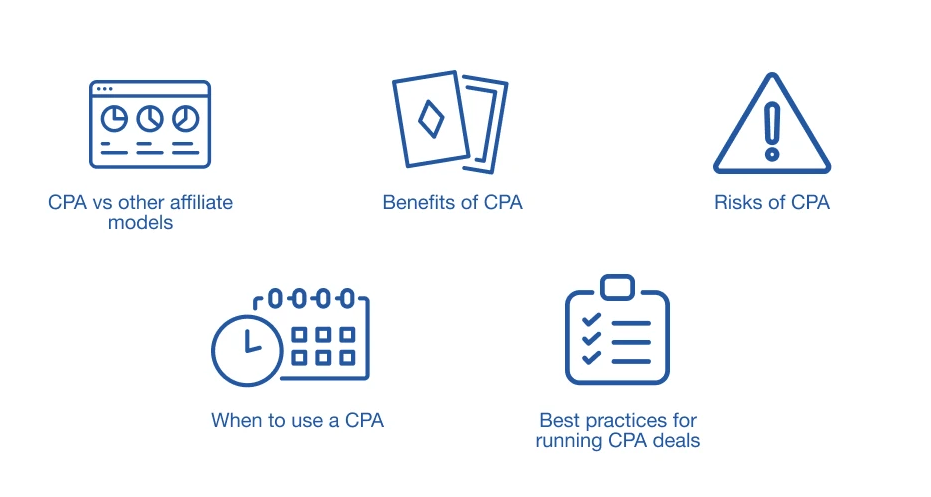
The CPA model explained
Put simply, a CPA deal means you pay affiliate partners a fixed fee for every new player they bring in. The fee is paid only once the player meets the agreed qualification criteria.
For example, a typical CPA deal might require a player to:
- Make a minimum deposit:
For example, at least £20 into their casino account. - Meet a minimum wagering threshold:
For example, placing bets totaling £50 or more. - Pass compliance and fraud checks:
The player must pass KYC (Know Your Customer) verification and show no signs of bonus abuse or fraudulent activity.
These conditions help protect your marketing budget by ensuring you only pay for players who demonstrate genuine intent to play. It’s a built-in way to avoid acquiring players who are simply trying to claim a sign-up bonus and disappear.
However, once these conditions are met, the affiliate’s fee is triggered, whether that player goes on to wager thousands or never logs in to your online casino again. That’s why careful qualification rules and strong monitoring are so important when using CPA deals.
CPA vs other affiliate models: How they compare
Online casino operators can choose from three main affiliate payment structures, each with its own set of pros and cons. Here’s a quick overview of how each one works:
- CPA (Cost Per Acquisition):
This model involves a one-time fixed payment for each qualified new player delivered by the affiliate. It is straightforward, easy to budget for, and useful when you need a quick influx of players—for example, when launching a new site or entering a new market. - Revenue share (Rev Share):
Instead of a single payment, you pay affiliates an ongoing percentage, typically between 25% and 40%, of a player’s net losses or net gaming revenue (NGR). Affiliates continue to earn payments as long as the referred player deposits and plays. This naturally aligns their interests with yours, because the more loyal and valuable the player, the more the affiliate can potentially earn. - Hybrid deals:
A combination of CPA and Rev Share models. For example, you might pay an upfront CPA of £50 per new player plus 20% of that player’s net revenue for as long as they remain active. Hybrid deals can help balance risk because the affiliate receives an immediate reward along with an incentive to bring in high-quality players who stay active.
Tip for operators:
CPA deals are effective for driving rapid volume, but if player quality is poor, they can end up costing more than a carefully managed Rev Share or Hybrid structure. Rev Share can be more profitable in the long term, especially if you have a strong retention strategy and want affiliates to share responsibility for delivering loyal, high-value players.
Benefits of CPA
There are several reasons why casino operators include CPA deals as part of their affiliate strategy. Here’s a quick overview of the key advantages:
- Fast user acquisition:
Because affiliates receive quick payouts, they are often more motivated to promote your brand. This can lead to a higher volume of player sign-ups in a shorter period. - Predictable costs:
You pay a fixed fee for each new player, which makes it easier to forecast and control your acquisition budget. - Ideal for short-term campaigns:
CPA is a strong option when you’re entering a new market or running a limited-time promotion, where speed and reach are critical. - Simple to manage:
With clearly defined qualification criteria, CPA deals can be easier to track and manage than revenue share agreements.
Tip for operators:
CPA is the right choice when you need to hit short-term growth targets, build early momentum, or gain visibility in competitive markets.
Risks of CPA
While the CPA model can be effective, it also comes with several risks that operators should manage carefully. Here are the key issues to be aware of:
- Exposure to low-quality traffic:
Some affiliates may focus on quantity over quality. They may deliver players who register and deposit only to claim a bonus, with no intention of returning. - Higher upfront costs:
With CPA, you pay the full fee once the qualification criteria are met, regardless of how the player performs over time. If retention is poor, the return on investment may also be disappointing. - Potential affiliate fraud:
Without strong monitoring, there is a risk of fraudulent activity such as fake accounts, collusion, or bonus abuse. This can quickly reduce the effectiveness of your acquisition budget and damage your online casino brand.
Tip for operators:
CPA works best when combined with strong fraud-prevention tools, clear qualification rules, and regular performance reviews. Monitor metrics such as player retention, average revenue per user, and chargebacks to protect your investment.
When to use a CPA
The CPA model can be a powerful acquisition tool, but it is not suitable for every stage of your online casino’s growth. Here are five situations where it makes strategic sense:
- Quick player growth:
CPA is ideal for fast-paced campaigns where immediate results are needed, such as launching a new brand or entering a new market. - Clear qualification rules:
To protect your budget, ensure you have firm criteria in place, including minimum deposits, wagering thresholds, and fraud checks. - Upfront budget available:
Since affiliates are paid once a player qualifies, CPA works best when you have sufficient cash flow to cover early acquisition costs. - Highly competitive market:
In crowded regions, CPA deals can help your brand stand out, as affiliates are more likely to prioritize partners offering fixed payouts. - Short-term testing:
CPA allows you to test new affiliate relationships quickly. If performance is strong, you can move to longer-term or hybrid deals.
Tip for operators:
Many brands use CPA to build early momentum, then shift toward hybrid or revenue share deals as they scale. This approach helps balance short-term growth with long-term value from both players and affiliate partnerships.
Best practices for running CPA deals
To maximize your return on investment and build profitable, long-term relationships with affiliates, you need a strategy that balances speed, scale, and quality. Below are several proven best practices every online casino operator should follow when running CPA campaigns, along with the reason each one matters to your bottom line:
| Best practice | What it involves | Why it matters |
|---|---|---|
| Define clear qualification criteria | Set firm conditions for what qualifies as a valid player, such as minimum deposit amounts, wagering thresholds, KYC completion, and fraud checks. | Ensures you only pay for genuine, high-value players and reduces wasted budget. |
| Work with trusted partners | Choose reputable affiliates or affiliate networks with proven track records. Carefully vet new partners before offering CPA deals. | Improves player quality and reduces the risk of fraud or compliance issues. |
| Track player quality | Monitor metrics such as player retention, average revenue per user, and patterns of bonus abuse to assess the true value of your acquisitions. | Helps identify which affiliates deliver high-value players and which partners to prioritize or replace. |
| Protect against fraud | Use fraud-detection tools, regular audits, and IP or device tracking to guard against fake sign-ups and bonus abuse. | Reduces financial losses and protects the integrity of your affiliate program. |
| Start with short-term deals | When testing new affiliates, start with short-term CPA campaigns or limited traffic volumes. Scale only when performance and player quality are proven. | Minimizes risk and provides data to support informed long-term partnership decisions. |
| Consider progressing to hybrid models | For top-performing affiliates, explore hybrid models that combine CPA with revenue share to create long-term value for both parties. | Encourages ongoing promotion and improves player quality through shared incentives. |
Final thoughts: Ideal for short-term gains
The CPA model remains one of the most effective tools in the casino affiliate marketing toolkit, especially when speed, volume, and cost control are top priorities. That said, like any acquisition strategy, its success largely depends on how you implement it.
By setting clear qualification criteria, choosing the right affiliate partners, and continuously monitoring player quality, you can achieve significant growth without compromising ROI.
Use CPA to build short-term momentum, but always keep a focus on long-term value. The best-performing operators treat CPA as one part of a broader, data-driven affiliate strategy.
Get started with a reliable, ready-made affiliate solution
Agreegain offers turnkey iGaming platforms complete with affiliate system integration, flexible payout models, and real-time performance tracking. This helps you launch quickly and scale with confidence.
Popular blog posts