

Launching and running an in-house casino platform: Know the challenges before you commit
Updated 11 Feb 2026•Published 11 Feb 2026
Overview
For entrepreneurs entering the online casino space, the appeal of full control and brand independence often makes the in-house platform approach seem the most attractive.
However, the reality is far more complex. Launching your own casino platform from scratch involves significant risks and requires deep knowledge of the iGaming industry, substantial capital investment, and a long-term commitment.
In this article, we’ll break down what you need to know about the challenges, risks, and potential rewards of building and operating an in-house casino platform.
The appeal of going in-house
As an online casino operator, you may consider building and running your own platform from scratch. Here are some of the key reasons this option can be so appealing:
- Full ownership:
Having creative control over your tech stack and product roadmap is highly valuable. - Freedom to innovate:
You can build your platform the way you want without being constrained by third-party solutions. - Customizable UX:
This allows you to tailor the online casino experience entirely to your target audience. - Long-term savings:
You avoid ongoing platform fees or revenue-sharing agreements. - Full control:
You decide which integrations, promotions, games, and back-end systems to use in line with your strategy.
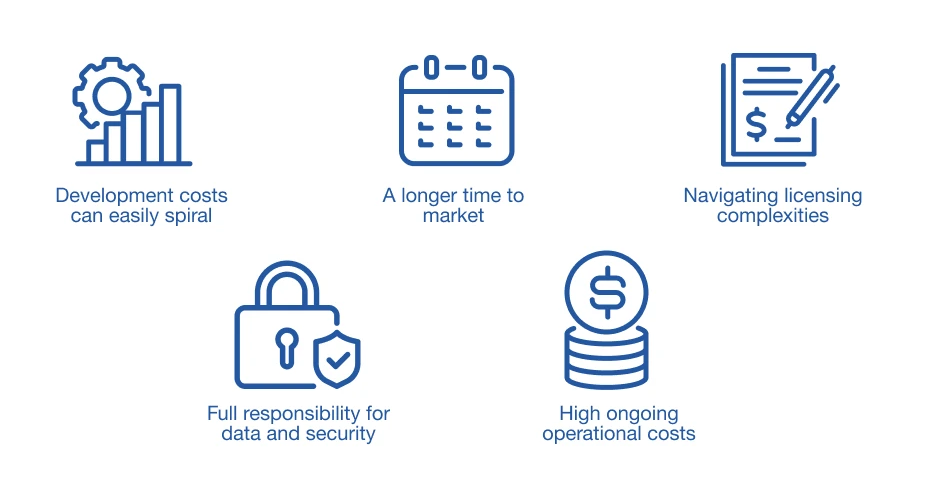
The hidden costs and complexities of in-house solutions
While the advantages of running your own platform can be tempting, they come with equally significant downsides. These challenges are especially relevant for newcomers to the iGaming industry or existing platform providers with very limited budgets.
This section takes a closer look at these potential roadblocks in detail:
Development costs can easily spiral
Building a platform from the ground up requires significant upfront investment. Capital is needed to fund essential elements such as:
- Platform architecture and front-end design.
- Integration with hundreds of casino games.
- A secure, multi-currency payment gateway.
- KYC/AML systems and player verification tools.
- Bonus engines, CRM tools, and responsible gambling features.
Meeting the above requirements for a compliant and smooth launch will require hiring a full team of developers, designers, testers, compliance specialists, and project managers.
They will need iGaming-specific experience to help navigate the complexities and nuances of the industry. Attracting top talent can easily drive costs into the six- or even seven-figure range before your site goes live and you begin onboarding players.
A longer time to market
While a white-label casino can launch in a matter of weeks, an in-house platform may take 12 to 24 months to develop, test, and obtain certification. During this time, you won’t be generating any revenue, yet you’ll still be burning through your budget.
If you’re aiming to respond to market trends or capitalize on a new niche, these long timelines can be a critical disadvantage. More agile providers can pivot and take advantage of online casino industry developments before you even enter the market.
Navigating licensing complexities
Building your platform from scratch means applying for and maintaining your own online gambling license. This is a far longer and more complex process than using white-label or turnkey solutions, where you can typically operate under an existing license.
Applying for your own online casino license involves:
- Rigorous audits:
Passing detailed financial, technical, and compliance assessments to meet regulatory standards. - Player protection standards:
Demonstrating robust systems for fair play, fraud prevention, and responsible gambling. - Regulatory reporting tools:
Building the infrastructure to capture, store, and report data in the way required by your chosen jurisdiction. - Jurisdictional delays:
Navigating potentially lengthy approval timelines that vary widely depending on the licensing authority you are working with.
It’s important to build flexibility into your casino license application process, as delays are almost inevitable with such a complex undertaking. Jurisdictions such as the UK Gambling Commission or the Malta Gaming Authority expect top-tier standards, and any compliance gaps can delay your launch or block it entirely.
Full responsibility for data and security
Running your own platform means you are fully responsible for collecting, storing, and protecting all user data. This is a major obligation in a sector tightly regulated by local and international data protection and gambling laws.
Your responsibilities as an online casino operator include:
- Data protection compliance:
Ensuring full compliance with data privacy regulations such as GDPR in EU markets and equivalent laws elsewhere. - Cybersecurity infrastructure:
Implementing strong technical safeguards to protect player data from breaches, fraud, and unauthorized access. - Privacy policy and breach response:
Creating clear privacy policies and putting defined procedures in place to respond to any data incidents. - Regulatory audits and assessments:
Managing ongoing audits and technical reviews by gambling authorities and compliance partners.
Failing to meet data protection standards can result in heavy fines, reputational damage, and, in the worst case, loss of your license or complete business shutdown.
High ongoing operational costs
Your capital investment doesn’t stop once you launch your platform. Running an in-house casino platform comes with significant ongoing operating costs, including:
- Infrastructure maintenance:
Ongoing server hosting, monitoring, and security updates to keep your platform stable and secure. - Platform upgrades:
Regular rollouts of new features, UX improvements, and technical fixes to remain competitive and compliant. - Employee salaries:
Monthly payroll for in-house teams across development, compliance, customer support, marketing, and more. - Legal and consulting fees:
Ongoing costs for legal counsel, regulatory guidance, and industry-specific consultants. - Licensing and compliance:
Renewals, jurisdictional tax filings, and scheduled audits to maintain your legal status and market access.
Taken together, these costs are the price of keeping your business legal, operational, and competitive. For new entrants to the online casino market, this can place significant strain on resources before it’s possible to turn a profit.
When does building in-house make strategic sense?
As outlined above, building an in-house online casino solution is not typically suitable for startups or solo entrepreneurs without prior iGaming experience.
That said, going in-house can be the right move depending on your current setup and experience. An in-house casino platform can be a smart investment if you:
- Already run a casino:
You’re an established operator seeking greater control over your technology and product roadmap. - Have solid funding:
You have significant capital or strong investor backing to support the high upfront and ongoing costs. - Are expanding globally:
You’re entering multiple regulated markets and require tailored features or compliance configurations. - Want to innovate:
You aim to build a unique product or game experience that current platform providers can’t offer. - Seek full independence:
You’re focused on long-term autonomy and want full ownership of your technology and intellectual property.
In these cases, the costs and complexities may be outweighed by the benefits of full customization, scalability, and brand differentiation.
A smarter solution: White label or turnkey
For most new casino operators, starting with a white-label or turnkey solution is the more practical path. Here’s what these types of platforms involve:
- White-label platforms:
Provide a fully operational online casino under the provider’s license, infrastructure, and backend. You apply your brand to the platform and launch with minimal delay. - Turnkey platforms:
These solutions give you more control over the tech stack and licensing aspects. They still include built-in games, payment systems, and support tools to help fast-track your market entry.
Both options significantly reduce the time, cost, and complexity involved in launching a new casino brand. These platforms offer the following advantages that allow you to:
- Launch quickly:
Enter the market in a matter of weeks rather than months, with a fully functional platform. - Use an existing license:
Operate legally under your provider’s approved gaming license, saving time and legal expenses. - Access leading providers:
Instantly connect to thousands of casino games, payment gateways, and third-party tools. - Gain industry experience:
Learn how the iGaming ecosystem works before investing in your own technology infrastructure. - Focus on growth:
Concentrate on player acquisition, retention, and brand development while your provider handles technical and compliance obligations.
Once you’re established, generating revenue, and building a loyal player base, you’ll be in a stronger position to transition to an in-house solution if you choose. This is how many of today’s leading online casino brands began, making it a proven route to market.
Final thoughts: Start smart, then scale
Building an in-house online casino platform can be a strong long-term strategy, but for newcomers to the iGaming industry, it’s rarely the best starting point.
With steep upfront costs, long development timelines, complex licensing processes, and demanding regulatory requirements, this is a high-stakes path. This approach is best suited to those with the right level of experience and resources.
Many successful online casino brands started on white-label or turnkey platforms before evolving into fully independent operations. These solutions allow you to gain valuable market experience, build your player base, and generate revenue without getting buried in technical and legal complexities early on.
If you’re looking to get started with a professional, fully supported casino solution, Agreegain can help. Our turnkey and white-label platforms provide everything you need to launch quickly, stay compliant, and scale efficiently while keeping the door open for future in-house ambitions.
Popular blog posts