

Online poker vs online casino: Understanding the divide in iGaming strategy

Updated 31 Dec 2025•Published 31 Dec 2025
Overview
In many ways, online poker pioneered online gambling, laying the foundation for today’s online casinos and iGaming platforms. Yet today, online poker has developed into its own distinct ecosystem, separate from the more casual, fast-paced world of online casinos and slot games.
This article explores the evolution of online poker, why it now stands apart, and what the future may hold for this unique online gambling experience.
Online poker: A brief history
Online poker first appeared during the internet boom of the late 1990s, with Planet Poker launching its first real-money games in 1998—marking the start of a digital revolution in card play. As connectivity speeds and encryption technology improved, online poker’s popularity exploded, boosted in part by televised poker tournaments.
PokerStars entered the market with advanced software that significantly improved the user experience, setting new industry standards. In 2002, it launched the World Championship of Online Poker (WCOOP), and the following year, Chris Moneymaker—an amateur player who qualified via PokerStars—won it. His victory sparked what became known as the “Moneymaker Effect,” dramatically increasing global interest and engagement in online poker.
Today, the global online poker industry is projected to reach $6.27 billion by the end of 2025. Looking further ahead, it’s expected to grow at a CAGR of 15.2% from 2025 to 2034.
Still, while online poker remains popular, its complexity and skill requirements make it less accessible than online casinos. As a result, poker’s growth plateaued in favor of more casual, quick-hitting casino options like video slots and live dealer games.
Why is online poker typically separate from online casino?
Even though poker and casino gaming share the same digital space, they’re usually treated as separate entities. That separation comes down to fundamental differences in how the two formats operate.
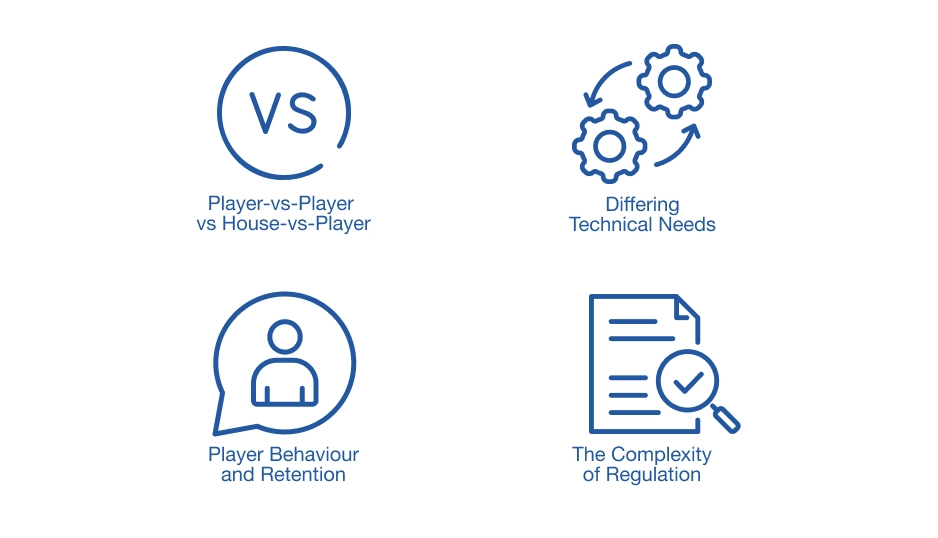
Several core differences explain this divide:
Player-vs-player vs house-vs-player
In online casino games—such as slots, roulette, or blackjack—the house acts as the opponent. This ensures the operator holds a built-in edge at all times, making these formats highly appealing from a business standpoint.
By contrast, online poker is player-versus-player. The house earns revenue by taking a percentage of each pot (the rake) or by charging tournament entry fees. Profitability therefore depends on maintaining a steady flow of active players, not just a handful of high-stakes games.
Differing technical needs
Poker platforms must support complex systems for real-time gameplay, player matching, anti-collusion safeguards, and secure player chat. This is far more demanding than random number generator (RNG)-based casino games.
The complexity of regulation
Online poker faces stricter oversight than casino games in many jurisdictions. Because it’s a peer-to-peer (P2P) game, it carries risks such as players colluding to affect outcomes.
Some regulators even require separate licenses for online poker, imposing tougher safeguards, tighter compliance rules, and more advanced anti-fraud protections. As a result, running a poker platform is often seen as higher-risk and more resource-intensive than operating a standard online casino.
Player behavior and retention
Poker players tend to be more skilled, community-driven, and less impulsive than the average online casino player. While they typically spend longer per session, their average spend (or loss) per visit is often lower than that of slot or live dealer players.
They also expect strong loyalty programs, transparency, and fair matchmaking. Meeting these expectations makes player retention more complex and costly compared to retaining a casino audience.
How online poker sites work
Online poker platforms are designed to replicate the in-person poker experience through websites and apps. Players in jurisdictions where online gambling is legal can sign up, deposit funds, and join tables with other real players.
Behind the scenes, poker platforms run highly complex systems to ensure smooth, secure gameplay. Because these systems are costly to maintain, many poker operators partner to pool players and resources—maximizing both efficiency and revenue.
Poker game formats
Most modern poker sites offer a variety of the following popular formats:
- Cash Games: Players can join or leave at any time, bringing their own funds to the table.
- Sit and Go Tournaments: Small-scale tournaments that start as soon as enough players register, typically 6 to 9.
- Multi-Table Tournaments (MTTs): Larger scheduled events where thousands of players compete for significant prize pools.
- Fast-fold Poker: A rapid format where players are instantly moved to a new table after folding, keeping the action fast-paced.
Key online poker site components
To deliver games smoothly and securely, poker platforms depend on several essential components:
- Game Servers: Operate behind the scenes to manage all game aspects in real time, including dealing cards, processing bets, and tracking player actions. Servers also ensure fair outcomes for every hand.
- Poker Client: The player-facing interface, available as a downloadable app or via web browser. It displays cards, chips, and tables while securely communicating with the server.
- Rake and Revenue Systems: Online poker sites collect a small fee (the rake) from each hand or tournament entry—typically a percentage in cash games or a fixed fee in tournaments.
- Shared Liquidity Pools: Poker networks share player bases, to fill games faster and maintain 24/7 activity across multiple regions.
- Responsible Gaming Tools: Features such as deposit limits, session timers, cool-off periods, and self-exclusion help players stay in control.
- Anti-Fraud and Security Systems: Advanced tools detect and block cheating, collusion, bots, and multi-accounting. Behavioural analysis and ID verification further ensure fairness.
With an understanding of how online poker operates behind the scenes, it’s worth examining the major players that dominate the industry today.
The biggest online poker providers
The online poker market has evolved significantly since the boom of the early 2000s, with many smaller platforms either consolidating or exiting the industry altogether. Today, a handful of major operators dominate the global landscape:
PokerStars
Launched in 2001, PokerStars remains one of the leading online poker platforms, offering a broad selection of cash games and large-scale tournaments with substantial prize pools. Its flagship event, the Sunday Million, guarantees a $1 million prize pool and attracts players from around the world.
GGPoker
GGPoker has quickly expanded its reach through strategic partnerships and high-profile events. The platform is best known for hosting the World Series of Poker (WSOP) Online, giving players the chance to compete for bracelets and major prize pools without leaving home.
Partypoker
A long-standing brand in the online poker scene, partypoker operates under Entain (formerly bwin) and emphasizes secure, fair gameplay. The platform is fully licensed and regulated, with a dedicated Game Integrity team ensuring a safe environment for players.
888poker
Owned by Evoke plc, 888poker is a major European brand that offers a wide variety of games and tournaments. It’s also integrated with other gambling products, including casinos and sportsbooks, giving players a full-spectrum gaming experience.
WSOP.com
As the official online platform of the World Series of Poker, WSOP.com primarily serves the U.S. market. It allows players to join real-money games and tournaments, including opportunities to win coveted WSOP bracelets online.
The future of online poker: Innovation and adaptation
Although the explosive growth of the early years has slowed, online poker continues to evolve. Operators are focusing on user experience, mobile-first platforms, and gamification features to attract younger players while keeping existing ones engaged.
To keep their poker offerings fresh and competitive, platforms are innovating in several areas:
- AI and Bots: Enhanced detection systems are being deployed to combat bots and collusion, protecting game integrity and improving player security.
- Cross-Platform Integration: Some operators are combining poker with casino features to create hybrid ecosystems that appeal to a broader audience.
- Live Streaming and Community Tools: Platforms like Twitch, YouTube, and Discord are being leveraged to showcase high-stakes play and build loyal communities.
- Crypto Integration: A growing number of niche sites now accept cryptocurrency payments and use blockchain for fairness verification.
- Regulation: With shifting regulations—especially in the U.S., Latin America, and Asia—poker networks are expected to expand, consolidate, or specialize to stay compliant.
While more niche than online casino gaming, these innovations are helping poker remain profitable and relevant in the fast-changing iGaming landscape.
Final thoughts: A distinctly strategic vertical
Online poker may no longer be the rapid-growth driver it once was, but it still holds a valuable and distinct niche within the iGaming sector. Its peer-to-peer model, regulatory complexity, and demanding player base differentiate it from traditional online casino offerings, both technically and commercially.
Although margins are often thinner and the technical requirements higher compared to standard casino platforms, a well-executed poker product can strengthen brand reputation. It’s also an effective way to diversify revenue streams and engage a highly loyal, community-driven audience.
As the industry continues to innovate, online poker is carving out new ways to stay competitive in a crowded iGaming market. For platform providers ready to invest in the long game, poker offers a complementary vertical that rewards operational excellence and long-term strategy.
For operators considering a move into online poker, it’s essential to weigh not only profitability but also how well the vertical aligns with your existing brand and player base.
Popular blog posts