

Beyond CPA vs Rev Share: How the hybrid model drives smarter growth
Updated 6 Mar 2026•Published 6 Mar 2026
Overview
Affiliate marketing remains one of the most effective ways to grow your online casino brand. The affiliate commission model you choose directly affects your player quality, ROI, and overall business sustainability.
Most operators rely on CPA for fast acquisition or Revenue Share for long-term loyalty. But what if you want the benefits of both approaches? That’s where the hybrid affiliate model comes into play.
In this article, we’ll break down how hybrid models work, when they deliver the most value, and how to use them to build stronger, more scalable affiliate partnerships.
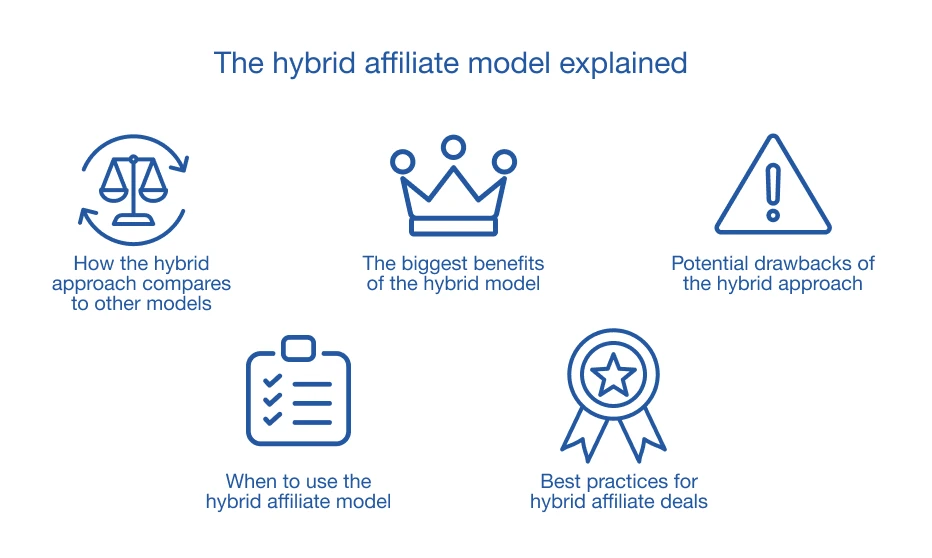
The hybrid affiliate model explained
The hybrid model combines elements of both CPA (Cost Per Acquisition) and Revenue Share affiliate deals.
You pay the affiliate a fixed upfront payment for each qualified player they refer, plus a smaller ongoing percentage of that player’s net revenue over time.
This is how it works in practice:
You pay the affiliate £40 CPA for each player who meets your qualification criteria, plus 20% of that player’s NGR (net gaming revenue) for as long as they remain active.
This model combines the best elements of both models. The key aim is to provide you with a constant stream of qualified players that will add long-term value to your brand.
How the hybrid approach compares to other models
Online casino operators typically work with three core affiliate commission structures. Each has its strengths, but the hybrid model offers a compelling balance of cost control and performance. Here’s how they compare to each other:
| Affiliate model | How it works | Key advantages |
|---|---|---|
| CPA (Cost Per Acquisition) | You pay a one-time fee for each qualified new player. | Simple to budget and great for high-volume growth, but riskier if player quality is low. |
| Revenue Share | You pay affiliates an ongoing percentage, typically 25–40% of a player’s net losses or NGR. | Aligns long-term interests and rewards affiliates for loyalty and retention. |
| Hybrid | You pay a smaller CPA, combined with a reduced revenue share percentage. | Blends short-term incentive with long-term value. Ideal for building sustainable affiliate partnerships. |
The biggest benefits of the hybrid model
The hybrid model provides a strategic blend of CPA and revenue share, offering operators greater flexibility and control.
Here’s how it can benefit your affiliate strategy:
- Balanced risk and reward:
Affiliates are motivated by immediate payouts and long-term earnings, encouraging performance across the player lifecycle. - Stronger affiliate relationships:
Continuous earnings encourage affiliates to invest in your brand and build lasting partnerships. - Better player quality:
Because affiliates profit from player retention, they’re more likely to prioritise value over volume. - Greater flexibility:
You can adjust CPA and rev share ratios based on affiliate performance, market goals, or campaign type. - Scalable for growth:
Begin with modest offers and scale incentives as results improve, making it ideal for testing or expanding into new territories.
Tip for operators: Hybrid deals can give you the best of both worlds when implemented correctly. They’re ideal for affiliate relationships where you want immediate growth without sacrificing long-term profitability.
Potential drawbacks of the hybrid approach
While the hybrid model offers plenty of advantages to online casino operators, it's not without its challenges. Here are the main risks you need to keep a close eye on:
- Higher complexity:
Managing dual payouts from CPA and rev share models in tandem requires more oversight, tracking, and reporting than single-model deals. - Misaligned expectations:
Without clear terms, affiliates may prioritise the upfront CPA over long-term player quality. This undermines the key goal of the hybrid model of rewarding lasting value. - Budget management:
Hybrid deals involve both immediate and ongoing costs, which can complicate cash flow forecasting and strategic planning. - Performance variability:
If affiliates underdeliver on retention, you might end up overpaying for players who don’t generate long-term value.
Tip for operators: Set clear qualification rules, define how and when the rev share aspect of the agreement will kick in. It’s essential that you review affiliate performance regularly, as a well-managed hybrid deal protects your budget while still rewarding real results.
When to use the hybrid affiliate model
The hybrid affiliate model can be a strategic win if implemented at the right stage of your online casino journey. That said, it won’t fit every use case, so here are a few scenarios when it works best for providers:
- Post-launch scaling:
Once your casino brand is live and initial growth is steady, hybrids help maintain volume while improving player value. - Rewarding high-performing affiliates:
Use hybrid deals as an incentive upgrade for partners who consistently deliver quality traffic and long-term players. - Entering competitive markets:
In saturated regions, hybrids offer a stronger pitch to top affiliates by combining fast payouts with shared success. - Running multi-stage campaigns:
Ideal for long-term promos, affiliates get immediate reward and ongoing motivation to support your full campaign lifecycle. - CPA fatigue:
If you're spending heavily on CPA but are concerned about ROI, hybrids let you cut upfront costs while preserving affiliate interest.
Tip for operators: It’s best to think of hybrid deals as a bridge. They’re perfect when you’ve outgrown pure CPA but aren’t ready for a full revenue share agreement. It’s an ideal way to scale smartly, not just fast.
Best practices for hybrid affiliate deals
To make hybrid deals work for your online casino brand, you’ll need strong tracking, partner selection, and performance controls. Here’s a breakdown of the components to get in place before utilising any hybrid affiliate programme:
| Strategy | What it involves | Why it works |
|---|---|---|
| Set clear qualification criteria | Define strict thresholds for deposit, wagering, and KYC. | Prevents bonus abuse and ensures you only pay for real, valuable players. |
| Use tiered rev share terms | Offer lower rev share percentages that increase with performance. | Aligns payouts with actual results and keeps costs predictable. |
| Monitor LTV and ROI | Use data to measure lifetime value, average revenue per user, and retention. | Helps assess whether affiliate traffic is sustainable and profitable. |
| Segment affiliates by model | Don’t offer a hybrid deal to everyone. Use it selectively for proven affiliates. | Keeps costs under control while rewarding quality partners. |
| Combine with strategic bonuses | Offer exclusive promotions to hybrid partners that increase conversions. | Gives affiliates more tools to succeed and keeps their content fresh. |
Final thoughts: A smarter way to scale affiliate growth
The hybrid affiliate model is a smart way to bridge short-term growth with long-term success. Combining upfront rewards with ongoing incentives helps you build stronger partnerships, attract higher-quality players, and scale more sustainably.
When used with clear qualification rules and solid tracking, hybrid deals can become a cornerstone of your affiliate strategy, especially when you're ready to prioritise quality over volume.
Ready to take your affiliate programme to the next level?
Agreegain equips operators with flexible, secure tools for managing hybrid deals and more, all built into our turnkey casino platform.
Popular blog posts