

Does catalogue size create commercial advantage? What the evidence shows in 2025–2026
Updated 29 Sept 2026•Published 29 Sept 2026
Key takeaways
- More choice helps least exactly when players don't know what they want yet, so guide undecided players instead of just showing them more games.
- The real risk of an oversized catalogue isn't worse choices, it's players who give up looking altogether, so the tools that help operators manage that content matter more as the library grows.
- Lobby space stays fixed while catalogues expand, so measure the share of relevant games players actually reach.
- Build portfolios around local demand, because preferences, regulation and competition differ in every jurisdiction you enter.
- Weigh providers on performance — demand, quality, release consistency and regional results — instead of adding studios for the count.
- Treat portfolio management as a discipline and review, promote, reposition or retire titles as player behaviour changes.
- Judge aggregators on their tooling: analytics, merchandising controls, localisation and reporting now separate platforms more than title counts do.
Browse almost any online casino platform, and one thing stands out consistently. The number of games available. Ten thousand titles. Twenty thousand. Thirty thousand or more. A message that may not always be stated outright but is generally communicated in other ways. A larger game library should give players more choice, attract a broader audience and ultimately generate more revenue.
That statement seems perfectly logical. More content should create more opportunities for players to discover the games they enjoy, spend more time on the platform, and return more frequently. For years, catalogue size has therefore become one of the simplest ways for operators to compare aggregation platforms, and one of the easiest metrics for suppliers to promote.
The stakes behind those decisions have risen sharply. In its State of the States 2026 report, the American Gaming Association recorded that annual iGaming revenue overtook commercial land-based casino revenue in both Pennsylvania and New Jersey for the first time in 2025, with Pennsylvania alone growing close to 28% to reach $3.46 billion. Online casino has moved from a secondary channel to the primary one in mature markets — which means portfolio decisions that were once low-consequence now sit close to the centre of commercial performance.
Yet the evidence increasingly shows that the relationship between catalogue size and commercial performance is more complicated than headline numbers suggest.
Outside the iGaming industry, decades of behavioural research have demonstrated that simply increasing the number of available choices does not automatically improve engagement or decision-making. Digital businesses, including catalogue giants such as Netflix, Amazon and Spotify, have invested heavily in recommendation systems, search, merchandising and personalisation because they recognise that helping users discover relevant content is often more valuable than simply offering more content.
So, the obvious question is whether the same principle applies to online casino game libraries. If simply adding more games always increased GGR, why are operators investing so heavily in game discovery, localisation, content curation and portfolio optimisation? Why are modern aggregation platforms increasingly judged by the quality of their management tools rather than simply the size of their catalogue?
This article examines the evidence behind one of the industry's most persistent assumptions. That a larger game library produces more GGR. Rather than asking whether a casino should offer more games, it explores a more useful question: what actually determines whether a game portfolio delivers stronger commercial performance? As the evidence suggests, the answer is likely to depend far more on relevance, discoverability and active portfolio management than on the total number of titles alone.
Why bigger game libraries don't always produce better results
Imagine two operators with access to the same game library. One consistently outperforms the other. The difference cannot be the number of games available. It must lie somewhere else. And that is where portfolio performance becomes far more interesting than catalogue size.
More choice doesn't always create more engagement
Let’s be honest: the idea that more games should generate more revenue appears difficult to dispute. Greater choice should increase the likelihood that players will find games they enjoy, encouraging longer sessions and higher engagement. This assumption has had a big impact on online casinos for years and helps explain why catalogue size remains one of the industry's favourite metrics.
However, behavioural research suggests the relationship between choice and engagement is far more nuanced. A meta-analysis of 99 observations drawn from 53 studies, published in the Journal of Consumer Psychology (Chernev, Böckenholt & Goodman, 2015), set out to establish when larger assortments actually help consumers and when they hinder them. Its conclusion was that the "choice overload" effect is conditional rather than universal: whether additional options improve or impair a decision depends on how complex the choice set is, how demanding the decision task itself is, how certain consumers are about their own preferences, and what they are ultimately trying to achieve. The practical implication matters more than the headline finding. Extra options deliver the least value precisely when a user has no clear sense of what they are looking for, which is close to the position most players are in when they open an unfamiliar lobby.
This principle has become increasingly influential across digital businesses. Streaming platforms, online retailers, and content marketplaces continue to expand their libraries. Yet, much of their investment now focuses on recommendation engines, search functionality and personalisation rather than simply increasing the amount of available content. The commercial objective has essentially transitioned from offering more choices to helping users reach the right choices more quickly.
Player attention is finite
The same commercial reality applies to online casinos. Every additional game competes for a player's limited time and attention, while the space available within the lobby remains relatively fixed. Featured sections, promotional banners and search results can only expose a fraction of the total catalogue during any single session.
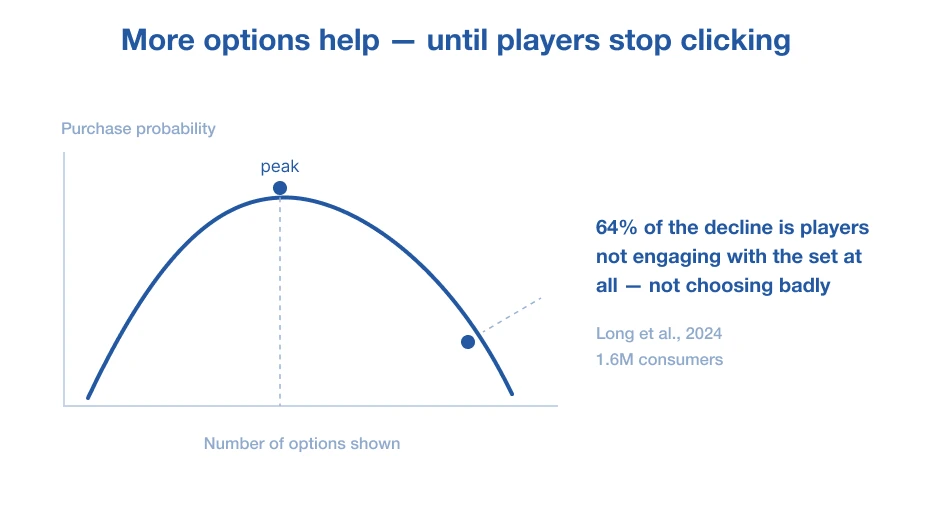
As game libraries continue to expand, helping players navigate them becomes increasingly important. A field experiment involving 1.6 million consumers, published in Manufacturing & Service Operations Management (Long et al., 2024), found that the relationship between the size of a recommendation set and the likelihood of a purchase follows an inverted curve: purchase probability rises as more options are shown, then falls once the set grows beyond a certain point. Most tellingly, around two-thirds (64%) of that decline was attributable not to shoppers making a worse final choice, but to their not engaging with the set at all — they simply stopped clicking. While casino games admittedly involve different behaviours from those in online shopping, the underlying issue remains remarkably similar. Players derive value from the content they can realistically discover, not from the content that merely exists on the platform. The study measured recommendation sets rather than entire catalogues, but the mechanism is the one that matters here: beyond a certain point, players stop engaging with the set at all rather than choosing from it badly. That is the failure mode a large lobby has to design against.
For operators, this changes the question somewhat. The objective is no longer to maximise the number of available games but to optimise the proportion of relevant games that players actually engage with.
More content only creates value when players can find it
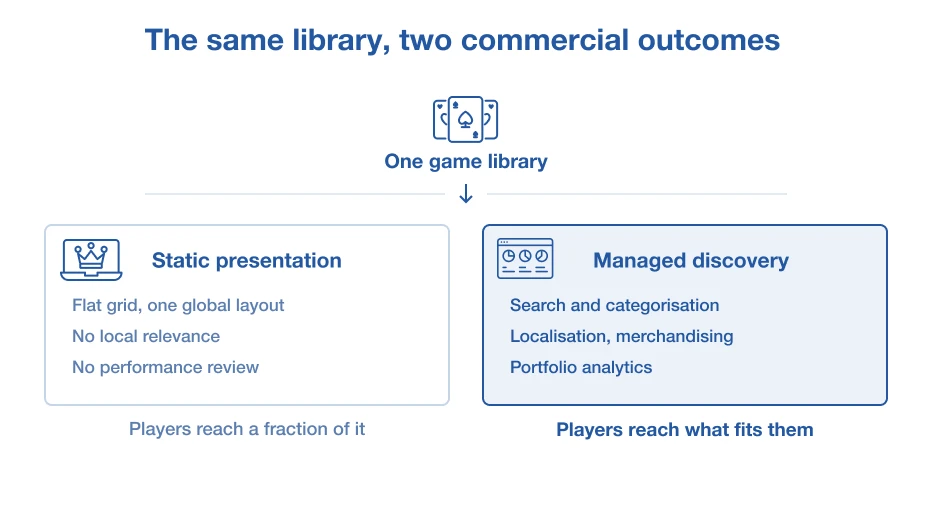
This helps explain why modern aggregation platforms increasingly compete on capabilities that extend well beyond headline game counts. Search tools, intelligent categorisation, recommendation systems, localisation, merchandising controls and portfolio analytics have become essential tools because they determine how effectively content is presented to different player groups.
The same game library can produce very different commercial outcomes depending on how easily players discover relevant content. A well-managed catalogue that reflects local preferences, highlights high-performing titles, and continuously adapts to player behaviour is likely to deliver stronger results than a substantially larger library that relies solely on static presentation.
Even leading game studios with massive portfolios recognise the limits of player attention. More providers and suppliers now actively request operators to focus on boosting their top-performing titles ra
ther than enabling their entire historical catalogue at once. Prioritising a studio's core revenue drivers protects lobby real estate while yielding a much higher return on investment per featured game."

What high-performing portfolios have in common
If expanding a game library is only part of the equation, what else separates high-performing casino portfolios from the rest? The following areas have become some of the strongest indicators of long-term portfolio performance.
1. Market relevance
A global catalogue doesn’t always perform consistently across jurisdictions. Player preferences, regulation, and competitive conditions vary considerably across markets, meaning the strongest-performing portfolios are typically built around local demand. Operators increasingly benefit from selecting games that fit the characteristics of each target market instead of assuming every title contributes equal commercial value.
Effective localisation no longer relies on trial and error. Modern portfolio management leverages market-specific top-performing game lists provided directly by suppliers and aggregators. By populating regional lobbies with proven local performers from day one, operators accelerate player adoption and eliminate underperforming filler content.
Tania KouvatsiContent Coordinator at Agreegain
2. Local player preferences
Even within regulated markets, player behaviour differs. Some audiences favour high-volatility slots; others prefer crash games, live casino or traditional table games. Understanding these preferences allows operators to prioritise content that players are most likely to discover, return to and recommend, improving engagement without continually expanding the catalogue.
3. Provider mix
Adding more providers does not automatically strengthen a portfolio. Successful operators evaluate providers based on player demand, content quality, release consistency, and regional performance. A carefully balanced mix often delivers stronger commercial outcomes than just increasing the number of available studios.
4. Content freshness
Player expectations continually evolve. New releases and seasonal launches help maintain interest and encourage repeat visits. Keeping a portfolio fresh and relevant, therefore, depends not only on the total number of games available but on regularly introducing content that reflects player interests.
How new content is introduced is just as critical as how often it arrives. Rather than dumping entire legacy portfolios onto a platform simultaneously, high-performing operators work with suppliers to roll out content in structured batches. Phased batch releases allow operators to create focused marketing pushes for each launch, ensuring new titles receive proper visibility instead of getting lost in the back pages of the catalogue.
Tania KouvatsiContent Coordinator at Agreegain
5. Featured games and merchandising
Visibility strongly influences performance. Games placed within featured collections, promotional campaigns and personalised recommendations naturally receive greater exposure than titles buried deep within a catalogue. Effective merchandising helps operators direct attention to content with the greatest commercial potential, as opposed to relying solely on player search behaviour.
Lobby positioning remains the single strongest lever for player acquisition. Content placed within prime lobby real estate—such as top-row banners, personalised recommendation rails, and featured categories—consistently draws the vast majority of session starts. Optimising game placement, rather than adding more titles to the bottom of the page, is what converts browse behaviour into real GGR.
Tania KouvatsiContent Coordinator at Agreegain
6. Performance monitoring
Monitoring metrics such as game utilisation, session frequency, player retention and revenue contribution allows operators to understand which titles genuinely support commercial objectives and which add little measurable value.
7. Portfolio curation
Perhaps the biggest difference is that successful operators increasingly treat portfolio management as an ongoing discipline. Games are continually reviewed, promoted, repositioned or retired as player behaviour changes. In this way, competitive advantage comes from maintaining a portfolio that evolves with the market rather than one that simply grows larger over time.
Curation as an ongoing commercial strategy
This represents an important change in how operators evaluate game aggregation platforms. Today, the greater emphasis is on continually improving how games perform. That means treating portfolio management as an ongoing commercial discipline rather than a one-time procurement decision.
| Expanding a library | Optimising a portfolio |
|---|---|
| More games | Better game discovery |
| More providers | Better provider mix |
| More titles | Better market relevance |
| Larger catalogue | Better player experience |
| More content | Better portfolio performance |
This transition is also changing what operators expect from their aggregation platforms. While access to a broad range of games remains important, competitive advantage increasingly comes from the tools that help operators manage that content more effectively. That means portfolio analytics, merchandising controls, localisation, search, categorisation and performance reporting now play a central role in helping operators adapt their game offering as player preferences and market conditions evolve.
The better question to ask of your game aggregator
Perhaps the biggest lesson from the evidence is that operators have been asking the wrong question all along. Catalogue size undoubtedly remains a central consideration, but once a platform offers sufficient depth and market coverage, simply adding more games is unlikely to become the primary driver of commercial performance.
The more valuable discussion is how effectively that content can be managed, optimised and presented to players. Rather than asking ‘How many games do we have?’ operators should be asking:
- Which games consistently perform best in my target markets?
- How easily can players discover the most relevant content?
- What tools are available to optimise and manage the portfolio?
- Which analytics help identify high/low-performing games?
- How quickly can the game offering adapt to changing player behaviour and market conditions?
In 2025–2026, answering these questions is fast becoming one of the clearest competitive advantages a casino game aggregation platform can deliver.