

The landscape of US online casino legislation: Key laws, jurisdictions, and trends

Updated 30 Dec 2025•Published 30 Dec 2025
Overview
The US online casino legal landscape is a complicated and constantly changing mix of federal and state laws, regulatory frameworks, and market trends. With each state holding the power to determine its stance on online gambling, the industry operates under a dynamic mix of varying legal and regulatory frameworks.
Understanding the legal landscape of US online gambling requires a deep dive into key federal laws, the state-by-state approach to regulation, and the emerging trends shaping the industry's future.
This article explores the major legislative milestones, the states leading the charge in online casino gaming, and the potential for further expansion over the next few years.
US online gambling: The federal landscape
Although laws are largely determined at the state level, federal legislation has historically helped to map out the framework and boundaries for online gambling. The following two key pieces of legislation have helped to shape the landscape of online gambling across the US, influencing how states approach legalisation and enforce it.
Impact of the unlawful internet gambling enforcement Act (UIGEA)
One of the most significant federal laws impacting online gambling to this day is the Unlawful Internet Gambling Enforcement Act (UIGEA) of 2006. This act targets online gambling by making it illegal for banks and financial institutions to process payments related to unlawful online gambling.
The law does not directly make online gambling illegal in the US. The intention was to make it more difficult for people to deposit or withdraw money from gambling websites that are not explicitly legal under state or federal law.
However, this legislation did not define what constitutes "unlawful" online gambling and what doesn’t. This allowed states to regulate their local online gambling industries in the following years.
The Wire Act and the DOJ's shifting reinterpretations
The Federal Wire Act of 1961 was originally intended to combat country-wide organised crime by prohibiting interstate sports betting via telecommunication systems.
As the internet emerged and the ability to bet online became possible, this decades-old law took on a new meaning. The Federal Wire Act was broadly interpreted to apply to all forms of online gambling, creating fresh uncertainty about the legality of online casinos and poker across the US.
In 2011, the Department of Justice (DOJ), under Barack Obama’s presidency, issued a legal opinion that reinterpreted the Wire Act. They stated that the 1961 act applied only to sports betting but not to other forms of online gambling. This landmark decision paved the way for individual states to legalise and regulate online poker, casino games, and lotteries within their boundaries.
In 2018, the DOJ, under Donald Trump's first presidency, reversed this decision after reinterpreting the original language of the Wire Act to imply it applies to all forms of online gambling, not just sports betting. The ruling faced several legal challenges, and in 2021, a federal court ruled against the DOJ’s interpretation, effectively keeping the 2011 stance in place.
States with legalised online casinos and poker
The legality and growth of online casinos across the US are complex, to say the least. The industry operates under a patchwork of state-level laws where each jurisdiction sets its own requirements for licensing, taxation, and compliance.
Below is a closer look at the US states that have legalised online gambling and those which are progressing towards legalisation in the short to medium term.
The following states permit licensed operators to offer a full suite of online gambling options, including casino games and poker.
New Jersey: A pioneer and market leader
New Jersey is the most valuable of all the online casino markets in the US, generating over $10.04 billion in revenue since online gambling was first legalised in 2013. It’s home to major online casino brands like BetMGM, DraftKings, and FanDuel, which operate through partnerships with their land-based Atlantic City casinos.
As the most mature online casino market in the US, New Jersey boasts strong online player protections, responsible gaming initiatives, and anti-fraud measures.
- Legalised Online Gambling: 2013
- Regulatory Body: New Jersey Division of Gaming Enforcement (NJDGE)
Pennsylvania: A rapidly growing market
Pennsylvania is one of the fastest-growing online casino markets in the US. It has annual revenues exceeding $1.5 billion but a higher tax rate (54% on online slots) compared to other states that allow online gambling.
Following a similar model to New Jersey, it has multiple online casino brands operating in partnership with state-licensed land-based casinos. This makes it a highly attractive market for operators that show no signs of slowing growth.
- Legalised Online Gambling: 2017
- Regulatory Body: Pennsylvania Gaming Control Board (PGCB)
Delaware: A pioneering online casino market
Delaware was the first US state to legalise online gambling in 2012 and yet its market remains comparatively small. In 2024, Delaware's online casinos generated approximately $78.4 million in gross gaming revenue (GGR).
Initially, Delaware's state-run online casinos operated under a monopoly system in partnership with 888 Holdings. However, in late 2023, the Delaware Lottery transitioned to a new partnership with Rush Street Interactive's BetRivers, replacing 888 Holdings as the exclusive online gambling provider in the state.
Delaware is also part of the shared poker liquidity agreement with Nevada, Michigan, West Virginia and New Jersey via the Multi-State Internet Gaming Agreement (MSIGA).
- Legalised Online Gambling: 2012
- Regulatory Body: Delaware Lottery
Michigan: A booming new online casino market
Launched in 2021, two years after online gambling was officially legalised in Michigan, it has grown quickly to become one of the top-performing states. Online gambling is estimated to generate over $1.5 billion annually, contributing significant tax revenue to the state’s finances.
Major operators currently include BetMGM, FanDuel, DraftKings, and Caesars. These platforms partner with Michigan’s commercial and tribal casinos, as state law requires operators to have a land-based partner.
With the state allowing the full suite of online casinos, poker, and sports betting, it’s one of the most comprehensive online gambling markets in the US. Michigan also allows interstate online poker, boosting sizable player pools and competitions.
- Legalised Online Gambling: 2019
- Regulatory Body: Michigan Gaming Control Board (MGCB)
West Virginia: A market with significant growth potential
Licensed online casinos began to launch in 2020, making West Virginia one of the newest and least developed markets in the US. The state permits online casino games, poker, and sports betting. Online casino licences are issued to the state’s five land-based casinos, which can partner with third-party operators to offer online platforms.
A key factor in this slower growth is West Virginia’s smaller population, meaning it naturally has a smaller player base than other states where online casino gambling is legalised. However, the market is poised for expansion as casinos can partner with up to three interactive gaming management services to offer online gaming on the casino’s behalf.
While not as large as New Jersey or Pennsylvania, West Virginia's online casino market is steadily growing. As competition increases and regulatory frameworks evolve, West Virginia’s online casino industry is set to see some rapidly rising revenue opportunities.
- Legalised Online Gambling: 2019
- Regulatory Body: West Virginia Lottery Commission
Connecticut: A thriving tribal alliance
Connecticut legalised online gambling following an agreement between the state government and two federally-recognised tribal nations, the Mashantucket Pequot Tribe and the Mohegan Tribe. Both tribes hold exclusive rights to offer online casino gaming and currently host one platform each.
Market growth has been steady with strong participation from local players across Connecticut. By May 2024, the state's online casino industry hit a new high with gross revenues reaching $46.3 million, marking a 41.3% year-on-year increase.
Potential expansion may come in the form of online poker, dependent on future regulatory developments.
- Legalised Online Gambling: 2021
- Regulatory Body: Connecticut Department of Consumer Protection (DCP)
Rhode Island: A one-operator monopoly in motion
Rhode Island became the seventh US state to legalise online casino gambling, doing so in June 2023. The first, and only, online casino went live in March 2024.
Online casino gaming is operated exclusively via the Bally’s Corporation under a 20-year no-bid contract. This means that Bally’s effectively has a monopoly on Rhode Island digital casino gaming in partnership with IGT (International Game Technology).
It’s still too early to tell how successful online casino gambling will be in Rhode Island but with 2024 revenues predicted in the region of $50 million, signs are positive. That said, the current licensing doesn’t allow for any competition within the state so future expansions may be limited.
- Legalised Online Gambling: 2023
- Regulatory Body: Rhode Island Lottery
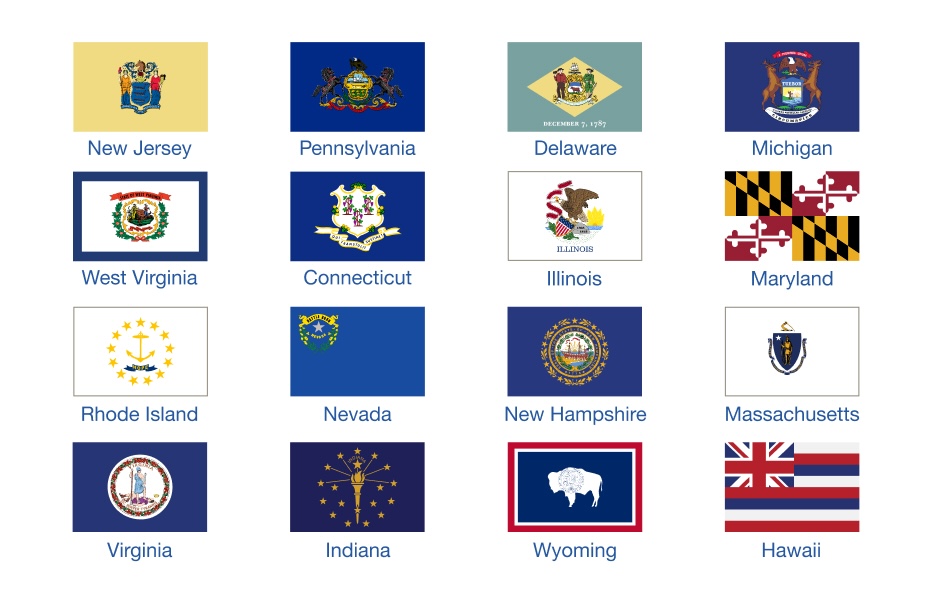
States potentially legalising online casinos in the near future
As the appetite and push for the legalisation of online casino gambling picks up pace, it’s good to know which states are close to joining the industry. Several US states are actively considering the legalisation of online casino gambling. Here’s a brief overview of the most likely contenders and their attitudes and statuses in early 2025.
Nevada: The poker capital with no online casinos
Despite being home to the global casino capital of Las Vegas, playing online slots or table games is not legal in the state of Nevada. For now, at least, it’s only online poker that is legal within the state's borders.
Nevada has an interstate liquidity-sharing agreement with New Jersey and Delaware through the Multi-State Internet Gaming Agreement (MSIGA). This allows for larger poker player pools and payouts.
As it stands, any future expansion into online casino licensing remains uncertain. This is mainly due to the unique draw of Nevada’s land-based gaming facilities which generated revenue of $15.76 billion in 2024 alone.
- Legalised Online Gambling: 2013 (Online Poker Only)
- Regulatory Body: Nevada Gaming Control Board (NGCB)
New Hampshire: A mixed path to online casino legalisation
New Hampshire legalised online sports betting in 2019, raising hope that the legalisation of online gambling would follow shortly after. However, the New Hampshire Lottery Commission (NHLC) which oversees all forms of gambling in the state, has opted for a more cautious approach.
As it stands, New Hampshire does not allow online casino games such as slots, roulette, or blackjack within its borders. Senate Bill 168, introduced in 2025 to legalise online gaming, was tabled in the Senate but is not advancing at this time.
The recent news of approval for Cordish Companies to construct a $200 million land-based casino in the state may place any online casino gambling hopes on ice. The company is a powerful online gambling opponent and likely to hold sway over any future gambling decisions in New Hampshire.
- Legalised Online Gambling: 2019 (Sports Betting Only)
- Regulatory Body: New Hampshire Lottery Commission (NHLC)
Other states looking to legalise online casinos
In addition to the above, a host of other states are tentatively investigating the legalisation of online casino gambling within their borders.
However, legalisation is rarely straightforward. The process involves negotiations among lawmakers, regulatory bodies, and stakeholders, making the timeline uncertain. Operators looking to enter these markets should stay as up-to-date as possible, as shifting political priorities can soon accelerate, or stall, progress.
As of March 2025, here's an overview of states which look to be on the cusp of legalising online casino gaming:
| State | Legislative Activity | Current Status |
|---|---|---|
| Massachusetts | Senator Paul Feeney and Representative Daniel Cahill have introduced companion bills (SD 2240 and HD 4084) | The bills are under consideration, reflecting Massachusetts's growing interest in expanding its gambling industry |
| Illinois | Companion bills (SB 2325 and HB 3570) to legalise iGaming have been filed in both chambers of the Illinois legislature, following public discussions by Governor J.B. Pritzker | The state is actively exploring the potential of online casino legalisation, with legislative proposals under review |
| Maryland | Delegate Vanessa E. Atterbeary and Senator Ron Watson have introduced bills (HB 410 and SB 500) to legalise online casino gaming | These proposals are currently under legislative consideration, indicating a move towards expanding Maryland's gambling options |
| Virginia | An online casino bill (SB 827) has been introduced but was pulled in early 2025 | Proposals are expected to be reintroduced in 2026 once the legislative work group has studied it |
| Indiana | Efforts to legalise online casino gaming have been initiated (HB 1572) but have been deferred for future consideration | The issue has been shelved for the year, with discussions expected to resume in subsequent legislative sessions in 2026 |
| Wyoming | Online casino legalisation (HB 65) has been explored, with further action currently postponed | The topic is on hold for now, with no date set for future legislative attention |
| Hawaii | Bills (SB 318 and HB 473) proposing the legalisation of online casino gaming have been introduced | The state is considering these proposals, reflecting a shift in its traditionally conservative stance on gambling |
State requirements for licensing, regulation, and responsible gambling
Passing laws to legalise online casinos in the US is only the first step in a complex process to establish a sustainable and compliant gambling market across the country.
All states that currently permit online casino gaming also impose strict licensing requirements and regulatory frameworks. This helps to ensure fair play, player protection, and responsible gambling across the board.
Licensing requirements and regulatory oversight
Each state that has legalised online gambling also sets its own licensing process and regulatory framework. There are currently no federal laws guiding this beyond the Unlawful Internet Gambling Enforcement Act and Federal Wire Act outlined above.
That said, the US online casino market is evolving rapidly so it’s important to keep up to date with federal, as well as state gambling laws.
Local regulations typically involve stringent application requirements, background checks, financial stability assessments, and in many cases, partnerships with existing land-based casinos.
To obtain a licence, operators must meet the following core regulatory requirements set by each state:
- Licensing Authorities: Regulatory bodies such as the New Jersey Division of Gaming Enforcement (NJDGE) and the Pennsylvania Gaming Control Board (PGCB) oversee compliance and issue licences to approved operators.
- Financial Stability and Compliance: Operators must demonstrate financial robustness, provide transparent business models, and comply with anti-money laundering (AML) regulations.
- Taxation and Revenue Distribution: States impose varying tax rates on online casino revenue, often allocating funds to public programs such as education, infrastructure, and responsible gambling initiatives.
Responsible gambling measures
To proactively combat problem gambling and promote responsible play at all times, states require operators to implement strict player protection measures, such as:
- Self-Exclusion Programs: Players can voluntarily exclude themselves from online gambling platforms for a specified period.
- Deposit and Betting Limits: Many states mandate tools that allow players to set personal limits on their gambling activities.
- Mandatory Responsible Gambling Messaging: Licensed operators must provide clear information about responsible gambling resources and helplines.
- Advanced Monitoring: Some platforms employ manual or artificial intelligence to detect problem gambling behaviours and intervene when necessary.
The future of online gambling in the US
It’s fair to say that the online gambling landscape across the US looks set to continue evolving rapidly. Several key trends and developments are set to play a major role in shaping its short to medium-term future.
To remain competitive, operators must be aware of the following potential changes and adapt their market strategies accordingly to take full advantage.
Expanding state legalisation
With the success of online gambling in states like New Jersey, Pennsylvania, and Michigan, more states are likely to explore legalisation. For many states, the potential of increased tax revenue and job creation are the biggest drivers.
However, resistance from anti-gambling advocacy groups and existing land-based casino interests may slow progress in some jurisdictions. As more states establish regulatory frameworks, others can leverage these models to shape and advance their own legislation and structures.
Federal regulatory developments
While online gambling remains largely a state-by-state issue, future federal intervention is increasingly possible. Calls for nationwide regulatory frameworks are growing in response to increasing interstate gambling transactions, fraud, and consumer protection issues.
Any changes in federal policy, such as a fresh reinterpretation of the Wire Act, could have significant impacts on the online casino gambling industry. It remains to be seen which direction the current White House administration will choose to take on this.
Technological innovations
Advancements in technology are shaping the future of online casino gambling worldwide, influencing how and when states across the US adopt legal online gaming.
The following innovations are set to play a key role in the industry's evolution:
- Live Dealer Games: Increased demand for real-time, offering more authentic interactive gaming experiences.
- Cryptocurrency and Blockchain: Potential integration of digital currencies and decentralised gambling platforms.
- Virtual Reality (VR) and Augmented Reality (AR): Emerging immersive gaming experiences that closely replicate the feel of a land-based casino.
- Artificial Intelligence (AI): Enhanced personalisation, fraud detection, and responsible gambling interventions.
Interstate and international expansion
As more states legalise online casinos, the potential for multi-state gaming agreements, similar to those governing online poker, could grow significantly.
Additionally, partnerships between US operators and international gaming companies may lead to cross-border expansion, opening new revenue streams and enhancing competition.
Conclusion: The road ahead for US online gambling
The US online gambling market is evolving at an unprecedented pace, shaped by shifting legislation, technological advancements, and growing player demand. Current trends indicate that more states will embrace legalisation in the next few years, driven by the economic benefits of promised tax revenue and economic growth.
However, significant challenges and a patchwork of state-by-state regulation remain the defining characteristics of online casino gambling in the US. Lack of regulatory stability, opposition from established gaming interests, and potential federal interventions continue to throw a spanner in the works of smooth industry expansion among states.
To stay ahead, operators must closely monitor legislative developments, ensure compliance with evolving state laws, and leverage emerging technologies to enhance player experiences. Being best placed to capitalise on strategic partnerships, responsible gambling initiatives, and adaptive business models will be key to long-term success for any online casino platform.
If you’re keen to be a part of the huge potential of the US online gambling market, Agreegain is here to help. Connect with our US market consultants today and explore how we equip you with all the tools and expertise needed to navigate your next move stateside.
DISCLAIMER
This information is not intended to be legal advice and is solely extracted from open sources. It should not be relied upon as a substitute for professional legal advice, and Agreegain does not accept any liability for its use.
Popular blog posts