
What online casino can learn from the sportsbook mindset

Updated 8 Jan 2026•Published 8 Jan 2026
Overview
Everyone’s talking about automation nowadays. Generic bonus triggers based on deposits or logins, pre-scheduled email or SMS journeys, automated win-back campaigns after inactivity, and the like. But if you take a step back, most of it ends up looking the same. That’s to say, expensive tech stitched into workflows that still don’t feel personal.
The truth is, if we mapped how players move through a platform, where they hesitate, what they ignore, what keeps them coming back, we’d likely be building very differently. In fact, some iGaming platforms are already doing that. And it’s not who you might expect. Sportsbooks, not casinos, are leading the way in designing journeys that respond to behaviour in real time, from account linking to smart triggers to contextual retention tactics.
This article looks at what casinos can learn from that mindset, and why applying it doesn’t mean turning a casino into a sportsbook, but rethinking how player journeys are built in the first place.
Understanding the casino player mindset
To design meaningful casino experiences, we must first understand the psychology of the person behind the screen. What drives them, what keeps them engaged, and what ultimately makes them return, or indeed, leave. And to be upfront, it is not always just about money and the potential for a significant financial reward.
Let’s get to the point. Casino games don’t just rely on luck. They’re built around behavioural patterns that keep players hooked. That feeling of not knowing when the next big win or bonus round will hit? It’s no accident. Unpredictable rewards are one of the strongest drivers of play, and they show up everywhere, from the spin of a slot to the surprise perks in a loyalty program. Even the smallest design elements are built to feed that sense of anticipation.
At the same time, the illusion of control also plays a significant role, particularly in games that appear to be grounded in an element of skill, such as blackjack, poker, or even live casino game shows. Games of chance are designed to feel interactive, and most players respond accordingly. As such, they aren’t just passive spectators. They want to click, choose, predict, and control, even when those actions change nothing about the underlying odds.
Meanwhile, as Marietta Times highlights, the thrill of anticipation is central to player motivation. Emotional triggers such as near-misses, narrowly avoided losses, and streaks, both good and bad, heighten engagement and distort the perception of risk. These moments are known to activate the brain's reward systems in much the same way as actual wins.
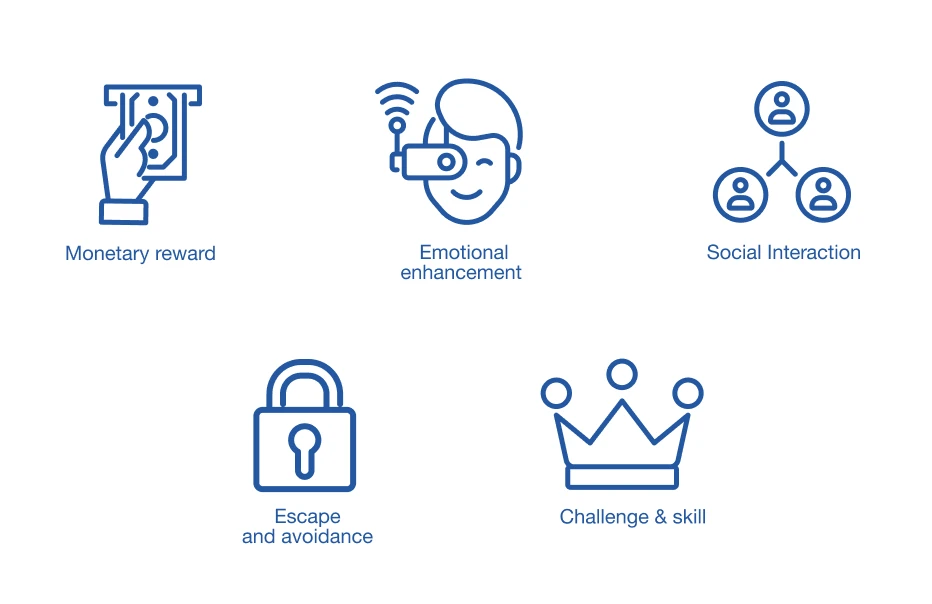
Recent behavioural research, including a landmark Finnish longitudinal study, identifies five core motivations behind gambling: monetary reward, emotional enhancement, social interaction, challenge, and escape. These motivations closely align with practical player archetypes: value seekers, thrill chasers, social players, strategists, and escapists.
Casino player motivations and archetypes
No single mindset dominates. However, across profiles, one insight holds true. Online casino players are emotionally invested in the experience of play itself, not just the outcome. If operators misread this mindset, they risk optimising for the wrong metrics and losing players who simply stop caring.
| Core Motivation | Player Archetype | Description |
|---|---|---|
| Monetary Reward | Value Seekers | Motivated by the potential to win money or get the best return on spend. |
| Emotional Enhancement | Thrill Chasers | Seek excitement, suspense, and the emotional highs of winning or risking. |
| Social Interaction | Social Players | Use casino games to connect with others, whether online or in shared settings. |
| Challenge & Skill | Strategists | Engage with games that allow decision-making, strategy, or a sense of mastery. |
| Escape and Avoidance | Escapists | Turn to games as a way to escape stress, boredom, or the everyday routine. |
What sets sports bettors apart
The value of control, mastery, and feedback
While casino games tend to rely on randomness and engaging features, sportsbook betting taps into something different. A deep desire for control, mastery, and feedback. Sports bettors generally do not feel like they are just participants in a game of chance. Typically, they see themselves as analysts, tacticians, and sometimes even insiders.
More often than not, they frame their decisions around knowledge of teams, stats, odds, and outcomes. This perceived control is powerful. According to research published in Frontiers in Psychology, bettors often display an ‘illusion of control’, particularly when betting on sports they follow closely. They aren’t necessarily betting blindly. However, they’re betting based on what they believe they know, and the feeling that this gives them an edge matters just as much as the actual odds.
Another critical difference lies in feedback loops. Casino players spin, win, or lose in seconds. For sports bettors, there’s usually a build-up in the form of the research, the bet placement, the anticipation of the event, and then the outcome. This extended timeline creates greater emotional investment and allows for post-outcome rationalisation (‘I almost got it right,’ ‘next time I’ll factor in injuries,’ etc.). For this reason, the experience is often reflective, not just reactive.
There’s also a strong identity component. Sports bettors frequently engage in community discussions through forums, tipster sites, and group chats to share picks. Ultimately, validating insights and building credibility. Betting becomes an integral part of how they engage with sports culture.
So, while casino players may play to feel something, sports bettors often bet to prove something, either to themselves or others. Understanding this distinction is powerful. If you’re designing experiences, promotions, or platforms, recognising that sports bettors value agency, validation, and engagement will give you a significant edge in retaining and growing a player base.
Casino vs sportsbook player mindsets
Here is a quick snapshot of what drives engagement in each vertical.
| Mindset Trait | Casino Players | Sports Bettors |
|---|---|---|
| Primary Drive | Escape and excitement | Strategy and prediction |
| Control | Low – chance-based outcomes | High. Skilled and insight-based bets |
| Session Style | Continuous, immersive play | Event-based, time-bound decisions |
| Emotional Hook | Suspense, thrill, visual stimulation | Mastery, competition, real-world ties |
| Feedback | Sensory – lights, sounds, wins | Logical – stats, results, bet history |
| Risk View | Entertainment-first | Value and edge-focused |
| Retention Factors | Variety, bonuses, immersive features | Market depth, control, live features |
How insights from sportsbook user behaviour can enhance the casino experience
Sports betting offers much behavioural insight that casino operators can learn from. Bettors return frequently, respond well to real-time feedback, and engage with interfaces that make them feel in control. By borrowing select elements from sportsbook-inspired thinking, operators have the opportunity to deliver casino experiences that feel more current, more motivating, and ultimately, more profitable.
What casino UX can learn from sportsbook design
Sportsbooks are designed for quick and purposeful interactions. This is because bettors usually arrive with a clear and purposeful intention. They know what event they want to bet on, and they want to get there fast. That’s why sportsbook UX optimises shortcuts, personalisation, and clean, no-nonsense navigation.
Casinos, by contrast, tend to focus on presentation, featuring game grids, bright thumbnails, and occasional filters or search options. It looks polished, but often feels static. There’s little sense of narrative or flow. For a player browsing casually or looking for something new, that can mean one thing. A quick exit.
This is where casino UX can learn from sportsbooks. Casino players may not want live odds, but they do want direction. They want to know what’s hot right now, what fits their play style, and what’s worth their next spin. Features like personalised game carousels, session-based recommendations, and timely nudges (e.g. ‘you’re one round from unlocking this bonus’) borrow directly from sportsbook UX. And they work.
Casinos don’t need to copy sportsbooks. But they should adopt the same intent, which is to keep the player moving and make every move feel like progress.
Boosting session frequency
Design isn’t just about what happens in a session. Done correctly, it should also be about what brings the player back. And this is where sportsbooks have long held the edge. Sportsbooks are masters of habit-forming design, consistently providing bettors with reasons to return. A new matchday. A price boost. A friend’s winning bet. Everything is a reason to open the app, check in, and maybe place a quick wager. That frequency adds up.
By comparison, online casinos tend to rely on session depth over session frequency. However, the most successful operators are discovering that the two don’t have to compete. The key is to give casual players more meaningful reasons to return.
In this area, sportsbook-style triggers can make a difference. Dynamic promotions that react to recent play. Nudges to complete an unfinished challenge. ‘Just dropped’ carousels that identify new or trending games. Time-sensitive incentives linked to the player’s own habits, and not merely generic pop-ups.
And when you combine that with personalised progression tracking, even something simple like a ‘you are 4 spins away from your next bonus’ nudge can create momentum. It’s not pressure, but just a reason to tap in, even for five minutes.
The key point is that session frequency should never be about sending spam notifications. Sportsbooks already get this. And while some casinos are starting to take notice and close the gap, it will be those who adapt fastest that will become part of the player’s daily routine.
Applying sportsbook thinking to loyalty and personalisation
Loyalty and personalisation might have found early momentum in the online casino world, but it’s sportsbooks that have truly run with the concept. What began as structured reward tiers and generic promotions has evolved into a dynamic, real-time approach to engagement.
To this extent, sportsbooks do more than just reward loyalty. They anticipate it. They track behaviour in real time, respond instantly to player actions, and personalise the experience with a level of insight most casino platforms are still chasing. To be clear. This isn’t just about tiered VIP levels or weekly cashback. It’s about recognising where a player is in their journey, and delivering something meaningful in that exact moment.
For instance, a bettor who has just landed a five-leg parlay doesn’t need a generic promo code; they need a well-timed nudge to explore what else is live, or maybe a push towards one-click rebetting. And a player returning after a week-long break doesn’t need to start over, they need a personalised welcome back. The best sportsbooks know this. And they build journeys around it.
Casinos can achieve the same by adopting a similar mindset.
Think of loyalty not as a fixed journey, but as a conversation that adapts over time. Reward discovery, not just deposits. Celebrate return visits, not just spend. Build pathways that learn from player preferences and adapt in real time. If someone keeps dipping into live blackjack every Friday night, meet them there. Make it feel intentional.
What not to copy
As tempting as it is to borrow every best practice from sportsbooks, casinos shouldn’t lose sight of what makes them unique. Sports betting thrives on data and immediacy. But casinos succeed because they create an environment of anticipation, chance, and storytelling. Copying sportsbook methods wholesale risks stripping away the very elements that give casino play its atmosphere.
Features like overly aggressive push notifications, constant odds-style updates, or rigid dashboards can turn a leisurely session into a stressful one. Unlike bettors, many casino players value exploration, surprise, and the sense that they might discover something unexpected. They don’t want to feel rushed from spin to spin or bombarded with transactional prompts.
The challenge is knowing where to draw the line. Better to say YES to dynamic recommendations and better personalisation, and NO to momentum-killing features that disrupt the magic of casino gameplay.
Operators who understand this balance will retain the soul of their casino while evolving to meet modern expectations.
What happens when you shift the mindset?
Some of the most agile, responsive, and player‑attuned thinking in iGaming hasn’t come from the casino but from sports betting. These platforms are used to live odds, real-time markets, and the constant pressure of external events. As a result, they’ve developed keen instincts, faster workflows, and a culture that treats every moment of player attention as valuable. When that mindset is applied to the casino environment, it can change everything.
In this mindset, things move faster. Features don’t sit in a backlog for six months, campaigns aren’t rolled out blindly, and promotions become more instinctive and timely, using current events or player triggers instead of fixed calendars. Player data starts informing everything from layout decisions to bonus types.
It’s also a mindset that respects loyalty as a long game. Sportsbooks understand that players develop habits, and that each interaction is an opportunity to reinforce that cycle. They personalise with purpose to keep the bettor engaged and coming back. That same thinking, when applied to online casino marketing efforts, leads to more intentional journeys, better segmentation, and customer retention.
But the best part is, you don’t need a complete platform overhaul to get started. You just need a team willing to rethink how they work, and the belief that there’s value in borrowing proven thinking from the other side of the iGaming equation.
Is your platform ready for this kind of upgrade?
When exploring new ways to personalise player journeys, the potential is clear, yet so are the practical considerations. Whether you're looking to upgrade your existing platform or adopt a more dynamic, data-led approach, it’s important to weigh what’s possible against what’s realistic. The right solution should align with your goals, infrastructure, and appetite for operational change.
Potential advantages
- Improved retention – Keep players engaged for longer
- Increased upsell chances – Guide players to new formats
- Faster optimisation – Test, learn, and adjust quickly
- Cross-sell with purpose – Move users across verticals
- Reduced churn – Intervene before users drop off
- More measurable impact – Track success with clear signals
- Higher player lifetime value – Increase revenue per user
- Stronger conversion rates – Turn more visitors into regular players
- Lower bonus waste – Deliver incentives where they convert
- Greater campaign ROI – Get more value from marketing efforts
- More consistent engagement – Smooth out peaks and drop-offs
- Deeper user insight – Make smarter decisions with clearer patterns
Possible disadvantages
- Higher implementation costs
Requires additional tooling, integrations, and skilled teams - Greater reliance on real-time infrastructure
Many casinos aren’t built for dynamic content delivery. - Incompatibility with white-label setups
Operators may have limited control over UX or data. - Limited vendor flexibility
Existing platform partners may not support needed features. - Increased operational complexity
Promotions, journeys, and triggers need constant management. - Slower rollout cycles
Casino platforms often lack agile deployment pipelines.
Let’s be honest. What are you trying to build?
Every operator wants results in terms of better retention, higher revenue, and smarter campaigns, etc. But those outcomes are side effects, not starting points. The real question is: what kind of player experience do you want to be known for? One that’s familiar, or one that’s adaptive, personal, and genuinely hard to walk away from?
There’s no one-size-fits-all approach. However, the most successful brands today are those willing to rethink the small things, such as how journeys unfold, how habits form, and how data drives action. That takes insight and a degree of honesty about your priorities, your platform, and your appetite for change.
And it’s not just a casino conversation. Sportsbooks have already redefined what dynamic, player-first engagement can look like. If you're serious about bridging that gap, start by reading our sister article: What Today’s Bettors Really Want from a Sportsbook.
Then let’s talk about what’s possible.
Popular blog posts