

Online poker vs online casino: Understanding the divide in iGaming strategy

Updated 31 Dec 2025•Published 31 Dec 2025
Overview
In many ways, online poker helped pioneer online gambling, building the foundations for the world of online casinos and igaming sites. Yet today, online poker has largely evolved into its own distinct ecosystem, separate from the more casual and rapid-fire world of online casinos and slot games.
This article explores the evolution of online poker, why it stands apart now, and what the future holds for this unique online gambling experience.
Online poker: A brief history
Online poker first appeared during the internet boom of the late 1990s, with Planet Poker launching its first real-money games in 1998, marking the start of a digital revolution in card playing. As connectivity speeds and encryption capabilities improved, the popularity of online poker exploded, thanks in part to televised poker tournaments.
PokerStars entered the scene with advanced software that significantly enhanced the user experience, defining the industry. In 2002, it launched the World Championship of Online Poker (WCOOP) and the following year, Chris Moneymaker, an amateur player who qualified via the PokerStars website, won it. His win sparked what became known as the "Moneymaker Effect", dramatically increasing interest and engagement in online poker worldwide.
Today, the global online poker industry has a projected valuation of $6.27 billion by the end of 2025. Looking further ahead, it’s expected to record a CAGR of 15.2% from 2025 to 2034.
Yet, while online poker still remains popular, the complexity and skills required to play it have made it less accessible than online casinos. As a result, online poker's growth plateaued in favour of more casual, fast-paced casino options like video slots and live dealer games.
Why is online poker typically separate from online casino?
Despite poker and casino gaming being part of the same online digital space, they are typically kept as separate entities. This can be attributed to the following fundamental differences in how both gambling formats operate.
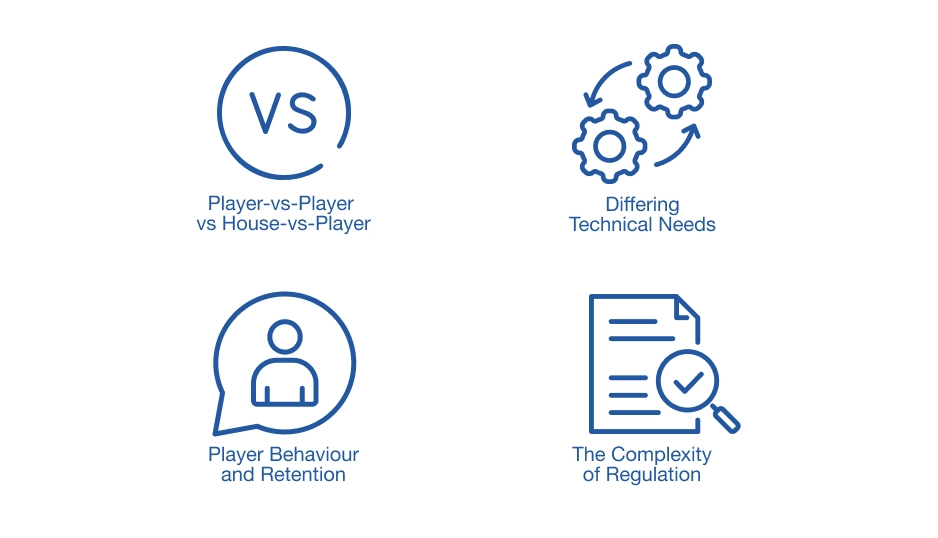
Several core differences help explain this separation:
Player-vs-player vs house-vs-player
In online casino games, such as slots, roulette, or blackjack, the house acts as the opponent for players. This means that the operator holds a fixed edge at all times, which makes these game formats appealing from a business perspective.
By contrast, online poker is a player-versus-player game. The house earns revenue by taking a percentage of each pot, called the rake, or charging tournament fees for players to enter. So, the profitability of a poker site depends on having an active, steady flow of players, not just a few high-stakes games.
Differing technical needs
Poker platforms need to power highly technical systems that support real-time gameplay, player matching, anti-collusion systems, and secure player chat functions. This is far more complex than random number generator (RNG) based online casino games.
The complexity of regulation
Online poker is subject to more rigorous oversight than casino games in many jurisdictions around the world. This is because poker is a peer-to-peer (P2P) game, which introduces risks like players colluding to influence the outcome of a game.
Some jurisdictions require separate licences for online poker, often imposing stricter operational safeguards, enhanced compliance obligations, and more advanced anti-fraud measures. As a result, running a poker platform is often considered higher-risk and more resource-intensive than operating a typical online casino.
Player behaviour and retention
Poker players tend to be more skilled, community-driven, and less impulsive than typical online casino players. While they spend more time in game sessions, their average spend (or loss) per visit is often lower than that of slot or live dealer players.
Online poker players also have high expectations when it comes to loyalty schemes, transparency, and fair matchmaking. This can make player retention more complex and resource-intensive than it would be with an online casino audience.
How online poker sites work
Online poker platforms are built from the ground up to recreate the in-person poker playing experience online via websites or apps. Players from jurisdictions where online gambling is legal can sign up, deposit funds, and join a poker table alongside other human players.
Online poker sites have a lot of complex processes running behind the scenes to ensure smooth gameplay while providing a safe and secure playing environment. As these systems can be costly to run, many online poker sites work together behind the scenes to pool players and resources, helping them to maximise efficiency and revenue.
Poker game formats
Most modern poker sites offer a mix of the following popular formats:
- Cash Games: Players can join or leave at any time, bringing their own money to the table.
- Sit and Go Tournaments: Small-scale tournaments that begin as soon as enough players join, typically 6 to 9.
- Multi-Table Tournaments (MTTs): Larger scheduled events where thousands of players compete for large prize pools.
- Fast-fold Poker: A quick-fire format where players are instantly moved to a new table after folding, speeding up the gameplay.
Key online poker site components
To ensure that poker platforms can provide their games smoothly and securely, they rely on several of the following key components:
- Game Servers: Running behind the scenes to manage all game aspects in real time, including dealing cards, handling bets, and player actions. Servers also ensure fair outcomes for every game action.
- Poker Client: The player interface runs via a downloadable app or in a web browser. It displays cards, chips, and tables while securely communicating with the server.
- Rake and Revenue Systems: Online poker sites take a small fee (rake) from each hand or tournament entry, usually as a percentage of cash games or a fixed fee in tournaments.
- Shared Liquidity Pools: Poker networks share player bases, helping platforms to fill games quickly and maintain round-the-clock activity across multiple regions.
- Responsible Gaming Tools: Features like deposit limits, session timers, cool-off periods, and self-exclusion help players stay in control.
- Anti-Fraud and Security Systems: Advanced tools detect and prevent cheating, collusion, bots, and multi-accounting. Behavioural analysis and ID checks also help to ensure fairness.
With an understanding of how online poker works behind the scenes, it's worth looking at the major players dominating the space today.
The biggest online poker providers
The online poker market has matured a lot from the boom times of the early 2000s, with many smaller platforms consolidating or being driven out of the market altogether. Today, a few major operators dominate the global landscape:
PokerStars
Established in 2001, PokerStars remains a leading online poker platform, offering a wide range of cash games and large-scale tournaments with substantial prize pools. Notably, their flagship tournament, the Sunday Million, guarantees a $1 million prize pool, attracting players worldwide.
GG Poker
GGPoker has rapidly expanded its presence through strategic partnerships and high-profile events. The platform is known for hosting the World Series of Poker (WSOP) Online series, allowing players to compete for bracelets and significant prize pools from the comfort of their own homes.
Partypoker
A legacy brand in the online poker scene, partypoker operates under Entain, formerly bWin, and focuses on secure, fair gameplay. The platform is fully licensed and regulated, with a dedicated Game Integrity team working to maintain a safe environment for players.
888poker
Owned by Evoke plc, 888poker is a prominent European online poker brand, offering a variety of games and tournaments. The platform is integrated with other gambling products, such as casinos and sportsbooks, providing players with a comprehensive gaming experience.
WSOP.com
As the official online platform of the World Series of Poker, WSOP.com focuses primarily on the US poker market. It gives players the chance to participate in real-money games and tournaments, including opportunities to win iconic WSOP bracelets online.
The future of online poker: Innovation and adaptation
Though the explosive early industry growth has levelled off, online poker continues to adapt and mature. Operators are investing in user experience, mobile-first platforms, and gamification features to attract younger audiences and retain existing ones.
To help keep their online poker offerings fresh while warding off external threats, platforms are innovating in the following areas:
- AI and Bots: Platforms are stepping up anti-bot and collusion detection to protect their integrity and boost security for players.
- Cross-Platform Integration: Some online poker sites are blending their poker with casino features, creating hybrid ecosystems for a wider appeal.
- Live Streaming and Community Tools: Twitch, YouTube, and Discord are being used to build loyalty and showcase high-stakes play online.
- Crypto Integration: Some niche sites now support crypto payments and blockchain-based fairness verification.
- Regulation: As regulation continues to shift, particularly in the US, Latin America, and Asia, poker networks are expected to expand, consolidate, or specialise to adapt to local rules.
While the online poker vertical is more niche than casino gaming, these innovations are helping it to remain commercially viable and relevant in a rapidly changing iGaming landscape.
Final thoughts: A distinctly strategic vertical
Online poker may no longer be the rapid growth engine it once was, but it continues to occupy a distinct and highly valuable niche within the iGaming sector. Its unique peer-to-peer model, higher regulatory complexity, and demanding player base set it apart from traditional online casino offerings, both technically and commercially.
While the margins may be thinner and the technical demands higher than traditional online casino platforms, a well-executed poker offering can enhance brand reputation. It’s also a great way to diversify revenue streams and engage a highly loyal and community-driven player segment.
As the industry continues to innovate, online poker is finding new ways to stay relevant in a fierce igaming landscape. For platform providers willing to invest in the long game, poker offers a complementary vertical that rewards operational excellence and long-term thinking.
For operators considering entering the online poker space, it's crucial to evaluate not just profitability, but strategic alignment with your current brand and player base.
Popular blog posts