
Unlocking the tribal gaming market: Opportunities and challenges for B2B partners
Updated 27 Mar 2026•Published 27 Mar 2026
Overview
In 2023, tribal casinos generated $41.9 billion, more than the combined revenue of Las Vegas and Atlantic City. Yet many outside the United States still misunderstand how tribal operators function or why they matter.
In the US gambling landscape, it’s fair to say that tribal casino operators hold a unique and powerful position. Distinct from commercial casinos, these enterprises are owned by sovereign Native American tribal nations and operate under a specific legal framework.
As tribal operators expand beyond land-based venues into online gambling, they present both opportunities and complexities for B2B stakeholders.
This article explores how tribal gaming works in both land-based and online forms. Understanding this can prove essential for long-term growth and strategic partnerships in the US gambling market.
A quick legal overview
The foundation of legalised tribal gaming in the US began with the Indian Gaming Regulatory Act (IGRA). This United States Federal Law, passed by Congress in 1988, was created to promote tribal economic development, self-sufficiency, and strong tribal governments while establishing a regulatory framework for gaming on tribal lands.
IGRA recognises the sovereign rights of federally recognised Native American tribes to offer gaming activities on their lands, providing certain regulatory conditions are met.
Under IGRA, gaming is divided into three classes:
- Class I: Traditional tribal games played for minimal prizes (e.g. ceremonial games), regulated solely by tribes.
- Class II: Bingo and certain non-banked card games (e.g. poker), regulated by tribes with oversight from the National Indian Gaming Commission (NIGC).
- Class III: Full-scale casino gaming, including slot machines and table games.
For a tribe to offer Class III gaming, they must negotiate and sign a compact (legal agreement) with the state government.
Compacts outline key operational terms, including:
- The types of games allowed
- Revenue-sharing arrangements
- Regulatory roles and enforcement mechanisms
How tribal casinos operate
Tribal casinos are located on lands held in trust by the federal government for the benefit of Native American tribes. These lands are considered sovereign territory, which gives tribes the right to self-regulate in many areas, operating within the boundaries of federal law and, in some cases, state law through negotiated agreements.
The two main forms of regulatory oversight are:
- The Tribal Gaming Commissions, who oversee day-to-day compliance.
- The National Indian Gaming Commission (NIGC). A federal body that ensures tribes meet IGRA requirements and maintain fair, honest operations at all times.
In several states, such as Florida and Washington, tribes have secured exclusive rights to operate casino gaming through state compacts. This gives them a dominant position in the regional gaming market.
Key operational differences
Tribal casinos differ from US commercial casinos in the following ways:
- Ownership: Tribal casinos are owned collectively by the tribe, not by private shareholders.
- Revenue use: Profits must be reinvested into tribal communities to improve local services, education and infrastructure.
- Compliance and taxation: Tribes follow different reporting standards and may not pay state taxes, depending on the details of their compact.
States with tribal casino operators
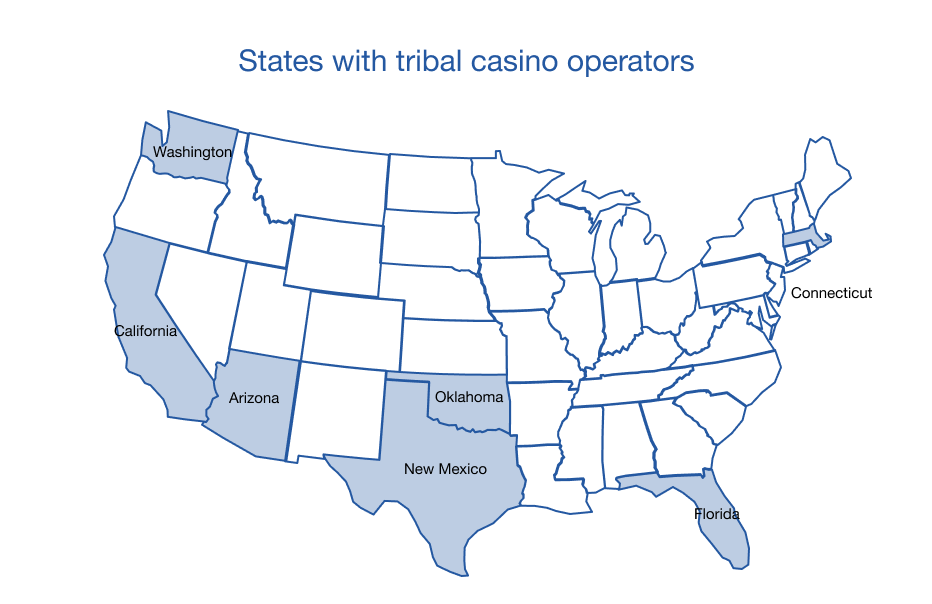
Tribal casino operators hold exclusive rights to operate Class III (casino-style) gaming in several US states through negotiated tribal-state compacts.
These exclusivity agreements have been instrumental in shaping the gaming landscape within these states, providing tribes with significant economic opportunities and a dominant presence in the regional gaming industry.
Notable examples include:
- California: Tribes have exclusive rights to operate slot machines and banked card games.
- Washington: Tribal compacts grant exclusive rights to operate casino-style gaming, including slot machines and table games.
- Florida: The Seminole Tribe holds exclusive rights to operate casino gaming and sports betting under a compact with the state.
- Connecticut: The Mashantucket Pequot and Mohegan tribes have exclusive rights to operate casino gaming, including slot machines and table games.
- Arizona: Multiple tribal compacts grant exclusive rights to operate slot machines and table games, with tribes contributing a portion of gaming revenue to the state.
- New Mexico: Tribes have exclusive rights to operate casino gaming under compacts with the state, which include revenue-sharing agreements.
- Oklahoma: Tribal compacts grant exclusive rights to operate Class III gaming, including slot machines and table games.
Revenue and economic impact
Beyond operations, tribal casinos also have a measurable impact on their communities and the national economy.
In 2023 tribal casinos generated a record $41.9 billion in gross gaming revenue. This marked an increase of over $1 billion (2.4%) above the previous year. The total revenue was calculated from reporting by 527 gaming operations across 245 tribes in 29 states.
Tribal gaming also provides significant local employment opportunities. A 2022 report by Indian Gaming Magazine states that Indian gaming is said to have provided over 680,000 jobs.
This total includes both direct employment, such as casino staff, security, and hospitality, as well as indirect roles like suppliers, construction, and other local services.
Revenue from tribal casinos is commonly reinvested in the local community to:
- Fund healthcare services, schools, and housing projects.
- Support infrastructure improvements such as roads and water systems.
- Expand employment and training opportunities on and off tribal lands.
- Enhance cultural preservation programmes and tribal governance.
This reinvestment model presents tribal gaming as a vehicle for community development and self-sufficiency.
Tribal operators in online gambling and sports betting
While tribal gaming began in the land-based space, many tribes are now beginning to enter digital iGaming and sports betting markets where permitted.
Here are some real-world examples from US states:
- In Connecticut, the Mohegan Tribe partnered with FanDuel, and the Mashantucket Pequot Tribe partnered with DraftKings to offer online sports betting and casino games under their state compacts.
- In Michigan, state law requires that all iGaming operators partner with a tribal or commercial casino. This has led to a range of partnerships, with tribal operators gaining market access through major platform providers.
The transition from land-based to online gambling is typically a lengthy and complex process featuring legal amendments to existing compact agreements.
These amendments allow third-party platforms to offer gaming services under a tribe’s licence, giving them access to previously off-limit markets.
Opportunities and challenges for B2B partners
For platform providers, game developers, payment service providers, and compliance specialists, tribal operators represent a growing market segment with unique requirements.
Opportunities:
- First-mover advantage in emerging markets.
- Partnerships in exclusive jurisdictions.
- Access to loyal, established player bases.
Challenges:
- Navigating compact law and federal or state oversight.
- Cultural and relational sensitivity is key, meaning negotiations that may require more time and trust-building.
- Customised compliance and integration solutions may be necessary.
Conclusion: Why tribal operators matter more than ever
Tribal casino operators are regulated, community-focused, and increasingly digital. They’re not just legacy players, they are growth partners and market gatekeepers across multiple US jurisdictions.
For B2B stakeholders looking to expand in the US market, tribal casino operators certainly present a unique opportunity. That said, understanding the legal, cultural, and operational frameworks that underpin tribal gaming is critical.
Whether through direct partnerships or infrastructure support, building long-term relationships with tribal operators can be the key to sustainable success.
Popular blog posts