

Beyond compliance: How smart KYC fuels casino growth

Updated 20 Mar 2026•Published 20 Mar 2026
Overview
Know Your Customer (KYC) is the process of verifying a player’s identity using document checks, database screening, and other validation tools.
For online casino operators, it’s not just important—it’s mandatory in all regulated markets. Failing to meet KYC requirements can lead to serious consequences, including revoked licenses, blocked banking services, and significant regulatory fines that could result in the shutdown of your iGaming business.
But KYC shouldn’t be seen only as a legal obligation. When approached strategically, it can become a powerful tool for building trust, reducing fraud, and gaining a competitive edge.
In this article, we’ll explore why KYC matters, what tools and practices to use, and how to turn compliance into a business advantage in the iGaming space.
Why KYC matters for online casino providers
KYC isn’t just a box-checking exercise—it’s designed to protect your business, support long-term growth, and keep you aligned with regulatory requirements.
Here’s how that works in practice across three key areas:
Regulatory compliance is non-negotiable
If you’re operating in a regulated market, KYC is a mandatory requirement with no exceptions. Every major jurisdiction with a gambling regulatory body enforces strict identity checks, such as:
- UK gambling commission (UKGC): Requires identity verification before allowing withdrawals.
- Malta gaming authority (MGA): Requires enhanced due diligence for high-risk players.
- U.S. state regulators: Require comprehensive age verification systems.
Enforcement is typically very strict, and failure to comply can be catastrophic for iGaming platforms. The UKGC has issued fines of over £10 million for past KYC breaches.
Payment processors also routinely cut off non-compliant operators, and banks will not work with platforms that lack proper verification procedures. This makes deposits and withdrawals impossible to manage and will severely impact your ability to operate an online casino.
KYC protects your business
KYC isn’t just there to protect players—it’s a critical safeguard that also protects your platform and your partnerships. It helps you defend against fraud, crime, and operational risks:
- Identity checks: These help prevent underage access, which is one of the fastest ways to trigger regulatory action.
- Document verification: Helps block fraudsters using stolen credit cards or payment details, reducing costly chargebacks.
- Anti-money laundering (AML): Screening detects and prevents money laundering activities, helping you maintain strong banking relationships and uninterrupted payment processing.
KYC builds long-term value
Strong KYC practices don’t just keep your online casino platform compliant—they can also drive sustainable growth and market credibility. They can support your business in the following ways:
- Increasing LTV: Verified players are more likely to engage authentically, reducing churn and increasing lifetime value.
- Cleaner data: Removing fake or duplicate accounts improves marketing performance and campaign accuracy.
- Stronger partnerships: Affiliates, payment providers, and investors prefer working with compliant, trustworthy platforms.
KYC implementation: White label vs Turnkey vs Self-built platforms
Your KYC implementation strategy depends heavily on the type of online casino platform solution you choose.
Whether you’re launching quickly with a white label model, scaling across markets using a turnkey solution, or building a bespoke product, your platform model affects everything from compliance control to data ownership.
Here’s how KYC works across three main online casino solutions:
White label platforms: KYC handled by the provider
In a white label setup, the platform provider manages KYC on your behalf. This includes the technology, processes, and regulatory alignment required to remain compliant.
Your role in this setup is to follow the provider’s framework and ensure you operate within their rules at all times.
Pros:
- Fast and cost-effective setup
- Minimal compliance workload
- Technical and regulatory updates are managed for you
Cons:
- Limited visibility and customization
- Shared systems reduce differentiation
- Less flexibility to adapt to new markets or high-risk segments
Turnkey platforms: Shared control with direct oversight
With a turnkey platform, you have your own brand and license while relying on a fully integrated software solution.
KYC tools are typically pre-integrated into the platform, but you are responsible for managing KYC workflows, maintaining provider relationships, and ensuring full compliance under your brand.
Pros:
- Greater control over verification processes
- Direct access to player data and analytics
- Easier to scale across jurisdictions
Cons:
- Requires in-house compliance expertise
- Higher setup and operational costs
- More complex vendor and data management
Self-built platforms: Full responsibility and custom KYC
Building your own platform means taking full ownership of every aspect of the KYC process.
You will need to design, implement, and maintain the entire verification process, from vendor integration to compliance monitoring and ongoing updates.
Pros:
- Maximum customization and flexibility
- Full control over data and compliance
- Ability to create unique user experiences
Cons:
- High development and ongoing maintenance costs
- Requires specialized technical and legal teams
- Full responsibility for any compliance failures
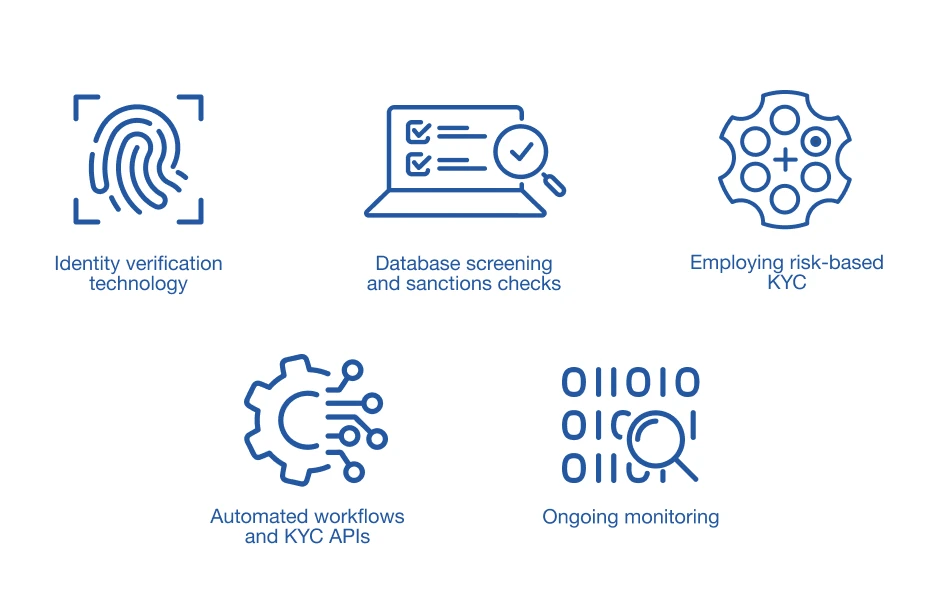
Tools and best practices for effective KYC
To meet regulatory requirements and improve the overall player experience, a modern KYC process needs to be both secure and seamless.
Here are the tools and best practices to prioritize in your KYC approach:
- Identity verification technology:
KYC checks can quickly become very labor-intensive, especially during sudden spikes in player sign-ups. Use real-time document scanning and biometric matching, such as facial recognition, to verify IDs quickly and reduce manual review bottlenecks. - Database screening and sanctions checks:
Screening new players against global watchlists, sanctions databases, and politically exposed persons (PEP) lists helps identify high-risk individuals early. This is essential for preventing regulatory breaches and reputational damage. - Risk-based KYC:
Not all players pose the same level of risk. Using tiered verification—basic checks for low-risk users and enhanced due diligence (EDD) for high-value or high-risk players—keeps compliance costs manageable without compromising security. - Automated workflows and KYC APIs:
Manual processing slows down onboarding and can increase error rates. Automate KYC workflows by using software tools that connect directly to your platform through integrated APIs. This enables real-time decision-making, reduces operational strain, and improves the player experience. - Ongoing monitoring:
KYC isn’t a one-time task. Continuously monitoring player behavior and re-verifying data when necessary helps identify suspicious activity, maintain accurate records, and ensure long-term regulatory compliance.
Using KYC as a strategic advantage
Far from being a burden, KYC can actively strengthen your business when used correctly. Here are some ways it can be leveraged as a strategic advantage:
- Build player trust: A transparent and secure verification process makes players feel safe, increasing their willingness to deposit and remain loyal.
- Attract better affiliates: Affiliates want to promote reliable brands. Demonstrating strong fraud prevention practices increases your attractiveness as a partner.
- Improve conversion and retention: Streamlined KYC flows reduce onboarding friction. Fewer drop-offs during registration lead to higher conversion rates and increased lifetime value.
- Future-proofing: As regulations tighten globally, strong KYC systems make it easier to expand into new markets or jurisdictions without major changes.
Final thoughts: Make KYC your competitive edge
KYC is far more than just a legal obligation that online casinos must fulfill. It should be viewed as a foundation for running a successful, secure, and scalable online casino. From regulatory compliance to fraud prevention and player loyalty, the benefits go far beyond simply checking boxes to satisfy regulators.
Whether you’re entering the market with a white label platform or managing your own technology startup, understanding and optimizing your KYC process can give you a clear competitive advantage in a crowded market.
The message is clear: Prioritizing smart, strategic KYC implementation positions your business to grow responsibly and sustainably over the long term.
Ready to build a compliant, future-ready casino brand?
Popular blog posts