
Why affiliate marketing still wins in iGaming: A strategic guide for casino operators
Updated 25 Mar 2026•Published 25 Mar 2026
Overview
Affiliate marketing has become one of the most powerful player acquisition strategies in the online casino industry. By partnering with websites, streamers, and social media influencers, operators can tap into trusted communities and reach high-intent players far more efficiently than through traditional advertising.
However, successful affiliate marketing requires more than placing a few banner ads or sharing a referral link. To build a profitable and compliant affiliate program, operators must understand the available models, choose partners wisely, and leverage data to drive growth.
This article explores how to make affiliate marketing work for your online casino and how it can accelerate your growth.
The strategic benefits of affiliate marketing
Affiliate marketing is an effective way for online casinos to grow by working with partners—known as affiliates—who promote the casino in exchange for payment. This payment might be a share of player revenue, a fixed fee for each new player, or a hybrid of both.
Let’s take a closer look at why affiliate marketing continues to deliver strong return on investment (ROI) for iGaming operators across different markets. Here’s what strong affiliate partnerships can achieve:
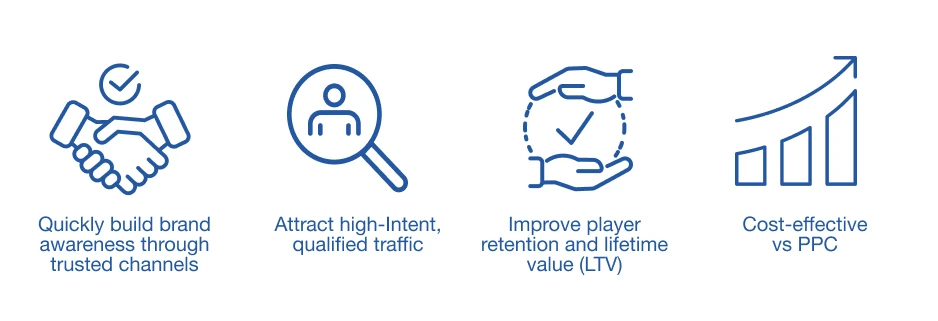
Quickly build brand awareness through trusted channels
Affiliates often operate in niche online communities, such as comparison websites or casino review platforms. They may also collaborate with streamers, YouTubers, bloggers, and social media influencers.
These affiliates have already invested time and effort in building credibility with their audiences. As a result, a recommendation or review from them carries far more weight with potential players than a standard banner ad or direct outreach from your casino.
For a new online casino entering the market, brand visibility is critical to attracting players and generating revenue early. Working with affiliates provides immediate exposure to a highly targeted and engaged audience.
Attract high-intent, qualified traffic
Unlike general casino marketing campaigns, affiliates have an existing audience who are often in the consideration or decision-making stage. If an online casino player is browsing a slot review site or following a slot-focused streamer, they are much more likely to convert.
That said, not all affiliates are created equal, so it’s important to carefully select your partners. Reputable affiliates with proven track records in regulated iGaming markets can deliver traffic that converts while also ensuring compliance with local regulations and KYC standards.
Well-managed affiliate partnerships can quickly provide a steady stream of qualified casino players at a fraction of the cost of broader acquisition channels.
Improve player retention and lifetime value (LTV)
Affiliates typically engage their audiences through fresh content, bonus codes, email newsletters, and community interaction. This creates ongoing relationships, where players repeatedly return to an affiliate for the latest casino news, offers, and promotions.
For operators, this extended engagement can lead to higher retention rates and increased lifetime value. For example, if a streamer regularly features your casino, their viewers may return not only to watch but also to play, keeping your brand top of mind and encouraging repeat deposits.
Cost-effective vs. PPC
With affiliate marketing models, casinos only pay for actual results—whether that’s a first-time deposit or ongoing revenue share.
This performance-based approach is especially attractive in a cost-conscious industry like iGaming. It ties costs directly to outcomes, making it a lower-risk strategy for new operators and a scalable model for those looking to expand.
By contrast, Pay-Per-Click (PPC) advertising requires upfront spending with no guarantee of results. A high click-through rate may look promising, but it doesn’t always translate into active players—especially in saturated or highly competitive markets like the U.S. or the U.K.
Common casino affiliate models
Affiliate agreements come in different forms, and casinos can choose the best fit depending on their risk tolerance, revenue goals, and market position. Here are the three most common affiliate marketing models in iGaming today:
CPA (Cost Per Acquisition)
The casino pays a fixed fee for each new depositing player referred by the affiliate. This model is ideal for affiliates looking for quick returns and for operators seeking predictable acquisition costs per sign-up.
- Pros: Easy to budget and allows for straightforward performance tracking.
- Cons: Provides no long-term revenue incentive for affiliates to refer players, which may lead to lower-quality traffic.
Revenue share (RevShare)
The affiliate receives a percentage of the net revenue generated by their referred players over an agreed period.
- Pros: Aligns affiliate incentives with the casino’s player retention strategies and typically involves lower upfront costs compared to other models.
- Cons: Revenue can fluctuate significantly depending on player engagement. To work well, this model requires a long-term commitment from both sides.
A hybrid model
Combines elements of CPA and RevShare, where the affiliate earns a smaller upfront payment along with a percentage of ongoing revenue.
- Pros: Balances short-term and long-term incentives and risk.
- Cons: More complex to manage and calculate than a single model.
Setting up your affiliate programme
Whether you’re starting from scratch or working with a platform provider, you’ll need to:
- Choose affiliate tracking software: Tools like Income Access, NetRefer, or MyAffiliates are specifically built for iGaming campaigns.
- Recruit affiliates: Options include cold outreach, affiliate networks, or conferences such as iGB Affiliate.
- Decide how it’s managed: Larger brands often run in-house teams, while smaller ones may outsource or use white-label providers.
- Integrate technology seamlessly: Ensure smooth tracking of clicks, sign-ups, first-time deposits (FTDs), and revenue.
Best practices: Making affiliate partnerships work
Affiliate marketing is most effective when it’s built on more than just a solid payment model. To succeed, operators need strong relationships with affiliates based on clear terms, strict compliance standards, and the right tools to support the process.
Here’s how operators—and the platforms they use—can make affiliate partnerships truly effective for long-term success:
Establish clear and transparent terms
Define your commission model, payout schedule, and performance-tracking methods. This helps avoid unpleasant surprises, such as unexpected costs, later on.
Be explicit about rules concerning bonus offers, responsible gambling, and player marketing practices. Doing so ensures compliance and builds brand trust.
Monitor and track performance
Use affiliate dashboards to access real-time data on clicks, sign-ups, deposits, and revenue. Adjust your strategy based on this data to maximize the value of your partnerships.
Identify your top-performing affiliates and consider offering them additional incentives or tailored campaigns.
Communicate clearly
Keep affiliate partners informed with campaign updates, new offers, and any changes to compliance rules. This helps them deliver higher-quality traffic to your platform.
Offer perks such as exclusive bonus codes or early access to promotions. These incentives can help you stand out from other casino affiliate programs and attract more sign-ups.
Choose the right affiliates
- Look for partners with a strong reputation and an audience that aligns with your target players. The more precise you are about your target demographics, the better your results will be.
- Evaluate the quality of their content, SEO rankings, and traffic sources. Ask for raw performance data to confirm whether they’re a good fit.
- Avoid affiliates operating in unregulated or gray markets, especially if your license doesn’t allow it. Staying compliant is essential, and promotion in unregulated markets can harm your reputation.
Measuring success: KPIs for casino affiliate campaigns
To maximize the impact of your affiliate programs, track these essential metrics:
| Metric | What it tells you |
|---|---|
| Click-through rate (CTR) | Measures how engaging your affiliate links and content are. A high CTR—typically above 5%—suggests effective placement and messaging. |
| Conversion rate | The percentage of users who take action—such as signing up or making a deposit—after clicking. A strong rate, typically above 10%, indicates high-quality leads. |
| First-time depositors (FTDs) | Number of new depositing players referred by affiliates. A key metric for acquisition-focused campaigns. |
| Revenue per affiliate | Average revenue generated per affiliate. Helps identify which partners deliver the most value. |
| Churn rate | Shows how frequently players drop off after joining your casino. A high churn rate may signal low-quality affiliates or poor player fit. |
| Lifetime value (LTV) | The total revenue a player generates over their entire relationship with your casino. Helps evaluate the long-term value of affiliate traffic. |
| Affiliate return on investment (ROI) | Your total return compared to your affiliate spend. Indicates whether your affiliate program is generating a positive return. |
Final thoughts: An essential growth strategy
Affiliate marketing offers a powerful, scalable, and cost-effective way to grow an online casino brand—but only when executed correctly. By choosing the right partners, leveraging the appropriate tools, and maintaining strict compliance, operators can transform affiliate traffic into a reliable, long-term revenue stream.
Whether launching a new platform or expanding an existing one, affiliate partnerships should remain a central pillar of your growth strategy.
Popular blog posts