

AI in Gambling: How online casinos use artificial intelligence in 2026

Updated 30 Oct 2026•Published 31 Dec 2025
Overview
Artificial intelligence (AI) is rapidly reshaping industries worldwide, and iGaming is no exception. Known for adopting new technologies early, the online casino sector now uses AI for everything from personalized promotions to automated compliance checks.
But is this wave of innovation just another passing tech trend, or is AI here to stay as a core part of the iGaming ecosystem?
This article explores how leading online casino providers are using AI in 2026. We’ll focus on which applications of the technology are proving sustainable and whether these innovations deliver real value to operators and players.
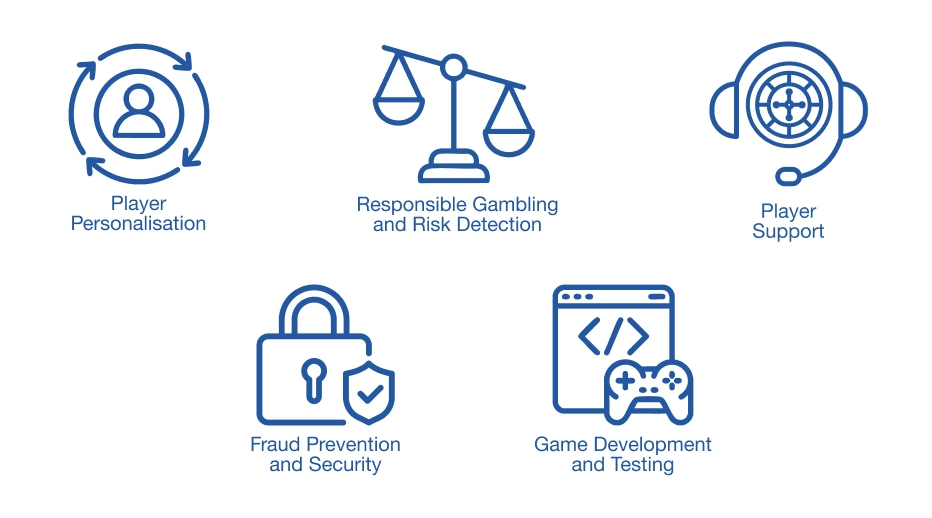
How online casinos are using AI in 2026
Casinos are implementing AI across a wide range of areas to improve efficiency and accuracy. Here are the key use cases:
Player personalization
AI can enable hyper-personalized user experiences by continuously analyzing gameplay behavior and activity. This allows casino providers to tailor game suggestions, bonus offers, and even site layouts to each user’s wants and needs in real time.
Responsible gambling and risk detection
AI tools can continuously monitor play patterns and betting behavior to identify and flag signs of problem gambling. When these systems detect risk markers, they can trigger automated interventions, such as safer gambling messages, deposit limit prompts, or referrals to a human safer gambling team. Self-exclusion itself remains a tool that players choose to activate.
This proactive, automated intervention can help detect problem behaviors much more quickly than the traditional method of manual activity checks. AI risk detection can also help operators comply with stricter responsible gambling requirements by producing audit trails and intervention logs.
In Great Britain, for example, the Gambling Commission’s customer interaction rules, in force since September 2022, require remote operators to use automated processes to identify customers who may be at risk of harm.
Player support
AI-powered chatbots are already a standard feature at many online casinos, providing instant 24/7 assistance in multiple languages. They reduce demand on human support teams by directing players to the right help pages, and they can escalate issues to human agents when necessary.
Under the EU AI Act, from August 2, 2026, operators serving EU players must make sure users know when they are interacting with an AI system rather than a human.
Fraud prevention and security
Operators can now use AI to help them combat fraud and meet anti-money laundering (AML) obligations. Automated analysis of typing speed and click patterns helps detect bot behavior or account sharing.
Operators can also partly automate Know Your Customer (KYC) checks, using AI to read documents and verify player identities. The system can instantly flag any suspicious transaction patterns for human review.
Game development and testing
Game studios use AI for feature testing, playability balancing, and modeling player retention. This helps them test game math, balance features, and model how players are likely to engage with a game before release, so they can tailor content to specific market segments.
iGaming software providers currently using AI
The following AI implementations show how quickly the industry is adopting these technologies to improve player experiences, responsible gambling, and operational efficiency.
Play'n GO
Play'n GO has publicly stated that it integrates AI into its game development processes to increase content output and efficiency, provided this does not compromise game quality. The company expects AI to keep transforming game production at an increasing pace.
Playtech
Playtech acquired responsible gambling analytics company BetBuddy in 2018 and integrated its behavioral identification technology into its Playtech Protect suite. By analyzing player activity, the system recognizes patterns that indicate potential harm, enabling timely interventions and support.
Pragmatic Play
In 2024, Pragmatic Play selected Optimove’s AI-powered Opti-X platform to deliver real-time personalized player experiences across its operator portfolio. This includes tailored game recommendations, dynamic content widgets, and AI-driven search to boost engagement, retention, and lifetime value across its operator portfolio.
Evolution Group
In a 2024 interview with Cyber Magazine, Evolution’s Chief Information Security Officer, Janis Lasmanis, said the company already uses AI to strengthen its cybersecurity, while carefully evaluating new AI and machine learning (ML) tools before wider adoption. Evolution aggregates and analyzes logs across its technology stack to detect anomalies that could signal security incidents, fraud, or cheating, and expects AI and ML to play a key role in improving its threat detection capabilities. The company also says it audits and monitors its AI models to prevent biased or unfair outcomes.
The potential pitfalls of AI integration
While AI is becoming an integral part of online casino operations, it’s important to acknowledge that the technology still has limitations.
As with any rapidly evolving technology, poor implementation or overreliance can lead to significant challenges, especially in a highly regulated industry like iGaming.
Hallucinations and inaccuracies
Generative AI models are known to produce “hallucinations.” These are outputs that appear accurate but are factually incorrect or misleading. In customer service, this can lead chatbots to give players false information.
In compliance or risk management, these errors can have major implications and may expose operators to regulatory breaches.
Lack of clear accountability
When an AI system makes a decision, such as flagging a player for potential fraud or suspending a bonus offer, questions of accountability arise. Who is responsible if the system gets it wrong?
Without clear human oversight and audit trails, AI-driven decisions can create gray areas for both compliance and customer trust.
Growing regulatory exposure
AI use in gambling is also coming under direct regulatory scrutiny. In the EU, the AI Act has prohibited AI systems that use manipulative techniques or exploit people’s vulnerabilities to distort their behavior since February 2025, which is directly relevant to personalized offers and bonus targeting. Transparency obligations, including informing users when they interact with an AI system, apply from August 2, 2026. Operators therefore need to be able to explain and justify how their AI tools reach decisions.
Creating more work
Ironically, poorly integrated AI can increase workloads instead of reducing them as intended. Systems that require frequent manual checks, corrections, or double-handling can create operational inefficiencies.
If AI tools are not properly trained or aligned with internal rules, teams may end up spending more time fixing mistakes than benefiting from automation.
Long-term AI features vs. trends
| Sustainable AI Use Cases | Short-Term Trends and Gimmicks |
|---|---|
| AI-assisted fraud detection and anti-money laundering (AML) | Generative AI for storytelling is not yet widely adopted or proven in gaming environments |
| Responsible gambling monitoring and intervention | Virtual AI dealers currently seem more like an experimental novelty than a true substitute for human live casino hosts |
| UX personalization and recommendation engines | Auto-generated marketing content often misses brand voice and compliance requirements without human oversight |
| AI-driven customer segmentation and bonus optimization | AI-branded features with limited measurable business or compliance impact |
| Regulatory reporting with AI-generated data logs | AI implementations that lack clear compliance, risk-management, or operational use cases |
Is AI a win for online casino players?
As artificial intelligence becomes a larger part of the online casino experience, its impact on players isn’t entirely clear-cut. While AI has the potential to enhance gameplay, support, and safety, it also raises valid concerns about fairness, transparency, and responsible play.
Here’s a quick breakdown of the current pros and cons of AI in iGaming:
Pros of AI in iGaming
- Personalized game suggestions and offers can make play more enjoyable.
- Real-time monitoring tools help promote responsible gambling and safer play.
- AI chatbots provide instant, 24/7 multilingual player support.
Cons of AI in iGaming
- Decisions made by algorithms can seem impersonal or opaque.
- Poorly planned implementation can lead to inconsistent decisions or non-compliant practices.
- Over-personalization risks nudging players toward spending more than they can afford.
Conclusion: Building a sustainable AI strategy for online casinos
AI is no longer a futuristic concept but a foundational technology that is rapidly shaping how online casinos attract, retain, and protect players.
Many successful operators already use AI as a competitive advantage. From streamlining player support to powering personalized experiences and supporting regulatory compliance, artificial intelligence is helping them build smarter, safer, and more profitable platforms.
Whether you’re launching your first online casino or looking to scale your existing operation, AI can be a strong enabler if you use it responsibly and build in human oversight. Best practice is to focus on proven use cases that deliver measurable value and to be cautious of trend-driven gimmicks.
Ultimately, operators that integrate AI with care, clarity, and a player-first mindset will be best positioned to thrive in the fast-changing iGaming landscape.
Popular blog posts