

One API, thousands of games — and still months of engineering work per provider

Updated 28 May 2026•Published 28 May 2026
Key takeaways
- The single-API promise is technically true, yet provider-specific behaviors still persist beneath every aggregation layer.
- An aggregator's real value lies in standardizing provider behavior, not in the headline game count.
- Callbacks, bonuses, jackpots, currencies, reporting, and jurisdictional filtering can all vary significantly between individual studios.
- Thin abstraction leaves operators maintaining provider-specific exceptions for years, despite marketing that promises effortless integration.
- Strong abstraction standardizes core infrastructure while preserving operator configurability across RTP, campaigns, and market deployment.
- The true cost of aggregation surfaces over years of scaling, not during the initial integration.
- Rigorous evaluation questions about callbacks, reporting, and engineering workload separate genuine standardization from thin aggregation.
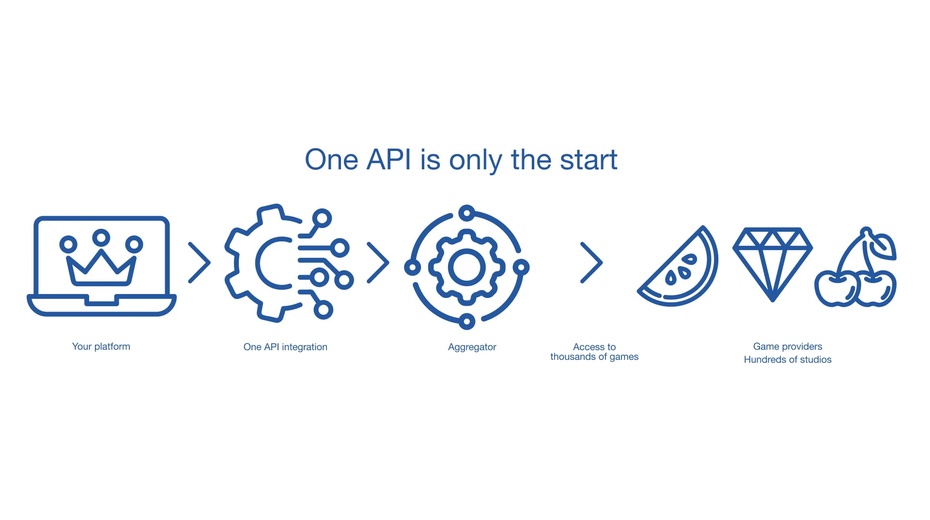
"One API integration. Thousands of games." That line has carried casino game aggregation marketing for years.
And technically, it holds up. A modern aggregator really can hand operators access to thousands of titles through a single connection point, sparing them direct integrations with dozens of individual studios.
What the headline conveniently skips is the complexity underneath. Provider-specific behaviors don't evaporate just because they now flow through an API. Bonus features, callback processes, session handling, reporting formats, jackpot logic, certification scope, even reconciliation timing — all of it can still differ substantially from one studio to the next. The question is whether the aggregator resolves those provider-level differences internally or quietly hands them to the operator's platform team.
In 2026, that distinction counts for far more than the headline game count. A modern aggregator isn't valuable simply because it connects many providers. Its real job is to normalize hundreds of provider-specific behaviors into something operationally manageable — without stripping away the configurability operators still need at game and studio level.
Where the aggregator fails to handle those differences properly, the operator's engineering team eventually pays the bill.
The single API promise: true, but not the full story
From a platform standpoint, a casino game aggregator genuinely simplifies integration architecture. Rather than maintaining dozens of direct studio connections, operators integrate one API that launches games, handles wallet interactions, processes transactions, and distributes content from multiple providers.
The simplification is real. The operational logic beneath the surface, however, can vary considerably between platforms.
Two games from different studios might look near-identical in a casino lobby yet behave very differently once real-money play begins. Session expiry rules, rollback handling, free rounds logic, wallet interaction, currency support, bonus eligibility, RTP configuration options, and reporting schemas aren't always implemented consistently across providers.
For operators, aggregation therefore isn't merely about connecting content. It's about managing operational consistency across hundreds — sometimes thousands — of provider-specific behaviors.
That's where aggregation quality becomes commercially significant. The real value of casino game aggregation lies less in the connection and more in how effectively provider behavior is standardized. Strong standardization lets operators judge new studios on commercial fit rather than technical complexity. Without proper abstraction — standardization and management — every added provider can gradually inflate engineering workload instead of shrinking it.
Inside the modern aggregator API
A modern aggregator API does far more than launch games from multiple studios through a shared connection point. Beneath the integration sits a substantial body of operational logic that must hold stable across providers, jurisdictions, currencies, and promotional systems.
Operators aren't just integrating content libraries. They're integrating transactional behavior, compliance logic, reporting processors, and promotional workflows that must run consistently across hundreds or thousands of games:
- Game launch and authentication — launch URLs, token validation, reconnect behavior, and session recovery can differ markedly between providers.
- Bet and win processing — transaction sequencing, rollback handling, and balance reconciliation aren't implemented identically across studios.
- Free spins and bonus features — wagering logic, expiration rules, eligible game handling, and promotional triggers frequently vary by provider.
- Jackpot support — contribution tracking, payout reconciliation, and reporting schedules may follow different operational standards depending on the studio.
- Currency handling — exchange logic, supported denominations, rounding behavior, and crypto support can diverge considerably.
- Jurisdictional filtering — certification scope, restricted game lists, and market availability rarely line up perfectly across regions.
- Reporting and data feeds — transactional schemas, event timing, and reporting granularity are far from standardized between providers.
- Tournament and promotional tools — leaderboard logic, prize formats, and campaign configuration often demand provider-specific handling.
The key differences in aggregation quality
The table below shows where the main differences in provider quality sit — and what operators typically inherit when those differences aren't properly standardized at the aggregation level.
| Area | Provider differences | Operator impact |
|---|---|---|
| Callback handling | Event sequencing, rollback logic, transactional responses | Platform teams build provider-specific handling logic |
| Bonuses | Free rounds rules, wagering logic, and expiry handling | Promotional systems require studio-by-studio adjustments |
| RTP configuration | Jurisdictional RTP restrictions and provider support | Compliance and configuration management become disconnected |
| Certification scope | Market availability differs between providers | Launch timelines vary by region and supplier |
| Jackpot accounting | Contribution tracking and reconciliation timing | Finance and reporting workflows become inconsistent |
| Reporting feeds | Different schema structures and reporting granularity | Internal reporting requires ongoing mapping and adjustment |
| Tournament tools | Leaderboard logic and campaign functionality vary | Promotional execution becomes harder to standardize |
| Currency handling | Rounding logic, denomination support, crypto compatibility | Wallet and reconciliation complexity increases |
Thin aggregation vs real abstraction
The commercial gap between aggregation platforms shows most clearly through abstraction — meaning the degree to which the aggregator hides, standardizes, and manages underlying provider complexity on the operator's behalf. It is a distinction the industry has increasingly come to treat as the real differentiator between platforms that otherwise look alike.
Two operators can integrate platforms marketed around the identical promise: one API connection, access to thousands of games. On paper, the infrastructure looks the same. How the operational reality evolves behind those integrations, though, depends entirely on how well provider behavior is standardized inside the aggregation layer.
The contrast becomes obvious when thin aggregation is set against strong abstraction.
Example 1: thin abstraction
An operator integrates an aggregator promoted as "single API, 5,000+ games." Onboarding initially seems easy — every new studio appears just a configuration toggle away from going live. In practice, each provider rollout still swallows weeks of engineering. Callback signatures vary, reporting fields aren't fully standardized, bonus campaign features differ between studios, and jackpot reconciliation demands provider-specific handling. Two years on, the platform team is still maintaining operational exceptions across large chunks of the catalog, and launching new providers still feels uncomfortably close to a direct integration project.
Example 2: strong abstraction
Deep abstraction produces a very different outcome. Callbacks, reporting, transactional logic, free rounds handling, and bonus systems are standardized behind the aggregation layer, while operators keep the configurability they need at provider and game level. RTP variants, jurisdictional restrictions, and studio-specific promotional tooling stay manageable — without adding fresh engineering dependency every time a provider joins.
And that difference compounds. The true cost of aggregation isn't measured at initial integration. It surfaces over the months and years that follow, as operators scale providers, enter new jurisdictions, expand promotional activity, and keep building on top of the platform.
What a good aggregation model looks like
A strong aggregation model doesn't try to erase provider individuality. Its purpose is operational consistency with flexibility preserved at provider, game, and market level.
That usually begins with standardization across the core infrastructure operators rely on daily:
- Unified callback structures — transactional events, rollback handling, and response sequencing behave consistently across providers, cutting provider-specific engineering logic.
- Normalized reporting feeds — reporting schemas follow one consistent structure, simplifying reconciliation, analytics, and operational monitoring.
- Centralized bonus handling — free rounds, wagering systems, and bonus campaign logic run through a shared framework rather than separate per-provider configuration.
- Standardized wallet behavior — balance handling, transactional sequencing, and session interaction stay predictable across the wider game catalog.
- Built-in jurisdiction controls — market restrictions, certification filtering, and regional game availability are managed centrally across providers.
- Consistent reconciliation logic — jackpot accounting, settlement timing, and transactional reporting follow stable operational workflows.
At the same time, strong standardization shouldn't strip out the configurability operators still need for commercial reasons. Flexibility often remains essential in areas such as:
- RTP selection — adapting game configurations to regional, regulatory, or commercial requirements.
- Provider-specific campaigns — supporting studio-led promotions that exist nowhere else in the catalog.
- Studio-level configuration — managing providers differently based on market strategy or performance.
- Market-by-market deployment — controlling provider and game availability per jurisdiction.
- Bespoke promotional tooling — supporting tournaments, jackpots, or campaign structures built for specific audiences.
The strongest aggregation platforms standardize infrastructure without forcing operators into a rigid content model. The goal isn't to make every provider behave identically — it's to make provider complexity manageable while preserving the flexibility operators need to differentiate their product.
Questions operators should ask before choosing a game aggregator
Comparing aggregation platforms can feel futile: the same studio logos, similar game counts, identical "single API" messaging. On the surface, many look interchangeable.
That's exactly why due diligence matters. Weak aggregation capability can generate years of operational overhead after launch, especially as providers, jurisdictions, and promotional systems keep expanding. A strong platform reduces operational complexity as providers scale — rather than shifting more of it onto the operator's own engineering teams. Infrastructure evaluation has become every bit as important as catalog size or provider count.
Among the most important questions to ask during evaluation:
For many operators, these questions grow far more important over time than the initial integration ever was.
To help operators evaluate aggregation platforms more effectively, we've created a downloadable Casino aggregator evaluation checklist covering the key technical, operational, and commercial questions operators should ask before selecting a provider.
Casino aggregator evaluation checklist
How Agreegain approaches aggregation
One of the more interesting shifts underway in casino game aggregation is that operators are starting to look hard at the operational reality behind the integration.
A few years back, catalog size dominated the conversation. How many providers? How many games? How fast can content go live? Those questions still matter — but they reveal little about what day-to-day platform management will look like further down the line, particularly for operators scaling providers across multiple markets.
New markets bring different certification requirements. Promotional systems grow more sophisticated. Regional configuration gets more granular. Internal reporting demands evolve. Gradually, the aggregation environment stops being seen purely as a content gateway and becomes part of the operator's broader operational infrastructure.
That's where consistency beneath the platform starts to count. Agreegain's approach to casino game aggregation is built around exactly that operational reality. The focus isn't simply connecting providers through a shared API — it's creating a structure that stays manageable as providers, jurisdictions, and commercial requirements scale over time.
Crucially, that doesn't mean sacrificing flexibility. Operators still need room to configure providers differently, adapt to regional requirements, and manage promotional strategies at market level — without turning every change into a fresh engineering project.
Popular blog posts