

Google Ads for casinos: What actually changed in 2025

Updated 9 Jun 2026•Published 9 Jun 2026
Key takeaways
- Google Ads remains viable for casinos in regulated markets, despite the assumption that gambling is banned.
- Recent changes bring tighter categorization, market boundaries, and scrutiny rather than any new advertising permissions.
- Certification is market-specific and URL-specific, so approval in one jurisdiction never transfers to another.
- Sweepstakes casinos are now excluded from social casino certification and assessed under online gambling rules.
- Certification confirms eligibility only; every campaign, creative, and landing page still faces Google's standard review.
- Landing pages, bonus wording, geo-targeting, and responsible gambling placement cause most compliance problems after launch.
- SEO, Bing Ads, and direct partnerships diversify acquisition when Google's enforcement proves unpredictable or restrictive.
Few acquisition channels are as misunderstood by online casino operators as Google Ads — largely because of the blanket assumption that gambling simply isn't allowed there. Yet despite long-standing restrictions, the channel still matters in regulated markets, where paid search visibility shapes brand discovery and competitive positioning. The real question is where, how, and under which conditions operators can realistically use it.
Over the past 12–18 months, Google has rolled out a series of structural adjustments to how casino advertising is assessed and enforced. The shift isn't about new permissions. It's about tighter categorization, defined market boundaries, and closer scrutiny of advertiser behavior. Certification rules are more explicit, gray areas such as sweepstakes have been clarified, and approval increasingly reflects track record and market-specific compliance.
For casino operators, the compliance landscape has moved — and past experience is no longer a dependable guide. Approval in one jurisdiction doesn't carry over to another. Certification isn't a one-off exercise. And policy compliance now stretches well beyond ad copy into landing pages, domains, account structure, and long-term conduct.
This article unpacks what has genuinely changed, how Google's current gambling advertising framework operates in practice, and what online casino brands should weigh when deciding whether Google Ads still earns a place in their wider customer acquisition strategy.
Disclaimer
This information is not intended to be legal advice and is drawn solely from open sources. It should not be relied upon as a substitute for professional legal advice, and Agreegain accepts no liability for its use.
Google's gambling advertising policies in 2025
Google's stance on gambling ads in 2025 didn't get looser or stricter — it got more structured. Clearer categories, focused country rules, and tighter checks around certification, landing pages, and targeting. For operators, compliance is now a chain of linked checks: who you are, where you're licensed, what you're promoting, where you're targeting — ending at the landing page itself.
The policy category that governs online casino ads
Casino campaigns are reviewed under the same policy structure Google applies to all real-money gambling products — typically covering casino (table) games, slot machines, online casino games, bingo, and, in many markets, other gambling products grouped under the same umbrella.
Crucially, Google doesn't grant a generic global permission. It runs a market-specific permission model, and the country-specific requirements section of Google's Understanding the Gambling and Games Policy page sets out which products each jurisdiction allows and what licensing or approvals apply. In practice, the same casino product can be entirely legitimate in one country and still ineligible for ads in another — before ad copy or bonuses even enter the picture.
Approved countries + certification
Google leads with three baseline requirements for gambling ads:
- Target only approved countries.
- Use a landing page displaying responsible gambling information.
- Do not target minors.
Then comes the operational layer: certification. Google requires advertisers to apply for certification for certain gambling-related ads, and campaigns can be disapproved or limited depending on the countries targeted and whether the advertiser holds the right certification for those locations.
Two details operators routinely miss:
- Separate applications are needed per country if you want to target more than one.
- If a campaign targets both allowed and disallowed countries, Google may mark the ads "Eligible (limited)" and restrict where they run.
Country rules are not the fine print — they define eligibility
The country table is the center of gravity for the entire topic. It doesn't stop at "licensed operators only." It frequently goes further, with requirements that hit casino advertising directly:
- Licensing or registration with a regulator that's often named explicitly.
- Domain rules — some jurisdictions demand a local domain.
- Mandatory warnings and/or assistance information on the landing page (sometimes in creatives too).
- Tighter sub-rules within a market — the US, for example, spells out state licensing and targeting constraints.
Landing pages are part of the compliance review
Google explicitly folds landing pages into eligibility. Responsible gambling information must be displayed, and certain jurisdictions demand specific warning language and help or assistance references.
This matters because many problems that look like "copy issues" are really destination issues:
- The warning exists but isn't visible or accessible enough.
- Localization mismatches suggest cross-border promotion.
- Page content implies availability in places you're not certified to target.
Google also links country requirements directly to the landing page operator — who runs the destination and what licensing status they hold.
Targeting rules: minors and location boundaries
Here Google is transparent: no targeting minors, and only approved locations. Beyond that, country requirements can layer on stricter targeting expectations — the US section illustrates this, detailing state boundary constraints, age restrictions, and expectations for warning and assistance information.
The practical takeaway for casino campaigns: geo-targeting is a compliance control. Get it wrong and you limit delivery — or put the whole account at risk.
Certification is tied to specific URLs (and Google enforces that)
One of the most frequent failures in casino campaigns is a mismatch between URL and certificate. Google states that certification is limited to the specific website submitted in the application, and ads must use that approved website. A mismatched final URL triggers disapprovals under "URL does not match gambling certificate," and the only fixes are using the approved URL or filing a fresh application for the other site.
This bites hardest for:
- Multi-brand groups
- Country-specific domains
- Mirrored landing pages
- Migrations and platform rebrands
Channel and format limits
Even when certified and targeting correctly, format eligibility varies. Google lists formats that cannot promote gambling — including Gmail ads and Shopping ads — with further constraints on specific placements. That doesn't make casino advertising "Search-only," but channel planning has to start from the fact that some placements are structurally off-limits.
New rules for sweepstakes and social casinos
Few corners of Google's gambling policy have generated as much confusion recently as sweepstakes and social casinos. For years these products sat in a middle ground: often legal locally, marketed as "not gambling," and widely used as a paid acquisition workaround. Over the past 12–18 months, that ambiguity has been cleared up.
Why sweepstakes models came under scrutiny
Sweepstakes-style casino products spread quickly because they appeared to sidestep the two biggest Google Ads barriers — real-money wagering and gambling licenses. In practice, many replicated core casino formats: slots-style gameplay, prize pools, and reward structures exchangeable for items with real-world value. For Google, that created a categorization problem — ads approved under social casino rules for products behaving like online casinos. The mismatch drew the scrutiny.
How Google now distinguishes sweepstakes from social casinos
The Gambling and Games policy now makes the distinction explicit. Sweepstakes casinos are not classed as social casino games and cannot obtain social casino certification. Games offering the chance to win items or rewards with real-world value fall outside the social casino category and are assessed under Google's online gambling framework, where eligibility rests on country rules and certification.
That matters because social casino advertising follows a lighter approval path. Sweepstakes platforms that leaned on it now face far higher odds of rejection or account review if the product hints at real-world value or monetization beyond purely simulated play.
Where operators are still getting flagged or banned
Even with clearer wording, enforcement issues persist. The most common triggers:
- Product features implying value transfer, redemption, or prize conversion.
- Landing pages describing rewards in ways Google reads as having real-world value.
- Messaging that differs between ad copy and on-site explanations of the product.
- Certification mismatches — applying under one category while the product is assessed under another.
Enforcement rarely hinges on intent. It hinges on classification: if Google decides a product behaves like online gambling, it's treated as such, whatever the label says.
Why legal doesn't equal ad-compliant
This is where confusion peaks. A sweepstakes or social-style product can be legal to operate in a market and still be ineligible for Google Ads there. Google applies its own advertising rules, independent of gambling legislation. As its policy makes clear, eligibility flows from categorization, approved countries, and appropriate certification — not local legality alone.
The broader lesson for casino groups: gray-area products no longer get generous readings. The lines between social casino, sweepstakes, and real-money gambling are sharper, and attempts to straddle categories carry a higher risk of rejection, suspension, or account-level scrutiny.
How gambling ad certification works on Google
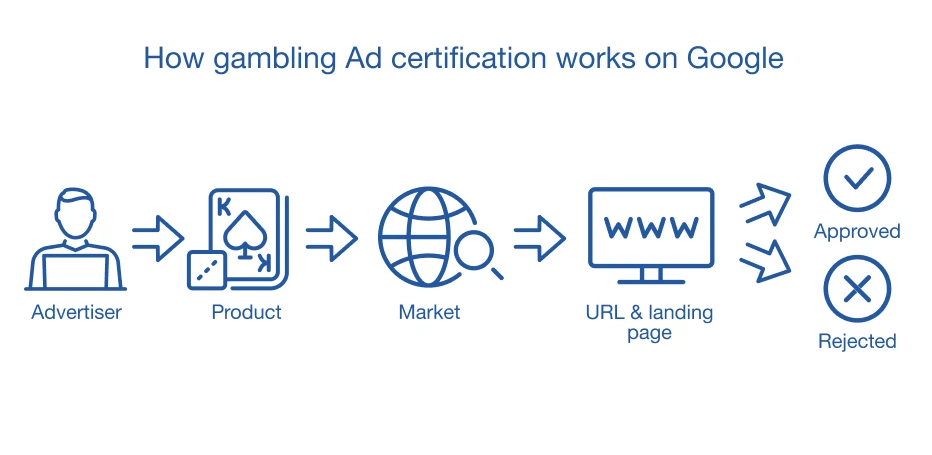
Certification is where Google's general policy becomes practical eligibility. It's neither a rubber stamp nor a one-time event — it's a controlled approval process tied to specific products, markets, and URLs, and enforced as such.
What Google actually checks during certification
Three things, fundamentally:
- Who the advertiser is — the legal entity behind the site, ownership of the advertised domain, and whether the operator holds the right license or authorization for the target market.
- What is being promoted — whether the product fits the applied-for category; for online casinos, that means casino games and related products under the online gambling category.
- Where ads will run — certification is country-specific. Multiple markets require separate approvals, and eligibility is limited to jurisdictions listed as permitted in Google's country table.
Equally important: certification attaches to the exact website URL in the application. Ads pointing to other domains, mirrors, or alternative landing pages sit outside the certificate and are commonly disapproved.
Common reasons certification fails
- Category mismatch — applying under the wrong category (social casino instead of online gambling, say) when the product's design suggests otherwise.
- Licensing gaps or unclear documentation — the license doesn't clearly cover the advertised activity or jurisdiction, or supporting material contradicts the application.
- Domain and control issues — certification isn't granted for sites hosted on third-party platforms or domains outside the advertiser's control; multi-brand groups stumble here often.
- Inconsistent product presentation — differences between the application, ad copy, and landing page can trigger rejection or review.
These failures are rarely about minor wording. They're about structural alignment between product, license, market, and destination.
Why certification does not equal campaign approval
A crucial distinction: certification confirms an advertiser may run gambling ads in a market. It guarantees nothing about any specific campaign, keyword set, creative, or landing page. Every ad still passes through Google's standard review, which checks:
- Ad copy and claims.
- Landing page content and visibility of required information.
- Geo-targeting and audience settings.
- Consistency with the certified URL and market scope.
So it's perfectly possible to hold a valid certificate and still watch ads get rejected, limited, or paused — especially when campaigns are scaled or adjusted.
Casino vs sportsbook vs hybrid platforms
Google groups these under broader gambling rules, but assessment differs in practice:
- Online casino platforms — certification usually covers casino products alone, with scrutiny on game type, monetization, and market eligibility.
- Sportsbook operators — same online gambling framework, but often with extra market-specific rules around event types and regulatory oversight.
- Hybrid platforms (casino + sportsbook) — these demand extra care. Certification, landing pages, and messaging must align clearly with what's promoted; mixing casino and sportsbook content in one campaign or destination page invites review trouble if the certification scope is unclear.
For multi-vertical platforms, separation and clarity are essential.
The practical takeaway for casino operators
Certification must stay aligned with:
- The product being promoted.
- The markets being targeted.
- The domains and landing pages in use.
- How campaigns are structured and scaled.
Market-by-market reality
Among the costliest assumptions operators make is that Google Ads approval scales internationally. It doesn't. Certification is jurisdiction-specific, and approval in one market says nothing about eligibility in another.
Regulatory interpretation is the first reason. The same gambling license can be treated very differently depending on the target country — some regulators are named explicitly in Google's country requirements, others aren't. An operator can be fully licensed and locally compliant yet find Google won't accept that license for advertising in another market, reflecting Google's own risk thresholds and approval framework.
Localization adds complexity. Legally accurate translated content can still trigger reviews if terminology, bonus descriptions, or responsible gambling references miss local expectations.
Geo-targeting is the third trap. Ads inadvertently reaching non-approved regions can flag accounts for closer scrutiny — often during campaign expansions, shared account setups, or broad targeting strategies built without compliance in mind.
For multi-market growth, the takeaway is blunt: each jurisdiction must be assessed, prepared, and certified on its own terms before spending — not after.
Key considerations for compliant gambling ads
Even with certification secured, most problems surface in execution — usually discovered only after ads are limited, rejected, or suppressed.
- Landing page structure — compliance elements must be clear and accessible. Responsible gambling information should be visible without excessive navigation, and page content must match the certified market, product, and domain precisely. Cosmetic changes and dynamic content can quietly introduce inconsistencies.
- Bonus language and incentives — promotional wording gets close scrutiny. Phrases implying guaranteed outcomes, risk-free play, or unclear conditions can trigger rejections even when legally permitted. Restraint outperforms aggressive acquisition language.
- Responsible gambling placement — RG messaging existing isn't enough. Placement, prominence, and relevance count. Warnings that are buried, generic, or mismatched to the target market may fail review standards.
- Geo-targeting mismatches — campaign settings, ad copy, and landing pages must all describe the same geographic reality. Currency, language, or regulatory references that clash with targeting parameters invite further review.
- Payment and KYC signals — payment methods, age verification, and onboarding flows feed into risk assessment. Incomplete or inconsistent information can undermine otherwise compliant campaigns.
The problems of running gambling ads on Google
Even a licensed, certified, seemingly compliant casino can find Google Ads unpredictable.
Sudden account disruption tops the list. Ads get paused, limited, or rejected with little warning — often triggered by routine changes like new landing pages or localization updates — and the explanation offered is frequently minimal, leaving teams to diagnose through trial and error.
Inconsistent enforcement is the second frustration. Similar ads may clear review in one market and fail in another, or pass one week and fall the next. Automated review systems drive much of this, and decisions rarely come with clear, actionable feedback.
The appeals process brings its own headaches: reviews take time, outcomes are uncertain, and resubmitting ads without meaningful changes can escalate risk rather than resolve it. For operators launching or scaling fast, delays can materially derail acquisition plans.
And scaling stays hard even after approval. Expanding keywords, testing creatives, or adding markets frequently reopens compliance scrutiny. Certification grants eligibility — sustained delivery depends on keeping campaigns, domains, content, and targeting aligned over time.
Alternatives to Google Ads for gaming brands
Google Ads shouldn't be the whole acquisition strategy — and for established casino brands, it rarely is. They spread the risk, treating it as one channel among several, balancing paid reach with longer-term visibility and direct partnerships.
SEO
Search engine optimization remains one of the most dependable acquisition channels for online casinos, particularly in regulated markets. Results take time, but well-structured content, solid technical foundations, and market-specific pages compound in value. Unlike paid search, SEO performance isn't reset by policy changes — a stabilizing force in multi-market strategies.
Bing Ads
Bing Ads runs on its own policies and enforcement patterns, which many operators find more predictable than Google's. Volumes are lower, but approval processes can be clearer and more transparent, and competition is often lighter. For some markets, Bing works as a testing ground or complementary paid search channel.
Paid media partnerships and direct placements
Direct relationships with publishers, affiliates, and media partners let operators reach audiences without depending on automated ad reviews. They demand stronger oversight and clear commercial terms, but can deliver consistency and scale when platform-based advertising tightens.
| Channel | Approval & compliance | Speed to launch | Scalability | Long-term value |
|---|---|---|---|---|
| Google Ads | High. Certification, country restrictions, landing page scrutiny, and ongoing reviews apply. | Moderate. Initial setup can be slow due to approvals. | Conditional. Scaling often triggers re-reviews and limits. | Medium. Effective when stable, but sensitive to policy changes. |
| SEO | Low. Subject to search guidelines, but no ad certification. | Slow. Requires sustained investment before results appear. | High. Content and authority compound over time. | High. Traffic value persists without ongoing media spend. |
| Bing Ads | Medium. Policies apply, but enforcement is often more predictable. | Fast. Quicker than Google in many markets. | Moderate. Lower volume but easier to expand. | Medium. Useful as a complementary paid channel. |
| Direct media & partnerships | Variable. Driven by commercial agreements rather than automated reviews. | Moderate. Depends on negotiation and setup. | Medium. Scales through partner reach. | Medium to high. Strong relationships can deliver consistent traffic. |
The influence of platform design on marketing performance
Advertising performance isn't decided by media strategy alone. For iGaming operators in 2026, the underlying platform plays a decisive role in how smoothly campaigns run — whether driven by paid search, organic traffic, or anything else.
Practically, platform infrastructure shapes many of the signals advertising platforms look for. Clear domain ownership, stable URL structures, predictable landing pages, and consistent localization all reduce friction during ad reviews. Well-structured onboarding flows, transparent payment processing, and visible responsible gambling controls support both compliance and user trust across channels.
This is where platforms like Agreegain add value without attempting to game advertising policy. By giving operators control over how products, markets, and content are structured, the platform helps ensure what's promoted externally matches what's delivered on-site — an alignment that matters as much for SEO and partner traffic as for paid campaigns.
What no platform can do is influence how Google enforces its policies, when reviews trigger, or how decisions escalate. Those sit entirely beyond external control.
The difference is readiness. When technology, legal positioning, and marketing execution align, acquisition becomes more predictable — even in tightly regulated environments.
Disclaimer
This information is not intended to be legal advice and is drawn solely from open sources. It should not be relied upon as a substitute for professional legal advice, and Agreegain accepts no liability for its use.
Popular blog posts




.webp)