

PPC in online gambling: A tactical playbook for casino operators
.webp)
Updated 12 May 2026•Published 12 May 2026
Key takeaways
- PPC offers casinos measurable, scalable, and immediate acquisition, though clicks can cost between £20 and £40.
- Google Ads permits gambling only in approved territories, with certification, compliant landing pages, and no minors.
- Microsoft Ads provides lower costs and lighter competition, suiting older, higher-value desktop audiences in approved regions.
- Meta and TikTok rarely approve real-money ads, leaving social platforms for organic content and retargeting.
- Geo-modified, long-tail, and negative keywords control costs, while compliant copy highlights provable benefits over hyperbole.
- Conversion tracking through GTM and GA4, plus behavioral retargeting, turns spend into measurable player value.
- Native advertising, affiliate PPC, and programmatic display diversify acquisition when mainstream platforms restrict casino campaigns.
Pay-per-click (PPC) advertising can be a serious weapon for online casino operators — provided you know how to wield it. With high customer lifetime value (LTV) and brutal competition, visibility across search and display networks can translate into substantial revenue.
Unlike most industries, though, iGaming brands contend with complex restrictions, inflated costs, and platform-specific limitations. This guide covers what you need to run compliant, effective PPC campaigns for your online casino.
Why PPC matters for online casinos
PPC gives operators a direct, efficient route to player acquisition. It's measurable, scalable, and immediate — qualities SEO and organic content can't always match, however well executed.
Handled properly, PPC can:
- Generate high-intent traffic quickly — unlike broader brand campaigns, PPC ads reach users actively searching for real-money gaming experiences, making them far likelier to convert.
- Target specific demographics or geos — platforms like Google and Microsoft Ads support detailed targeting by location, age group, device type, even time of day, putting you in front of the right players at the right moment.
- Support promotions, launches, and reactivation — campaigns switch on and off instantly, perfect for time-sensitive offers, market entries, or re-engagement pushes aimed at former depositors.
- Deliver trackable ROI — with proper conversion tracking, you can measure cost per acquisition (CPA), player value, and long-term return on ad spend directly, enabling sharper budgeting and growth forecasting.
The stakes, however, are steep. Cost-per-click (CPC) for online casino terms ranks among the priciest in digital advertising, often topping £20 to £40 per click. Add strict ad policies and compliance rules that can derail campaigns or throttle reach, and a well-informed, well-executed PPC strategy stops being optional.
Where can you run PPC for online casinos?
Before launching anything, you need to know where you're permitted to advertise — and on what terms. Not every platform welcomes casino-based PPC promotion. Here's how the major players treat it and how to approach each:
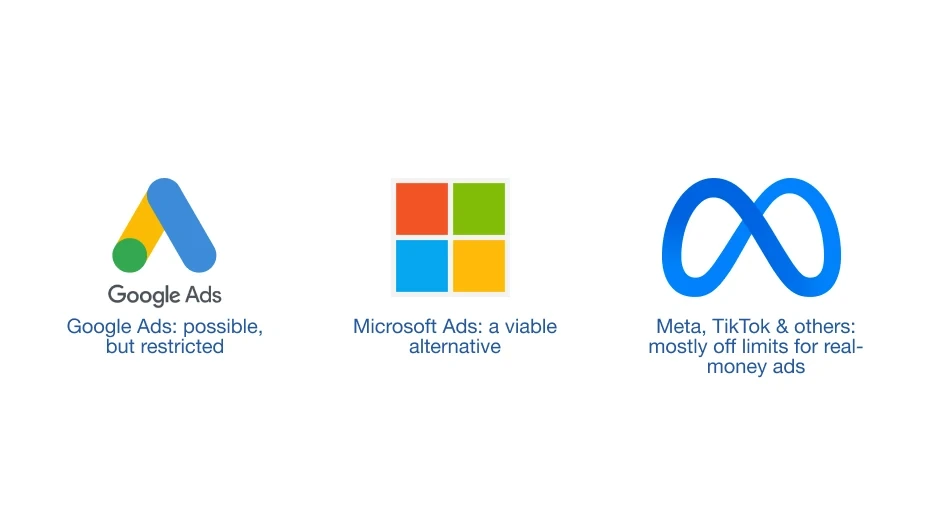
Google Ads: possible, but restricted
Google does permit real-money gambling ads, but only in select territories and only for certified advertisers. Operators must apply for a Gambling and Games license through Google Ads and ensure campaigns satisfy both Google's advertising policies and local gambling laws in every target market.
Key considerations before attempting a Google Ads campaign:
- Geo limitations — Google allows PPC gambling ads only in countries where it explicitly permits them, and operators must follow both Google's requirements and local legal advertising frameworks. Targeting restricted territories risks rejection or outright account suspension.
- Landing page compliance — pages must clearly display terms and conditions, licensing information, responsible gambling messages, and age restrictions. Google's reviewers often check sites manually; a landing page that falls short means ads that don't run.
- Excluding underage users — campaigns must never target minors, whether through audience exclusions or platform restrictions. Even accidental appearances of underage targeting can trigger policy violations and cost you Google Ads privileges.
- Avoid misleading claims — Google bans exaggerated language, deceptive calls-to-action, and references to unlicensed promotions. Phrases like "guaranteed win" or "best odds" get flagged unless clearly substantiated.
- Higher than average costs — gambling keywords are competitive and high-risk, so expect CPCs among the highest of any vertical. Campaign approvals can also drag, especially in new regions or when testing fresh creatives.
Microsoft Ads: a viable alternative
Microsoft Ads — formerly Bing Ads — also allows real-money gambling advertising under its own restrictions. Its reach trails Google's, but it makes a valuable secondary channel, particularly for testing campaigns in approved regions at lower CPC rates.
What to weigh before launching on Microsoft Ads:
- Geo limitations — like Google, Microsoft permits gambling ads only in approved countries, and campaigns must meet its gambling advertising policies alongside local law. That said, Microsoft's enforcement can be slightly gentler in certain regions, smoothing approvals.
- Lower CPCs and competition — with less competition than Google, similar keywords cost less, making Microsoft attractive for budget-conscious campaigns or for trialing creatives and targeting before scaling.
- Smaller reach, older demographics — Bing's audience is smaller and skews older than Google's. Total traffic suffers, but it suits targeting higher-value players who favor desktop devices and deposit larger amounts.
- Certification still required — operators must apply for approval to run gambling ads and meet guidelines on age restrictions, responsible gambling messaging, and accurate copy. Non-compliance brings disapproved ads or account flags.
- Opportunity for support and credits — Microsoft is known for direct advertiser support and occasional ad credit incentives, useful for smaller operators wanting hands-on optimization or budget extensions.
Meta, TikTok & others: mostly off limits for real-money ads
Meta (Facebook and Instagram), TikTok, and similar social networks are generally non-starters for promoting real-money gambling. Strict advertising policies — particularly around protecting minors — mean most operators find campaigns blocked unless they meet very narrow criteria.
What to know before considering these platforms:
Heavily restricted jurisdictions — real-money gambling ads run on Meta or TikTok in only a handful of countries, and only with prior approval. In most cases, your casino brand is automatically excluded from paid promotion unless you hold full certification and satisfy both local law and platform policy.
Youth protection policies — robust safeguards keep underage users away from gambling content. Ads must exclude under-18s and avoid imagery or tone appealing to younger audiences, such as cartoon characters or playful language.
Real-money ads rarely approved — even with full compliance, approval is elusive. Meta's ad review team errs firmly on the side of caution and appeals rarely succeed; TikTok is stricter still, with near-zero tolerance for gambling advertising outside tightly controlled test markets.
Alternative use cases — while real-money ads are nearly impossible, non-cash alternatives face fewer barriers:
- Social casino games — sites using virtual currency for entertainment, not real money.
- Sweepstakes casinos — operating under promotional law rather than gambling law, common in the US market.
- Responsible gambling or brand-awareness campaigns — promotions built on strong messaging rather than direct wagering.
Key operator takeaway: unless you operate in a rare approved territory with explicit platform permission, treat Meta, TikTok, and other social networks as channels for organic content and retargeting.
Build campaigns that convert and comply
With compliance settled, campaigns need laser focus — traffic is expensive, and platform exclusions or fines are a real risk.
Choose the right keywords
Keyword choice controls both cost and relevance. Broad, generic terms like "online casino" carry high CPCs and low conversion rates, especially against major iGaming brands. Refine your strategy:
- Use geo-modifiers — territory-specific keywords such as "UK casino bonus" or "legal casino site in Ontario" pull more qualified traffic and support geo-targeting compliance. Players searching these terms are usually closer to a deposit decision.
- Target branded competitor keywords — where permitted, bidding on competitor names like "alternative to Betway" intercepts high-intent users. Mind the rules, though: some search engines restrict trademarked terms in ad copy even where bidding is allowed.
- Focus on long-tail intent — phrases like "fast withdrawal slot sites" or "blackjack casino with £5 minimum" signal specific needs. Volume is lower, but conversion rates run higher thanks to clear intent.
- Use negative keywords — cut wasted spend by excluding terms like "free games", "demo slots", or "land-based casinos" where they don't fit your model. Refresh the list regularly from search term reports.
Write ad copy that balances compliance and urgency
Casino PPC copy walks a tightrope: standing out without triggering platform restrictions or sounding misleading. How to manage it:
- Avoid hyperbole or unverified claims — promises like "Best Casino with Guaranteed Wins!" or "Win Big Instantly" invite rejection. Lead instead with provable value: licensing, features, unique offers.
- Use clear, trustworthy messaging — a title like "Play Top Slots | Licensed UK Casino | 1000+ Games Available" signals legitimacy and value without breaching policy.
- Highlight real benefits — promote tangible differentiators such as game selection, fast withdrawals, 24/7 support, or optimized mobile UX.
Optimize your landing page
However sharp the ad, the landing page converts clicks into signups. To improve the odds:
- Display licensing and RG messaging — show your license number, regulator logo, and links to responsible gambling resources prominently. Essential for platform compliance and user trust alike.
- Match the ad promise — if the ad says "100 Free Spins", the page must reflect that offer instantly. Bait-and-switch inflates bounce rates and can trigger ad disapproval.
- Ensure speed and mobile responsiveness — slow or badly formatted mobile experiences kill conversions. Prioritize fast loading, mobile-first design, and clear information hierarchy over flourish.
- Feature a clean, intuitive CTA — calls to action like "Join Now", "Sign Up Securely", or "Claim Bonus" should be immediately visible and effortless to use.
- Use A/B testing — trial different headlines, layouts, button colors, and offers. Small changes compound into significant performance gains.
Track, measure, and scale
Casino PPC demands continuous optimization to maximize impact and protect your budget. This is never set-and-forget: real-time data is what lets you refine strategy and double down on what performs.
Set up conversion tracking
Accurately tracking player actions underpins every successful iGaming PPC campaign. Without it, you can't measure ROI or see which campaigns drive real value.
Use tag management tools — platforms like Google Tag Manager (GTM) and Google Analytics 4 (GA4) let you manage and monitor key player actions across your site with minimal disruption.
Track the right events:
- Registrations — know which campaigns or keywords drive new sign-ups.
- First deposits — monitor true acquisition performance, not just traffic volume.
- Total deposit value — track player value over time to spot high-LTV channels.
- Cost per acquisition (CPA) — understand what each new depositing player costs.
- Return on ad spend (ROAS) — calculate revenue generated per £1 spent.
Why it matters — with these metrics in place, you can identify which keywords, ad groups, geographies, or landing pages deliver the best ROI, then adjust bidding and budgets to match your PPC goals.
Segment and retarget
Most players won't deposit on their first visit. Smart segmentation and retargeting re-engage users who've already shown interest.
Create behavioral segments — group your audience by how far they progressed through the funnel and tailor ads accordingly:
- Abandoned sign-ups — target users who registered but never deposited with a personalized incentive or simplified onboarding.
- One-time depositors — nudge occasional players with time-sensitive promotions or loyalty offers to lift frequency.
- Lapsed high-value players — win back top-tier users with VIP perks, new game releases, or account-specific bonuses.
Use retargeting tools — the Google Display Network, Gmail Ads, and programmatic solutions serve tailored ads across the web. Make sure your consent management, cookie banners included, aligns with data privacy regulations such as the GDPR.
Takeaway for operators: retargeting lifts conversion rates by keeping your brand front of mind and pulling warm prospects back into the funnel — at a lower cost than acquiring fresh traffic.
Alternative paid channels for casino ads
If Google, Microsoft, or social platforms limit your options, other paid media strategies are worth exploring. The channels below diversify acquisition — often with fewer compliance hurdles or more targeting flexibility.
Native advertising
Native platforms like Taboola and Outbrain promote your casino content as sponsored stories across a broad network of high-traffic news and lifestyle sites. The ads mimic editorial content and sit in-feed, typically under headlines like "Top Casino Bonuses This Week" or "Best UK Slots Sites Revealed" — a format that builds trust, sparks curiosity, and performs particularly well for softer, top-of-funnel offers.
To get the most from native channels:
- Use advertorial-style landing pages — native ads perform best when the page mirrors editorial tone and layout. Storytelling and value beat hard sells for keeping bounce rates low and engagement high.
- Test multiple headlines and images — A/B test combinations of headlines, visuals, and calls to action; even small changes can swing click-through and conversion dramatically.
- Disclose paid content clearly — transparency builds trust. Labels like "Sponsored" or "Advertiser Content" keep you within ad guidelines; many platforms require them by default.
- Optimize for scale — once top creatives and placements emerge, scale gradually. Native platforms usually offer flexible budgeting and face fewer compliance hurdles than search or social.
Affiliate PPC
Some affiliates fund PPC campaigns driving traffic to your brand — you pay for the traffic or players they convert, not the ad spend itself. The model shifts advertising risk to the affiliate and opens new audiences without upfront cost.
Key considerations:
- Clear contract terms — specify whether affiliates may bid on branded keywords or replicate your exact ad copy.
- Brand protection — deploy affiliate monitoring tools to catch unauthorized trademark use or misleading messaging.
- Quality control — verify affiliates target only compliant geographies and use approved landing pages.
Done well, affiliate PPC complements internal efforts — especially in markets where your brand lacks visibility.
Programmatic display ads
Programmatic advertising uses demand-side platforms (DSPs) to buy display impressions across thousands of websites, targeting users by behavior, interests, and location. Unlike Google Ads or Meta, many programmatic platforms offer greater flexibility around gambling content, particularly in highly regulated markets.
Advantages of the approach:
- Advanced targeting — reach high-intent users based on browsing history, device type, or even time of day.
- Real-time optimization — algorithms adjust bidding on the fly according to ad performance.
- Retargeting capabilities — serve tailored ads to previous site visitors based on their funnel stage: signed up, deposited once, or merely browsed.
Work with a DSP experienced in iGaming and confirm which publishers accept gambling ads — otherwise wasted impressions and spend follow.
Build, optimize, repeat for PPC success
PPC is one of the most potent tools in your casino's acquisition arsenal — but only with surgical precision.
Between strict ad policies, sky-high CPCs, and ferocious competition, guesswork has no place. Success means knowing the rules cold, picking the right channels, writing ads that are compliant yet compelling, and tracking ROI obsessively.
Nail the fundamentals — platform compliance, smart targeting, high-converting landing pages — and you're positioned to scale profitably. Whether launching your first campaign or refining an existing one, PPC is a revenue engine waiting to be unlocked.
Popular blog posts