

Mexico raised its gambling tax to 50%. Is it now the most expensive major LATAM market?

Updated 10 Nov 2026•Published 10 Nov 2026
Key takeaways
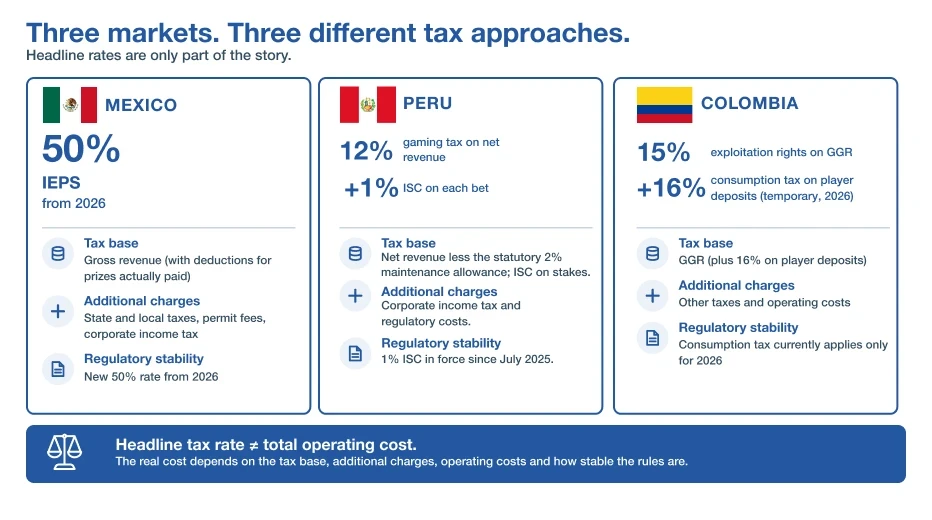
- Mexico has the highest headline gambling tax of the three markets: 50% IEPS from 2026, with deductions for prizes actually paid.
- Peru has the lowest headline rate of the three, a 12% gaming tax on net revenue, but adds a 1% tax on the value of each bet, which can raise its effective burden considerably.
- Colombia combines 15% exploitation rights with a temporary 16% national consumption tax. Both are calculated on GGR, giving a combined direct charge of around 31% of GGR, but the consumption tax was created under emergency powers and applies only for 2026.
- The lowest percentage does not automatically mean the lowest cost. The tax base, additional charges and the stability of the rules all matter. Brazil, which banned betting in September 2026, shows how quickly that stability can disappear.
Disclaimer
This information is not intended to be legal advice and is solely extracted from open sources. It should not be relied upon as a substitute for professional legal advice. Agreegain does not accept any liability for its use.
Since January 1, 2026, Mexico’s federal gambling tax has risen from 30% to 50%. For anyone looking at where to invest in Latin America, that’s a number that immediately jumps off the page.
And the comparison to other major markets in the region seems pretty straightforward on the surface. Peru’s online operators pay a 12% gaming tax. Colombia’s pay 15% in exploitation rights, plus a temporary consumption tax. On those numbers alone, Mexico looks like a much more expensive place to operate.
Except these numbers don’t tell the whole story. The percentage matters, of course, but so does what it is charged on, what other taxes and charges apply, and how often the rules change. Once you factor these in, the gap between the three markets can look very different.
More importantly, tax ultimately affects how much money you have left to acquire players, fund promotions, run the operation, and make a return. So, if you were deciding where to put your next LATAM investment today, would Mexico really be the most expensive of the three?
What does it actually cost to operate in each market?
Mexico IEPS: What is behind the 50% gambling tax rate?
Mexico’s 50% figure is real. On January 1, 2026, the federal IEPS rate on gambling and prize draws increased from 30% to 50%. But the headline doesn’t tell us what an operator ultimately pays.
Here are the features behind it:
- Headline rate (50% IEPS): Set out in Article 2, Section II(B) of the IEPS Law, this is the federal gambling tax and the number that attracts the most attention. The rate now explicitly applies to online betting, including operators based outside Mexico.
- When it changed: The increase was introduced by a decree published in the Diario Oficial de la Federación on November 7, 2025. The 2027 Economic Package does not propose a further change to the rate.
- What comes next: A draft of a new Federal Law on Games and Draws is under government review, so Mexico’s online gambling regulation and permit requirements may change even if the tax rate does not.
- What can reduce the calculation: Operators can deduct prizes actually paid to players. Promotions and similar incentives do not qualify as prizes.
- State and local taxes: Operators may also face locally imposed gambling taxes. However, qualifying state and local gambling taxes can be credited against the IEPS liability, up to 20% of the federal tax due.
- Federal permit costs: Gambling permits can require additional payments to the federal government. These depend on the activity and individual permit, rather than a single standard percentage for every operator.
- Corporate income tax: Remains separate from gambling-specific charges and must be considered when assessing the profitability of the business as a whole.
- Compliance: Legal operation also brings reporting, record-keeping, tax and anti-money-laundering requirements, adding costs that will never appear in the 50% headline.
Ultimately, Mexico’s new rate clearly makes the market more expensive. But it still doesn’t mean an operator simply hands over 50% and keeps the other half.
The more useful question, therefore, is what remains once you account for the relevant deductions, additional charges, and the costs of operating legally. That is the money available to run the business and ultimately make Mexico worth the investment.
Further information and tax guidance: Mexico’s SAT guidance on calculating IEPS for gambling and prize draws explains what enters the calculation and which prizes and refunds can be deducted.
Peru online gambling tax: Why 12% is not the whole bill
Peru starts with one of the lowest headline rates in the region. Licensed remote gaming and sports betting operators pay a 12% gaming tax on net revenue. The complication is a second tax that is charged on something else entirely.
Here are the main features:
- Headline rate: 12% gaming tax. Under Law 31557, as amended by Law 31806, operators pay 12% of monthly net income, after a deduction for platform maintenance costs. The tax applies to operators based in Peru and abroad.
- Selective Consumption Tax: Since 2025, a 1% Selective Consumption Tax (ISC) has also applied to the value of each bet. Because it is charged on stakes rather than revenue, its real weight depends on how much of each stake the operator retains.
- What that means in practice: If an operator retains around 10% of stakes as GGR, a 1% charge on stakes works out to roughly 10% of GGR. Industry analyses suggest the combined burden can approach 50% of GGR in some scenarios, particularly where operators absorb the tax on bonuses and promotions. The figures are illustrative, but they show why the tax base matters as much as the rate.
- Regulator and collection: MINCETUR licenses and supervises the market, while SUNAT administers the taxes.
- What comes next: Two opposing proposals are before Congress. One would change the ISC base, which the Ministry of Economy and Finance estimates could cut ISC revenue by 90 to 95%. The other would raise the ISC rate from 1% to 5% of each bet.
Peru therefore looks inexpensive on the headline percentage, but its stake-based tax can change the economics considerably, especially for operators that rely on high betting volumes and promotional activity. And because the two proposals point in opposite directions, the cost of operating in 2027 is still an open question.
Further information and tax guidance: Law 31557, Law 31806, Supreme Decree 005-2023-MINCETUR, Supreme Decree 008-2025-EF (ISC), SUNAT, MINCETUR.
Colombia online gambling tax: Why 15% is only half the story
Colombia starts with a familiar-looking number: licensed online operators generally pay exploitation rights equal to 15% of GGR. The issue is what has been added to that charge, and how quickly those additions have changed.
Here are the main features:
- Headline rate: 15% exploitation rights. For qualifying online games, this is calculated against GGR rather than player deposits.
- The 2025 change: In February 2025, Colombia temporarily introduced 19% VAT on online gambling deposits. This was fundamentally different because the tax was triggered when money entered the player’s account, before it was known how much gambling revenue it would generate.
- What happened next: The industry association Fecoljuegos reported that online GGR fell by around 30% after the introduction of VAT. The figure should be treated as an industry estimate, but it illustrates why the choice of tax base matters.
- The approach changed: At the end of December 2025, a new emergency decree (Decree 1474) set a 19% tax on online gambling. The Constitutional Court suspended it in January 2026 and later declared it unconstitutional, ordering indirect taxes collected under it to be refunded to those who bore them.
- Current additional tax: In March 2026, Decree 0240 introduced a 16% national consumption tax on games of chance operated exclusively online. The tax is triggered by player deposits, but it is calculated on GGR: total bets minus prizes paid in each two-month period. It applies only for 2026.
- Legal status: Decree 0240 was issued under a state of emergency that the Constitutional Court upheld only in part in June 2026. Each measure adopted under it is reviewed against the limits the Court set, and any measure that goes beyond them can still be struck down.
- What comes next: The government has also sought to move additional gambling taxation into ordinary legislation, meaning operators still need to watch what follows the temporary measures.
Colombia therefore presents a different risk from simply having a high rate. Changing the rate changes the cost. Changing what gets taxed can change the economics of the business.
Because both charges are calculated on GGR, Colombia’s direct burden is easier to compare than it first appears. Together, the 15% exploitation rights and the 16% consumption tax amount to around 31% of GGR, before the 1% administration fee paid to Coljuegos, corporate income tax and other costs. That is well below Mexico’s 50% headline rate. The more difficult question is not today’s figure, but whether it will still apply next year.
For an investor, repeated changes make forecasts, acquisition budgets and expected returns harder to rely on. Even when today’s cost can be calculated, the bigger question is how long that calculation will remain valid.
Further information: Decree 0240 of 2026 sets out the current 16% national consumption tax, Coljuegos publishes the rules for exploitation rights on online games, and the Constitutional Court’s ruling on the 2026 state of emergency explains the limits within which the emergency tax measures must operate.
Which LATAM market has the highest gambling tax in 2026?
Based on current tax structures, Mexico has the highest headline gambling tax of the three. Its 50% IEPS remains substantially higher than Colombia’s combined direct charges of around 31% of GGR, even after allowing for the deductions and credits available within the Mexican system. Peru sits at the other end on the headline rate. Its 12% gaming tax is the lowest of the three, but the 1% ISC on stakes means its effective burden depends heavily on each operator’s margins and promotional model, and in some scenarios may come much closer to Mexico’s than the headline suggests. Colombia is more difficult to place. Its direct burden is lower than Mexico’s, but its tax structure has been considerably less stable since 2025, and the current consumption tax is set to apply only for 2026.
| If you are comparing... | What the current picture suggests | Why |
|---|---|---|
| Direct gambling taxation | Mexico has the highest headline rate | 50% IEPS, compared with around 31% of GGR in Colombia and 12% plus 1% of stakes in Peru |
| Tax base | Peru is the only market taxing stakes | Mexico and Colombia tax revenue after prizes, while Peru adds a 1% ISC on the value of each bet |
| How long current rules apply | Mexico unchanged for 2027 so far; Colombia only to the end of 2026; Peru under review | No new IEPS rate is proposed for 2027; Colombia’s tax is temporary; two opposing ISC proposals are before Peru’s Congress |
| Room for acquisition and bonuses | It depends on the business model | Colombia’s GGR-based burden is lower than Mexico’s; Peru’s stake-based ISC weighs most on high-volume, bonus-heavy operators |
| Ability to forecast future tax costs | Mexico currently offers the clearest path | Its rate is set in law and no change is proposed for 2027 |
| Risk of the calculation changing | Colombia and Peru stand out | Colombia has changed its additional tax repeatedly since 2025; Peru’s Congress is considering both cutting and raising the ISC |
| Overall investment cost | No single percentage answers this | Tax is only one part of acquiring players, operating legally and generating an acceptable return |
Does Mexico’s 50% rate make it the most expensive market?
If we mean the highest headline gambling-tax rate, the evidence points toward Mexico. But that is not quite the same as saying Mexico will be the most expensive market for every operator.
A business with an established Mexican player base may reach a very different conclusion from a new entrant spending heavily on acquisition. Likewise, Peru’s low headline rate becomes less attractive for operators whose model depends on high betting volumes and bonuses. In contrast, Colombia’s economics become harder to value if investors cannot be confident that today’s tax structure will last.
Beyond the three: Brazil and Panama
Brazil: From a legislated tax schedule to a betting ban
Brazil would have been the obvious fourth market in this comparison. Its 13% GGR tax was the lowest of the major markets and already legislated to rise to 15% by 2028. On September 25, 2026, however, Provisional Measure 1,394/2026 banned fixed-odds betting and online casino games, and licensed operators went offline on October 6.
The measure has the force of law, but Congress has up to 120 days to approve, amend or reject it, and industry associations have challenged it at the Supreme Federal Court. On October 26, 2026, the rapporteur kept it in force and scheduled a public hearing for November 3. The hearing ended without a decision, and as of November 9, 2026 the ban remained in force, with neither Congress nor the Supreme Court having reached a final decision. For investors, Brazil is the clearest example of why a predictable tax schedule is not the same as a predictable market.
Panama: A smaller market with tighter online rules
Panama is a much smaller market, but its online segment is growing quickly. According to national statistics, online bets rose by almost 60% year over year in the first seven months of 2026, reaching around US$464 million.
Gaming is regulated by the Gaming Control Board (Junta de Control de Juegos) within the Ministry of Economy and Finance, which has allowed licensed online gaming within Panama since 2020. Law 527 of 2026 has tightened the rules further. It allows the regulator to order the blocking of unlicensed betting websites, prohibits gambling by anyone under 18 and requires biometric identity and age verification for online betting.
Panama is unlikely to change the headline comparison, but it shows how quickly compliance and verification requirements can become a casino platform issue rather than a purely legal one.
What should investors compare across LATAM gambling markets?
The comparison between Mexico, Colombia and Peru shows why the headline rate should only ever be one factor in a much broader comparison. Before deciding whether one market is more expensive or attractive than another, investors need to ask a broader set of questions:
- What does the tax apply to?
Taxing GGR, stakes or deposits can produce very different economics, even when the percentage looks similar. - What else does the operator pay?
Local taxes, permit costs, corporate taxes and mandatory contributions can materially change the overall burden. - What is left afterward?
How much remains for player acquisition, bonuses, payments, technology, operations and margin? - How much scale is needed?
A market can support profitable operators while still being difficult for a smaller or new entrant to make work. - How predictable are those costs?
Can a three-year investment case reasonably rely on today’s tax and regulatory assumptions? A legislated tax schedule does not guarantee that the activity itself will remain permitted. - What happens when the rules change?
New tax calculations, reporting requirements and regulatory obligations can create technology and operating costs as well as a larger tax bill. - Can your casino platform keep up?
A new tax base, reporting rule or verification requirement has to work in the wallet, payments and reporting logic before an operator can comply with it.
Ultimately, the most attractive market is not necessarily the one with the lowest percentage next to its name. What matters is the business you can build with what remains.
Frequently asked questions
When tax rules change, the casino platform has to follow
There is one final cost that doesn’t appear in a headline tax rate: the cost of implementing the rules. Peru and Colombia provide useful examples. Peru charges one tax on net revenue and another on the value of each bet, while Colombia has moved from VAT on deposits to a consumption tax that is triggered by deposits but calculated on GGR. Each change affects more than the amount an operator pays. The casino platform needs to identify the right transactions, apply the correct calculation and provide the information required for reporting.
Depending on the change, this can affect the wallet, payments, accounting logic and regulatory integrations. The same principle applies across regulated markets. A new tax, reporting requirement or player rule eventually has to become something the technology can actually do. Brazil shows the other extreme. When a market closes on short notice, the platform has to block new deposits, process withdrawals and report remaining player balances within days.
In practice, a change in tax base rarely stays inside the finance team. A stake-based tax has to be calculated on every bet as it is placed, a deposit-triggered tax at the moment funds reach the player’s account, and a GGR-based tax only once bets are settled and prizes paid. Supporting all three, or moving between them on short notice, means the wallet, reporting and reconciliation logic all need to handle the same transaction differently.
For operators expanding across LATAM, the question is therefore not only whether a casino platform supports Mexico, Colombia or Peru today. It is how easily the operation can be adapted when those markets change tomorrow.
Agreegain’s configurable casino platform gives operators greater control over market-specific requirements and integrations, reducing the need to treat every regulatory change as a new development project. This level of flexibility is important when the economics of a market can change much faster than the original investment plan.
Disclaimer
This information is not intended as legal advice and has been compiled solely from publicly available sources. It should not be relied on as a substitute for professional legal advice, and Agreegain accepts no liability arising from its use.
Popular blog posts