

Switching casino platforms mid-contract: Is it worth it?
Updated 3 Nov 2026•Published 3 Nov 2026
Key takeaways
- Staying has a price, so calculate what workarounds, delays and blocked markets cost before the contract expires.
- Compare timelines, not price tags, because contract fees alone never show what the business will actually spend.
- Some switching costs arrive anyway, since moving early often brings forward work you would face at contract expiration.
- Pick your trade-offs deliberately between control, speed and supplier accountability.
- Awkward questions protect the deal, so pin down data ownership, hidden costs and incident ownership before you sign.
- The smallest effective change wins when it fixes the real problem without replacing more technology than necessary.
Imagine, if you will, that everyone agrees the current casino platform has problems. But that, unfortunately, is where the agreement ends. Engineering sees a difficult migration ahead. Finance sees a contract you are still paying for. Compliance wants certainty that there are no disruptions during the move. And marketing just wants more control without another development request.
So, whose argument decides whether you stay or switch? Probably none of them on their own would be enough. Replacing a platform mid-contract only makes sense when the cost and risk of moving are outweighed by what happens if you don’t. The real question isn’t whether you’ve found a better platform. It’s whether the problems with the one you have are serious enough that waiting for the contract to expire will ultimately cost the business more.
Answering that means putting both options under the same scrutiny to establish what staying will really cost, what switching will actually involve, and whether the problems pushing you toward the door would disappear with a different platform.
How much is staying really costing you?
With several competing arguments around the table, the obvious place to start might seem to be the proposed replacement. But before asking whether another platform justifies the disruption of moving, take an equally hard look at the option that can too easily escape scrutiny—sticking with the platform you have.
Doing nothing can look remarkably attractive when the alternative is a platform migration. But staying has a cost too. Consider the development requests needed to work around existing limitations, the manual processes they create, or the engineering time spent maintaining additional integrations. Then there are the harder-to-see costs, like a market you cannot enter yet, or a marketing team unable to configure the bonuses and CRM journeys it wants without supplier involvement.
None of these automatically makes switching the right decision. But they do belong in the calculation. So, the useful question is what will staying with this platform actually cost the business between now and contract expiration? Until you know that, there is nothing meaningful to compare the cost of switching against.
Now put switching through the same test
Once you know what staying will cost, switching needs to face the same scrutiny. But don’t make the mistake of comparing the remaining price of one platform contract with the quoted price of another. Neither number tells you what the business will actually spend, or indeed, what it stands to gain or lose. The real comparison is what happens between now and the date your current contract expires. Staying may mean further development, workarounds and missed opportunities. Switching brings termination, migration and implementation costs, but some of that expenditure may simply bring forward work you would have faced at expiration anyway. So,put both options on the same page. What does waiting cost, what does moving now cost, and what does the business gain during the time between the two? The questions below provide a useful starting point for making that comparison.
| What to evaluate | If we stay until expiration | If we switch now |
|---|---|---|
| Contract cost | What are we committed to paying for the remaining term? | What does early termination cost, and will contracts overlap? |
| Development | What known development will we need before expiration? | Which requirements can we meet through configuration, and which still require development? |
| Internal resources | How much engineering and operational time goes into maintaining workarounds and integrations? | What resources will implementation, integration, testing and migration consume? |
| Commercial opportunity | What launches, markets or product changes could be delayed or prevented? | What becomes possible sooner, and what is that worth? |
| Operational control | Where will we remain dependent on the supplier to make changes? | What additional control would we actually gain after moving? |
| Compliance | Are current limitations creating regulatory work, delays or exposure? | Can we maintain requirements and reporting throughout migration and afterward? |
| Player impact | Are existing limitations affecting the player experience today? | What disruption could players experience during migration? |
| End of contract | What migration costs will we probably face at expiration anyway? | Which of those future costs are simply being brought forward by moving now? |
Decide which trade-offs you are prepared to make
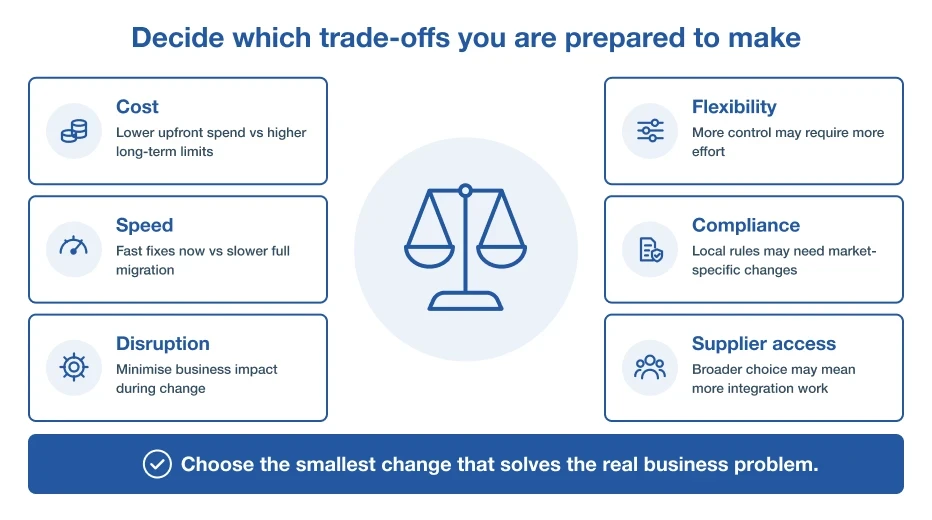
The comparison may tell you that moving now makes sense. It won’t necessarily tell you what you need from the new platform. That requires accepting that some platform decisions involve genuine trade-offs rather than problems that can be eliminated altogether.
Casino platform trade-offs: FAQs
That is also why the answer does not always have to be the same type of platform arrangement. Agreegain, for example, offers white-label and turnkey solutions alongside casino platform and API-based game aggregation options. The right approach depends on what the operator already has, what it wants to replace and how much of the technology and operation it wants to own or manage.
Ask the awkward questions before they become expensive ones
Once switching looks like the better option, be careful not to judge the replacement by everything your current platform gets wrong. Instead, look closely at the costs, responsibilities and dependencies that will come with the new relationship. That starts with getting clear answers to some potentially uncomfortable questions.
- Who owns our player data?
Ownership is only the start. Can you access and export complete, usable data when required, in what format, and are there restrictions or costs attached? - What can we change ourselves?
Separate genuine configuration from changes that require supplier development. Test this against the things your teams actually change, like bonuses, CRM rules, content, payments, limits, reporting and market-specific settings. - What requires custom development?
Establish how requests are scoped, prioritized and charged. More importantly, what happens when something important to your business competes with the supplier’s development schedule? - What does the quoted price exclude?
Look beyond the headline commercial model. Implementation, migration, integrations, third-party services, support tiers, minimum commitments and development charges can materially change the comparison with your current provider. - What happens to our existing integrations?
Payments, KYC, CRM, game providers and other services may not simply move across. Establish what can be retained, what needs rebuilding, who does the work and who maintains those integrations afterward. - What happens during migration?
Understand how player accounts, balances, data and integrations move, what needs to run in parallel, how the transition will be tested and what happens if something doesn’t go according to plan. - What service levels actually apply?
An uptime percentage doesn’t typically tell the whole story. Establish response and resolution commitments, escalation routes and, importantly, who takes ownership when an incident crosses several suppliers.
The aim is to establish where cost, control and responsibility reside once a deal is concluded. And it is worth taking note of how difficult it is to get those answers. You can’t iron out vague answers about data portability, development responsibility, or regulatory change once the contract is signed.
Does everything need to change?
Before committing to a full platform replacement, first establish how much actually needs replacing. Some problems may have a more specific solution. If maintaining multiple game-provider integrations, for instance, is consuming engineering resources, an aggregation layer could remove much of that work without requiring the underlying platform to change. Other problems, perhaps involving player management, reporting, payments, compliance, or limited operational control, may point to a more fundamental replacement.
This matters because changing more technology than necessary adds cost, migration work and operational risk. A change that is too limited can reduce disruption, but it may also fail to solve the problems that made change necessary.
So define the outcome first. What needs to work differently after the change, what can remain as it is, and what does your team want greater control over?
Defining that outcome also answers the question we started with. Whose argument decides whether you stay or switch? None of them on its own. Engineering’s migration concerns, finance’s contract commitments, compliance’s need for continuity and marketing’s demand for control all belong in the same comparison, each expressed as what it will cost the business to stay and what it will cost to move. Once every argument is weighed in the same terms, the decision stops being a debate between departments and becomes a business case the whole team can stand behind.
That is also where a technology partner such as Agreegain can add value. Not always by providing an entire replacement platform, but by exploring which parts of the existing setup need to change and how they can work with what the operator wants to retain.
The objective isn’t the biggest migration. It’s the smallest change that solves the right problems.
For a broader look at the technology behind online casinos, see our video: How online casinos work: Key mechanisms and algorithms for operators.
Popular blog posts