
Under the hood of casino platform integrations: The engineering that keeps operators online
Updated 2 Oct 2026•Published 2 Oct 2026
Key takeaways
- Every game launch hides a chain: the platform authenticates the player, secures the session and exchanges validation with the provider—all within seconds.
- Turnkey platforms carry years of engineering: operators inherit architecture, security, compliance and integrations with well over a hundred providers, each with its own API.
- Poor APIs cause real damage: weak integrations expose security vulnerabilities, disconnect sessions, desynchronize balances and erode player confidence.
- Architecture isolates provider failures: a well-designed platform acts as a protective layer, containing one provider's problem before it spreads across the system.
- Telemetry spots trouble in seconds: calls that consistently exceed ~200 milliseconds flag a degrading provider, which the platform can automatically deactivate.
- Certification is only the start: continuous automated test suites catch unannounced provider changes before they become operational issues.
- Ask about real-time data and replayability: these two overlooked capabilities reveal whether a platform can genuinely be operated—or is a black box.
Every time a player launches a casino game, a complex sequence of events takes place in the background. Multiple systems authenticate the player, establish secure sessions, exchange data with external game providers and keep balances, bets and winnings synchronized. And all of this happens within a matter of seconds.
For operators, much of this engineering stays invisible until something goes wrong. A slow provider, an unstable API or an unexpected outage, for instance, is all it takes, and it can quickly become a commercial problem that affects player trust and revenue.
Building the architecture that keeps those risks under control takes years of engineering experience. From stable integrations and failover systems to rigorous testing, much of a platform's value lies in preventing operators from experiencing problems.
We spoke with Ioannis Loukeris from Agreegain's development team about the engineering discipline behind modern casino platforms, why resilient integrations matter, and what operators should understand before choosing a technology partner.
What really happens behind every game launch?
From a player's perspective, launching a casino game is usually instantaneous. Behind the scenes, however, dozens of technical processes work together to authenticate users, establish secure connections and synchronize information between multiple systems. Understanding that hidden complexity helps explain why experienced platform engineering is so difficult to replicate.
Q: For an operator who's never seen behind the curtain, what actually happens technically when a player opens a casino game?
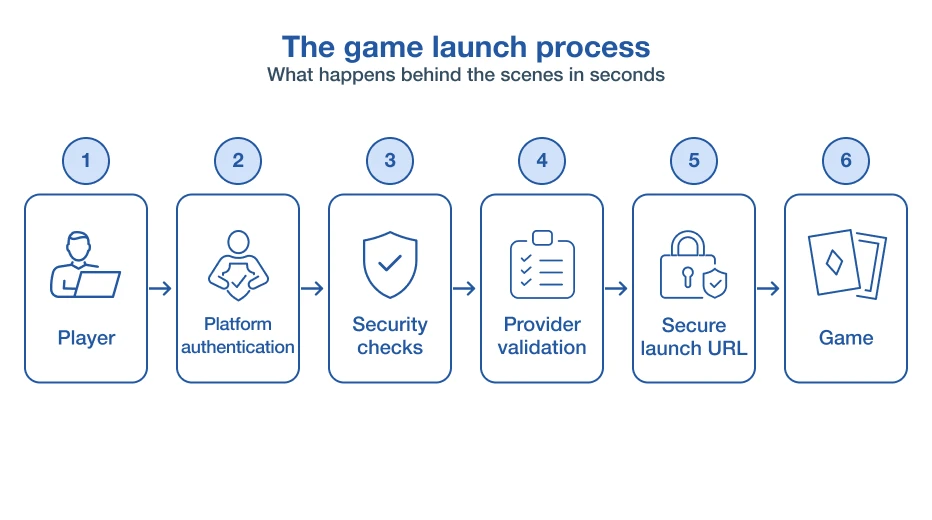
Most players click “Play” and expect the game to load almost instantly. Behind that single click, however, a carefully orchestrated sequence of communication takes place between the casino platform and the game provider.
The process begins when the front end requests a game launch URL from the platform. Before that request ever reaches the provider, the platform authenticates the player, performs the necessary security checks and establishes a secure session. The provider then performs its own validation, confirms that everything is in order and communicates with the platform to prepare the game session. Only after these checks are complete does the provider generate a secure game launch URL and return it to the platform, which then passes it back to the player's browser so the game can finally load.
Although this entire exchange normally takes only a matter of seconds, every step has to work flawlessly. The player expects a fast and effortless experience, but behind the scenes, the platform is continuously verifying identities, protecting data, synchronizing information and ensuring secure communication between multiple independent systems. If any part of that chain fails, the game may not launch correctly.
This is why building a modern casino platform is far more than simply connecting games from different providers. The engineering challenge lies in making an extremely complex process appear effortless while ensuring every interaction remains secure, accurate and reliable, long before the player places their first bet.
Q: When an operator chooses a turnkey platform or aggregator, what engineering work are they actually inheriting?
A quality turnkey platform represents years of engineering, refinement and real-world operational experience. It isn't simply a collection of features brought together under one interface. Behind it lie the architecture, security, compliance, integrations and operational knowledge required to support a modern iGaming business.
This task has become even bigger as regulation has evolved. Platforms today need to operate across multiple jurisdictions, integrate with a wide range of third-party services, protect sensitive data and remain reliable under continuous demand. Building all of that from the ground up requires a significant investment of time, expertise and resources. Even a platform designed for a single operator in one market is a significant undertaking.
The same principle applies to game aggregation. There are well over a hundred game providers on the market, each with its own API, technical requirements and way of handling game sessions, transactions and updates. Keeping those integrations maintained and synchronized is a continuous engineering task in itself.
An aggregator removes much of that complexity by giving operators a single, stable integration. Rather than maintaining dozens of individual provider connections and adapting to every technical change themselves, operators integrate once and let the aggregator handle ongoing maintenance behind the scenes. That allows operators to focus their own development resources on the areas that differentiate their business, instead of continually maintaining provider integrations.
How good engineering protects operators from technical risk
Technical problems don't stay purely technical for long. Slow providers, unstable integrations or poorly designed APIs eventually lead to interrupted sessions, frustrated players and lost revenue. The following questions explore how resilient platform architecture prevents those issues before they affect the operator's business.
Q: People often hear the term “API,” but what does a poorly engineered integration actually look like in practice?
A well-designed API is something players should never notice. When it works properly, game sessions start smoothly, balances remain accurate, bets are processed correctly and winnings are credited without delay. The problems only become apparent when that begins to break down.
One of the most serious risks is security. Like any system responsible for moving money and handling sensitive player data, game provider APIs are constantly exposed to attempted attacks. If those interfaces aren't designed and maintained to a high standard, they can introduce unnecessary vulnerabilities that put both operators and players at risk.
Stability is equally important. An unreliable integration may cause game sessions to disconnect unexpectedly, delay the confirmation of bets or winnings, or leave balances temporarily out of sync. Even after the underlying issue is resolved, the player still experiences uncertainty. If they can't immediately see their winnings or complete a session as expected, their confidence in the platform begins to decline.
Documentation also plays a bigger role than many people realize. Poorly documented or inconsistent APIs force developers to build workarounds simply to make different systems communicate. Those workarounds add unnecessary complexity and become additional points of failure as platforms evolve.
Ultimately, the quality of an integration is measured by how little players notice it. The best engineering remains invisible, allowing every game, transaction and balance update to occur consistently, securely and without interruption.
Q: How do you prevent one provider's technical problems from becoming the operator's problem?
The objective is to make sure that a problem affecting one provider remains exactly that—a provider problem—rather than something that disrupts the operator's entire platform.
Achieving that starts with the platform's architecture. A well-designed platform or aggregator acts as a protective layer between the operator and the many third-party services it depends on. Rather than exposing the operator directly to the different behaviors and technical differences across providers, the platform standardizes those interactions through a consistent interface and continuously monitors each provider's performance.
If something unexpected happens, whether that's an error, unstable behavior or a provider becoming unavailable, the platform should be able to isolate the issue before it spreads further. That means preventing one failing service from affecting unrelated parts of the platform or creating a wider disruption for players.
The same principle also applies to security. By controlling how information passes between the operator and external providers, the platform reduces unnecessary exposure and helps filter out problems before they reach the wider system.
Ultimately, resilience isn't about assuming problems will never occur. In a platform connected to dozens of external providers, occasional issues are inevitable. Good engineering is about quickly containing those issues, so the rest of the platform can continue operating normally while the affected service is investigated and resolved.
Q: As operators continue adding providers and thousands of additional games, how do you keep the platform performing consistently?
The architecture of the system plays the most important role in scalability. Adding more providers and games isn't simply about increasing the amount of content available to players. Every new integration introduces additional communication, data processing and system interactions that the platform has to manage efficiently.
A well-designed architecture uses modern technologies and carefully planned topologies to scale as demand grows. Ideally, performance should increase in a predictable, almost linear way as additional resources are introduced, rather than becoming progressively more difficult to manage.
There's also a common misconception that adopting a service-oriented or distributed architecture automatically solves scalability. In reality, that's only part of the solution. The way individual services communicate with one another, and the responsibilities assigned to each service, are just as important. Poor design at that level can introduce unnecessary issues, regardless of how modern the underlying technology may be.
Ultimately, every platform reaches the point where the database becomes one of the most important engineering challenges. As more providers, players and transactions are added, maintaining performance depends on careful architectural decisions across the platform, not simply on adding more hardware. That's where thoughtful engineering becomes essential to ensuring operators can continue expanding their content without compromising the player experience.
Q: Can you describe a particularly difficult integration challenge your team solved, and what operators would have experienced if it hadn't been?
One of the most technically demanding challenges we've faced has been the sheer variety of ways in which different game providers operate. From the outside, they may all appear to offer the same thing—a catalog of casino games. But behind the scenes, their operating logic, communication methods and technical requirements can differ significantly.
Our objective was to unify all of those different approaches behind a single, consistent API. Initially, some providers were so different that it seemed almost impossible to achieve. It required careful planning, extensive research and a great deal of analysis to understand where those differences existed and how they could be bridged without compromising reliability.
In some cases, we also had to compensate for issues within the providers' own implementations, resolving them inside our own system so operators could interact with every provider in exactly the same way.
Had we not solved those challenges, some providers simply couldn't have been offered through the aggregator. Even more importantly, operators would have had to deal with inconsistent behavior across providers, with bets, wins and game sessions handled differently depending on which studio the player happened to be using. That would largely defeat the purpose of using an aggregator in the first place.
The goal was never simply to connect more providers. It was to ensure that, regardless of who developed the game, operators could rely on a single, consistent integration that behaved predictably across the entire platform.
Keeping thousands of integrations running reliably
Building integrations is only part of the challenge. Keeping hundreds of provider connections performing reliably over months and years requires continuous monitoring, testing and operational discipline. This is where much of a platform's long-term value is created, even though operators and players rarely see the engineering that goes into it.
Q: How does a single aggregator integration reduce technical risk compared with maintaining dozens of direct provider integrations?
The value of an aggregator lies in giving operators a single, stable API that doesn't change, or changes only in backward-compatible ways. Once that integration has been implemented and validated, operators can continue running their own systems without constantly adapting to changes introduced by individual game providers.
Behind the scenes, however, those providers continue to evolve. They introduce new features, update their APIs, improve security or, occasionally, even make changes that require significant engineering effort to support. In some cases, those changes may not even be backward-compatible.
Rather than every operator having to monitor, implement and test those changes themselves, the aggregator absorbs that responsibility. It updates each provider integration, maintains compatibility and ensures the platform continues to present operators with the same stable interface they originally integrated.
For operators maintaining direct connections, that responsibility never disappears. Every provider relationship becomes another integration to monitor, maintain and keep in sync over time. As the number of providers grows, so does the engineering effort required simply to keep everything running reliably.
Ultimately, the role of an aggregator is not just to simplify the initial integration. It's to take on the ongoing engineering work required to maintain dozens of provider connections, allowing operators to concentrate their own development resources on building and improving their platform rather than continually maintaining third-party integrations.
Q: When something does go wrong, how quickly can the platform detect and respond before players are affected?
With telemetry, we can detect potential issues almost instantly. Every interaction with a provider is monitored, so if response times begin to increase, we can identify unusual behavior within seconds. For example, if individual calls consistently exceed around 200 milliseconds, that can be treated as suspicious. Once enough of those events accumulate, it's usually possible to confirm that the provider's service is degrading rather than experiencing a temporary delay.
Once the issue has been identified, the response depends on the operator's preferences. The platform can automatically isolate the affected provider by deactivating it and removing its games from the lobby, preventing new players from joining unreliable sessions.
Players who are already in a game naturally require different handling. If a provider has become unavailable, they may encounter a timeout the next time they interact with the game. For operators using our full platform, we can proactively notify players and return them safely to the casino lobby. Where operators use their own platform alongside our aggregator, how those situations are presented to players depends on the platform they've built around the integration.
Automation also has to be applied carefully. A brief network interruption doesn't necessarily mean a provider has failed. That's why operators can choose between fully automated responses and alert-based monitoring with manual intervention. Both approaches have their advantages, and the right choice depends on the operator's operational preferences and appetite for automation.
Q: What testing happens before a new provider goes live, and why does testing continue long afterward?
The important thing isn't simply getting an integration tested once so a provider can go live. Initial certification is essential, but it only confirms that everything is working correctly at that specific point in time. It doesn't guarantee that the integration will continue behaving as expected months later.
Every provider carries out its own certification process before allowing us to offer its games. That gives us the approval to launch the integration, but it's only the first stage. Platforms evolve, providers introduce new features, security improvements are implemented and APIs change over time. Any of those changes can unintentionally affect an existing integration.
We've experienced situations where providers made changes to address security issues or introduce new functionality without communicating those updates in advance. Even relatively small changes can have unintended consequences if they're not detected quickly.
That's why we've established a dedicated automated testing system for every provider we integrate. Rather than relying solely on the original certification, we continuously test our integrations with comprehensive test suites tailored to each provider. This allows us to identify unexpected changes early and resolve them before they become operational issues for our clients.
Ultimately, certification allows an integration to go live. Continuous testing is what helps keep it reliable throughout its lifetime.
Q: Operators often see uptime guarantees in service agreements. What engineering work actually lies behind those promises?
Commercial guarantees and service level agreements don't exist in isolation. They're built on the engineering decisions that determine how a platform behaves when something inevitably goes wrong.
From our perspective, incidents and failures can never be eliminated entirely. The objective isn't to assume they'll never happen, but to design a platform that keeps operating despite them. That philosophy influences every aspect of the platform architecture.
Redundancy ensures there isn't a single point of failure, while intelligent failover allows services to continue operating if individual components become unavailable. Strong monitoring helps detect issues early, and feature or third-party gating allows affected parts of the platform to be isolated without unnecessarily disrupting the rest of the system.
Together, these protections form part of a broader contingency strategy. Rather than allowing a single incident to affect the entire platform, the objective is to contain the problem, maintain normal operation wherever possible and restore affected services safely.
Ultimately, the confidence to offer meaningful uptime guarantees comes from building systems that are prepared for failure, not from assuming failure will never occur. The more scenarios a platform can handle without significant degradation, the stronger the service commitments it can realistically make to operators.
Choosing a platform: The questions most operators never ask
Most platform evaluations focus on visible features, game portfolios and commercial terms. Yet many of the decisions that determine long-term reliability sit much deeper within the platform itself. We concluded by asking experienced operators what they should look for before committing to a technology partner.
Q: If an operator is comparing casino platforms today, what technical questions should they be asking that most people completely overlook?
I'd start with two questions. First, ask whether the platform can provide real-time data that accurately reflects the system's current state. Second, ask whether that data is fully documented and can be replayed. Those two capabilities reveal a great deal about how the platform has been engineered.
Real-time visibility gives operators confidence that they can understand what's happening across the platform as events unfold, rather than waiting for problems to surface through customer complaints or operational disruption. Replayability is equally important. If every significant event can be reconstructed, investigated and audited afterward, issues can be resolved based on evidence rather than assumption.
In many ways, these capabilities separate a platform that can genuinely be operated and supported from one that simply works when everything is going well. A platform should never be a black box. Operators should be able to understand what it's doing, why it's doing it and what happens if something unexpected occurs.
Features, game portfolios and commercial terms will always be important, but they're only part of the evaluation. The engineering beneath the surface ultimately determines how predictable, transparent and reliable a platform will be over the long term.
The strongest casino platforms make complex engineering appear effortless.