

What casino aggregator certification does — and doesn't — cover across jurisdictions in 2026
Updated 25 Aug 2026•Published 25 Aug 2026
Key takeaways
- Certification assures, accountability stays — a certified game, aggregator, and supplier still leave the operator answerable to the regulator.
- Compliance splits into three layers — certified games, certified aggregation infrastructure, and operator obligations that never transfer.
- Certified aggregators cut real work — pre-certified integrations, approved game portfolios, single supplier frameworks, and jurisdiction-ready content shorten launch preparation.
- Four duties never leave the operator — product configuration, reporting and record keeping, player protection, and third-party oversight, which the UKGC states explicitly.
- One market's approach does not satisfy another — the UK and Malta separate operator and supplier obligations differently, while LatAm markets write new certification rules into their frameworks.
- Aggregation centralizes compliance relationships — the oversight burden shrinks from dozens of supplier relationships to one environment, even though accountability stays put.
For operators expanding across regulated markets, a certified casino game aggregator can remove a significant amount of compliance workload and complexity. Yet one important question remains at the center of the conversation about certification. Which compliance obligations transfer through certification, and which remain with the operator?
The answer matters because regulators continue to hold operators accountable for compliance, regardless of how much certified infrastructure supports their operation. That means a game may be certified. An aggregator may be certified. A supplier may be certified. And for these reasons, certification provides assurance, but in the eyes of industry regulators worldwide, accountability remains squarely with the operator.
As regulatory expectations continue to evolve across established and emerging markets, a clear understanding of who owns which compliance obligations can help operators approach audits and reviews with greater confidence.
The three layers of casino compliance
To get a clear picture, it is sometimes helpful to think of casino compliance as operating across three distinct layers. Each tier serves a different purpose, has different responsibilities, and may be subject to its own requirements. Understanding how these layers interact makes it easier to see which compliance benefits can be gained from certified infrastructure and which responsibilities remain with the operator.
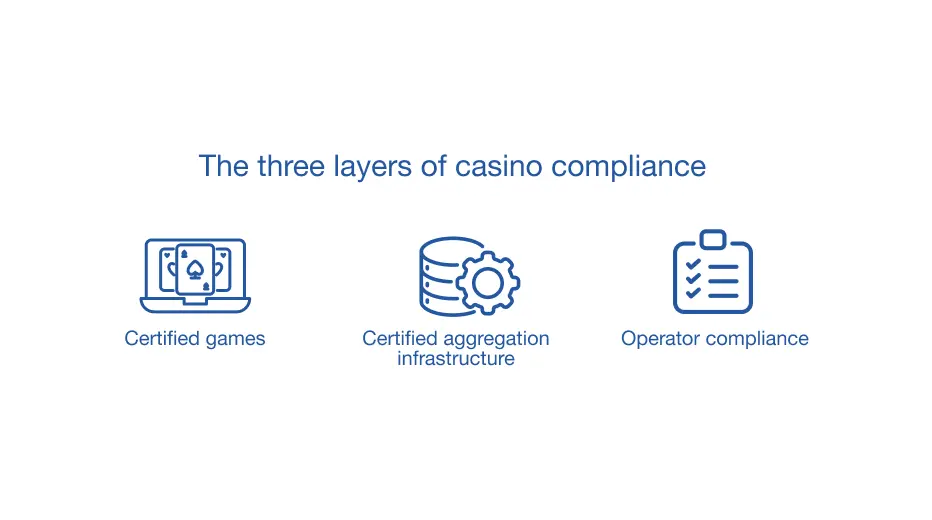
Layer 1: Certified games
The first layer of casino compliance begins with the games. Before entering regulated markets, games typically undergo technical testing to verify fairness, functionality, and the integrity of their random number generation systems. This process provides assurance that the game operates as intended and meets the technical standards required by specific jurisdictions. For operators, much of this certification work has already been completed before the game reaches their platform.
Certification here typically covers:
- Game fairness testing
- RNG certification
- Technical compliance testing
- Game functionality and performance
- Jurisdiction-specific game approvals
Layer 2: Certified aggregation infrastructure
The second layer sits between operators and game suppliers. In many regulated markets, aggregators operate certified technical frameworks that support supplier integrations, content delivery, and platform controls. Rather than managing certification processes across multiple individual supplier connections, operators can often rely on an established infrastructure that has already undergone technical review and testing.
Certification at this level may cover:
- Supplier integrations
- Content delivery infrastructure
- Platform security controls
- Data transmission and system integrity
- Technical framework testing
- Approved supplier connectivity
Layer 3: Operator compliance
The final layer remains with the operator. While certified games and certified infrastructure can reduce the workload, regulators continue to hold operators accountable for compliance standards. This is because many regulatory obligations relate not to the technology itself, but to how the operator deploys, manages, and oversees its services within a specific jurisdiction.
Operators typically remain responsible for:
- Jurisdiction-specific game configuration
- Regulatory reporting and record keeping
- Responsible gambling measures
- Player protection controls
- AML and KYC procedures
- Third-party supplier oversight
- Internal governance and compliance processes
What operators can inherit from a certified aggregator
While certified aggregators do not remove operator responsibilities, they can significantly reduce the amount of technical work required to launch and manage casino content.
Here are some of the key benefits operators can gain from working with a certified aggregator.
- Pre-certified integrations: Many supplier integrations have already undergone technical review, testing, and implementation within the aggregation framework. This helps operators avoid duplicating work across multiple provider relationships while simplifying the process of bringing new content to market.
- Certified game portfolios: Aggregators often provide access to games that have already been tested and approved for specific regulated markets. While operators remain responsible for deployment and compliance, access to certified content can reduce technical review requirements and speed up launch preparations.
- Established supplier frameworks: Rather than managing separate onboarding processes for every provider, operators can access multiple suppliers through a single established framework. This reduces administrative complexity while simplifying supplier management, technical integration, and portfolio expansion.
- Jurisdiction-ready content: Some aggregators maintain content portfolios prepared for use in multiple regulated markets. This can help operators identify suitable content more quickly, reduce preparation time, and support more efficient market entry planning across different jurisdictions.
Where accountability remains with the operator
While games, aggregators, and suppliers may be certified, regulators still expect operators to maintain oversight of the services they provide and the partners they work with.
Here are the main compliance responsibilities that remain firmly with the operator.
- Product configuration: Certification does not remove the need to configure products correctly for each market. Operators remain responsible for ensuring that games, player settings, limits, promotions, and other features are deployed in accordance with local regulatory requirements.
- Reporting and record keeping: Regulators expect operators to maintain accurate records and fulfill ongoing reporting obligations. While suppliers and aggregators may provide supporting tools and data, responsibility for regulatory submissions and record keeping generally remains with the licensed operator.
- Player protection: Responsible gambling measures rest firmly with the operator. This includes player monitoring, deposit limits, self-exclusion processes, affordability checks, and interventions to protect vulnerable players.
- Oversight of third parties: Perhaps most importantly, operators remain responsible for overseeing the suppliers and service providers they rely on. The UK Gambling Commission explicitly states that licensees remain responsible for the actions of third parties they contract with, reinforcing the principle that accountability does not transfer alongside certification.
Certification responsibility at a glance
The table below highlights what certification may cover at each level and which responsibilities typically remain with the operator.
| Layer | Certification may cover | Operator still owns |
|---|---|---|
| Games | RNG testing Fairness testing Game approvals | Correct deployment and configuration |
| Aggregation infrastructure | Integrations Platform controls Content delivery Technical testing | Oversight of suppliers and services |
| Casino operation | Limited or no transfer of responsibility | Reporting Player protection AML/KYC, governance Compliance duties |
Why compliance looks different across jurisdictions
It is interesting to note that while the relationship between certification and accountability remains broadly similar across regulated markets, the exact division of responsibilities can still vary. This is one reason operators should avoid assuming that a certification approach accepted in one market will automatically satisfy requirements in another.
In the UK, regulators distinguish between gambling operators and software providers, imposing separate obligations on each. Malta follows a similar principle by distinguishing between B2C operators and B2B suppliers. Across Latin America, many newly regulated markets are introducing certification requirements covering games, suppliers, platforms, and technical systems as part of their regulatory frameworks.
Get the jurisdiction guide to see which compliance obligations certification can cover
The discrete compliance advantage of aggregation
Much of the public discussion around aggregation focuses on content volume, supplier access, or speed to market. However, one of the less talked about advantages is the ability to centralize compliance complexity. Every new supplier adds another relationship that operators must oversee. As portfolios grow, so does their complexity. This is where aggregation can deliver value beyond content distribution.
By bringing certified suppliers, standardized integrations, and established technical frameworks together within a single environment, operators can reduce the number of individual compliance relationships they need to manage. Accountability remains unchanged, but the effort required to manage compliance across a growing supplier network can be substantially reduced.
Popular blog posts