
Online casino platform features: A complete buyer's guide for operators
Updated 13 Oct 2026•Published 13 Oct 2026
Key takeaways
- Sort every capability into standard, add-on, or custom development before you sign the contract.
- Check whether KYC runs natively or depends on multiple third-party integrations.
- Confirm jurisdiction-based game catalogues come as standard through a single aggregation API.
- Ask about fees on local payment methods and whether withdrawals process automatically.
- Treat responsible gambling tools sold as add-ons as a red flag — in regulated markets they are licence requirements.
- Verify open APIs and modular architecture so new markets do not require custom development.
- Probe the overlooked back-office capabilities — reporting, permissions, workflow automation — that daily operations depend on.
Most operators evaluate an online casino platform based on what they see during a product demonstration. Yet many of the features that determine long-term operating costs, compliance, and scalability only become important after launch. This buyer's guide highlights the casino platform features that have the greatest operational impact, explaining what should come as standard, what often costs extra, and the questions every operator should ask before signing a contract.
How to use this online casino checklist
Not every feature carries the same level of importance when evaluating a platform. Some capabilities should already be included as standard, while others may require additional modules, third-party integrations, or custom development. Understanding the difference can help operators compare casino platform providers more effectively and identify potential costs before signing a contract.
Throughout this guide, each feature category is evaluated using the following criteria:
✓ Included as standard: Features every modern platform should provide as part of its core functionality.
! Available as an add-on: Features that may require additional licensing, integrations, or implementation costs.
✗ Missing or requires custom development: Capabilities that could increase project complexity, delay market entry, or result in higher long-term operating costs.
Each section explains what the feature does, what should already be included as standard, what operators should watch for, and the key questions to ask potential casino providers during the evaluation process.
Expectations have shifted in recent years. Capabilities that were once sold as optional modules — jurisdiction-based content controls, automated responsible gambling limits, regulator-ready reporting — are now baseline requirements in most regulated markets. Operators evaluating platforms today should treat them as standard rather than as negotiable extras.
Essential online casino platform features
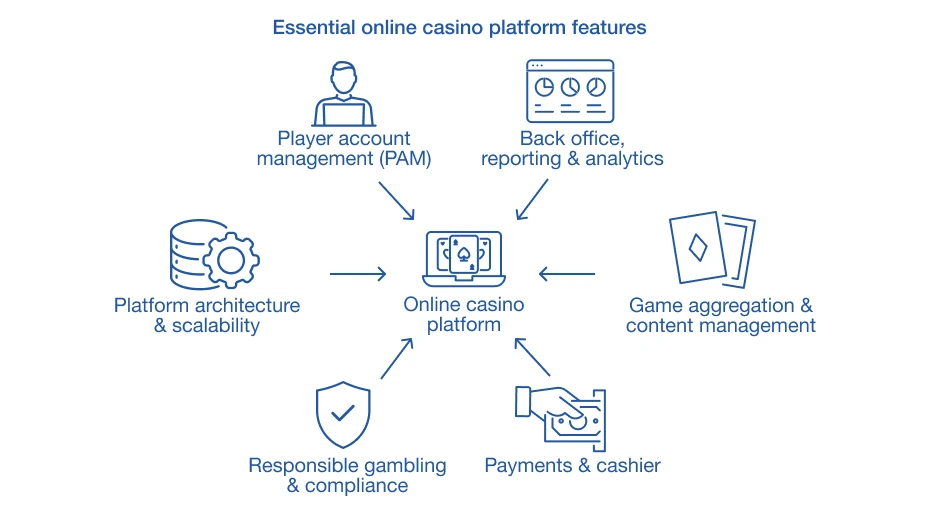
Every casino platform is built around several core operational components that influence the player experience, day-to-day management, regulatory compliance, and long-term scalability. While the specific implementation may vary between providers, the following feature groups should form the foundation of every modern platform.
When evaluating casino platform features, operators should look beyond initial discussions to understand what is included as standard, what may require additional investment, and how each capability will support a business as it grows.
Player Account Management (PAM)
Player Account Management (PAM) is the operational core of any modern casino software platform, supporting the entire player lifecycle within one integrated system.
✓ What should come as standard
- Player registration and secure authentication
- Integrated KYC and identity verification
- Wallet and multi-wallet capability
- Player segmentation and bonus management
- Deposit, loss, and session limits
- Self-exclusion and responsible gambling controls
! Watch out for
- KYC requiring multiple third-party integrations
- Basic CRM with limited player segmentation
- Manual bonus or campaign management
- Limited wallet flexibility or payment options
❓Questions to ask your provider
- Which PAM features are included as standard?
- Is KYC managed natively or through third-party integrations?
- How flexible are player segmentation and bonus management tools?
Back office, reporting & analytics
The back office is the operational centre of an iGaming platform, giving operators the tools to manage users, monitor performance, support regulatory compliance, and make informed business decisions.
✓ What should come as standard
- Role-based permissions and user management
- Audit trails and activity logs
- Workflow management tools
- Real-time dashboards
- Financial, operational, and marketing reports
- Regulator-ready reporting and data exports
! Watch out for
- Limited reporting that requires manual data analysis
- Basic dashboards with little operational insight
- Separate reporting tools for different departments
❓Questions to ask your provider
- Which reporting and analytics tools are included as standard?
- Can reports be customised for different operational teams?
- Are regulator-ready reports and exports built into the platform?
- How are user permissions and audit trails managed?
- Which dashboards provide real-time operational visibility?
Game aggregation & content management
Game aggregation provides operators with a single integration to manage content from multiple casino game providers / content supplier, simplifying content administration while supporting a consistent player experience across markets.
Content is then organised and presented to players through the casino module, which controls catalogue structure, lobby configuration and game presentation
✓ What should come as standard
- Single API integration for multiple providers
- Centralised provider management
- Jurisdiction-based game catalogues
- Casino lobby and content management
- Game promotions and featured content
- Regional content and market controls
! Watch out for
- Individual integrations required for new providers
- Manual content updates across multiple markets
- Lobby management with limited configuration options
❓Questions to ask your provider
- Can game catalogues be configured by jurisdiction or brand?
- How are promotions and featured games managed?
- What level of control do operators have over casino lobby content?
Payments & cashier
The payments & cashier module enables operators to process deposits and withdrawals securely while supporting local payment preferences, multiple currencies, and fraud prevention. A modern casino software platform should provide these capabilities through a single, well-integrated payment environment.
✓ What should come as standard
- Payment gateway integrations
- Local and regional payment methods
- Multi-currency support
- Automated deposit and withdrawal processing
- Fraud detection and risk management tools
- Secure payment processing
! Watch out for
- Limited payment gateway integrations
- Additional fees for local payment methods
- Manual withdrawal approval processes
- Fraud prevention tools requiring third-party services
❓Questions to ask your provider
- Which payment methods are included as standard?
- Does the platform support local payment options in each target market?
- Are fraud detection and risk management tools built into the platform?
Responsible gambling & compliance
Responsible gambling and compliance should not be considered an optional feature. In many regulated markets, they are licence requirements that operators must demonstrate before launching and throughout ongoing operations. Regulators such as the UK Gambling Commission and the Malta Gaming Authority set out specific obligations around player protection, and a platform that cannot evidence these controls will not survive the licensing process — regardless of how well the rest of it performs.
✓ What should come as standard
- Deposit, loss, and session limits
- Reality checks and responsible gambling notifications
- Self-exclusion tools
- AML support and monitoring
- Regulatory reporting and audit capabilities
- Configurable compliance controls for regulated markets
! Watch out for
- Responsible gambling tools available only as paid add-ons
- Manual compliance monitoring and reporting
- Limited support for jurisdiction-specific regulations
- Separate systems required for AML or regulatory reporting
❓Questions to ask your provider
- Which responsible gambling tools are included as standard?
- Are AML monitoring and regulatory reporting built into the platform?
- Can responsible gambling controls be configured for individual jurisdictions?
Platform architecture & scalability
The underlying architecture of an iGaming platform determines how easily it can adapt to changing business requirements. A modern casino platform should support modular deployment, third-party integrations, multi-market operations, and future expansion without requiring major redevelopment.
✓ What should come as standard
- Cloud-based architecture
- Open APIs and third-party integrations
- Modular platform design
- Sportsbook integration readiness
- Multi-market and multi-brand deployment
- High performance, availability, and security
! Watch out for
- Closed architectures with limited integration options
- Platforms requiring custom development for new markets
- Performance limitations as operations grow
- Core functionality dependent on legacy technology
- Hosting or data-residency requirements that the architecture cannot accommodate
❓Questions to ask your provider
- How easily can the platform integrate with third-party systems?
- Is the architecture designed to support multiple brands and regulated markets?
- What level of scalability is available as the business grows?
- Can the platform meet data-residency or local hosting requirements in your target jurisdictions?
Commonly overlooked platform features
Many features only become important once day-to-day operations begin. Product demonstrations naturally focus on player-facing functionality, but operators often discover that the greatest operational challenges lie behind the scenes. Limitations that appear minor during procurement can quickly become ongoing costs as businesses expand into new markets, introduce additional providers, or respond to changing regulatory needs.
The capabilities most commonly overlooked include:
- More detailed reporting and operational analytics
- Flexible compliance workflows and regulator-ready reporting
- Data migration and onboarding tools
- Granular user permissions and role management
- Advanced CRM and player segmentation
- API flexibility for third-party integrations
- Local payment method support
- Workflow automation that reduces manual administration
These capabilities may not be the most obvious, but they are invariably the casino software platform features that operators rely on every day.
Questions every operator should ask before choosing an online casino platform
Before making a final decision, step back from individual features and evaluate the platform as a whole. The following questions can help guide conversations with potential providers and identify whether an online casino platform is designed to support your business beyond initial launch.
Product
- Which core features are included as standard?
- Which capabilities require additional modules or integrations?
- How frequently is the platform updated?
Compliance
- Which responsible gambling and compliance tools are built in?
- How does the platform support different regulatory jurisdictions?
- Are regulator-ready reports included?
Commercial
- Which features involve additional licensing or implementation costs?
- How are new providers, payment methods, or markets added?
- What ongoing support is included?
Technical
- Does the platform support open APIs and third-party integrations?
- How easily can the platform scale across multiple brands and markets?
- What security and performance standards are maintained?
Operational Support
- How are platform updates and maintenance managed?
- What level of technical support is available after launch?
Download the casino platform checklist (PDF) to compare providers
Matching platform features to your delivery model
The features you should prioritise will depend partly on how your online casino is delivered. While the core capabilities remain important across all deployment models, the balance between provider-managed services and operator responsibility changes. Understanding these differences helps ensure your evaluation focuses on the features that will have the greatest impact on your long-term operational requirements.
White label casino platform
Designed for faster market entry, a white-label casino platform typically includes more functionality as standard. Operators should focus on understanding which features are managed by the provider and where customisation or operational control may be limited.
Turnkey casino platform
Turnkey platforms provide greater operational flexibility while leaving more day-to-day responsibilities with the operator. Evaluation should focus on integration capabilities, reporting depth, and administrative controls.
Full solution casino platform
A full solution offers the highest level of ownership and flexibility, making platform architecture, APIs, scalability, and operational tooling particularly important. Operators should ensure the platform can support long-term growth without unnecessary redevelopment.
Frequently asked questions
What a complete online casino platform should include
A modern online casino platform should deliver more than an entertaining player experience. It should include the core platform features operators need to launch, manage, and grow a successful casino, from player account management and back-office tools to game aggregation, payments, compliance, and scalable platform architecture within a single operational environment.
Successful evaluations look beyond launch-day demonstrations and focus on the systems that will support day-to-day operations and future growth. Choosing a platform with the right foundations from the start can reduce integration work, minimise operational complexity, and help operators scale with greater confidence as their business evolves.
Popular blog posts