

The casino build decision that determines speed of launch and new market entry
Updated 1 Sept 2026•Published 1 Sept 2026
Key takeaways
- Launch speed is decided at build time — the architecture chosen years earlier determines whether a new market takes weeks or months.
- Monoliths turn market entry into redevelopment — tightly coupled compliance, payments and front-end systems mean one change ripples across the whole platform.
- Modular design isolates change — compliance, payments and localisation adapt independently while the rest of the platform stays untouched.
- The same project runs 6–8 weeks or 4–6 months — identical market entry, radically different timelines depending on the architecture underneath.
- Expansion costs compound on a monolith — each new jurisdiction adds redevelopment burden, while modular projects stay predictable market after market.
- Test adaptability during platform selection — ask what must change, what must be retested and how long it takes when the next jurisdiction updates its rules.
Ask a group of operators what determines how quickly a casino can launch in a new market, and most will point to licensing, game and tech integrations, and localisation efforts. All of these factors do indeed influence launch timelines, but they are not always the reason some operators move faster than others.
In many cases, the biggest influence on the speed of market entry was determined years earlier, when the platform was built. Those early decisions determine why some operators today can adapt to new regulatory requirements and local market conditions in a matter of weeks, while others face months of redevelopment before they can move forward.
The difference is not the market opportunity itself. It is the architecture underneath the platform and how easily it can adapt when new opportunities emerge.
The reason some operators struggle to expand quickly
The answer often lies in how the platform was originally designed. Every new market introduces change. Compliance requirements differ between jurisdictions. Payment preferences vary from region to region. Front-end experiences need to be localised to reflect local languages, currencies, and player expectations. None of these challenges are unusual. The problem arises when a platform struggles to accommodate them efficiently.
In many traditional platform architectures, key functions are closely interconnected. A change to one area can create consequences elsewhere, increasing development, testing, and deployment requirements. What begins as a straightforward market-entry project can evolve into a much larger redevelopment exercise.
This challenge is most commonly associated with monolithic platform architecture, where compliance, payments, and customer-facing systems are built as part of a tightly connected structure. While this approach can work effectively within established markets, it often becomes less efficient when operators need to adapt quickly to new regulatory requirements or local market conditions.
What exactly is modular casino architecture?
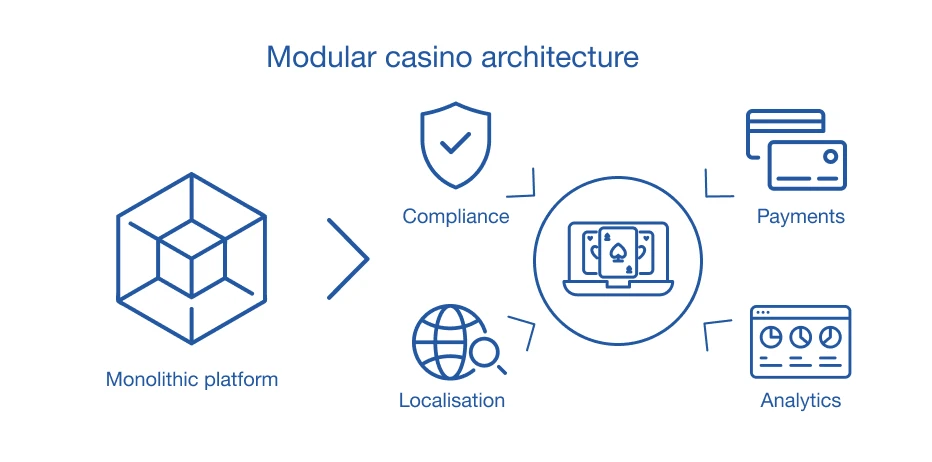
If monolithic architectures create challenges because key platform functions are tightly connected, modular architecture takes a different approach. Rather than treating the platform as a single interconnected structure, it separates major functions into independent sections that can be adapted without disrupting the wider operation.
For operators, the most important advantage is flexibility. Areas such as compliance and payments, for instance, can be managed independently, allowing changes to be introduced where needed without triggering unnecessary redevelopment elsewhere in the platform.
This becomes particularly valuable when entering new markets. A new compliance framework may require changes to regulatory controls and reporting processes. A new jurisdiction may also introduce different payment preferences or localisation requirements. Within a modular architecture, these changes can be addressed within their respective areas while the rest of the platform remains largely unaffected.
The result is a platform that is designed to adapt faster and more efficiently to changing market requirements, helping operators reduce complexity, accelerate deployment timelines, and approach expansion projects with greater flexibility.
The same expansion project on two different architectures
Consider an operator preparing to enter a second regulated market. The project involves many of the adjustments that typically accompany market expansion, including new compliance requirements, local payment integrations, reporting changes, and customer-facing localisation. While the market opportunity is identical, the experience can look very different depending on the architecture underneath the platform.
| Expansion activity | Monolithic architecture | Modular architecture |
|---|---|---|
| New compliance requirements | Needs wider platform changes and testing | Updated within the compliance area |
| Local payment integrations | May affect other platform functions and workflows | Added independently within payments |
| Front-end localisation | Often validated alongside broader platform updates | Managed separately from compliance and payments |
| Testing requirements | Multiple platform areas will require retesting | Testing is largely limited to the affected area |
| Development effort | Redevelopment across interconnected systems | Configuration and adaptation of individual components |
| Typical launch timeline | 4–6 months | 6–8 weeks |
| Operational impact | More complexity and resource requirements | Lower complexity and greater flexibility |
Ultimately, the difference goes beyond launch speed alone. Shorter deployment timelines can reduce development costs, simplify project management, accelerate revenue generation, and make future market expansion significantly easier to execute.
Watch our video on turnkey online casino solutions to see how they work and why they matter.
How platform architecture affects growth strategy
For an operator launching in a single market, the difference between a four-month project and an eight-week project may seem significant. However, many operators focused on growth are not planning just for one future launch. They are planning for the second, third, and fourth markets that may follow.
This is where platform architecture begins to influence business strategy every bit as much as development timelines. Every new jurisdiction introduces fresh platform requirements. For operators using monolithic platform architectures, these projects can become increasingly resource-intensive over time. Each expansion often requires additional redevelopment, testing, and deployment work across multiple platform functions. As the number of markets grows, so too does the complexity of maintaining and adapting the platform.
Modular architectures approach growth differently because components can be compartmentalised and adapted independently, and expansion projects remain more predictable and easier to manage. The platform can absorb change without requiring extensive redevelopment each time a new market opportunity arises.
The long-term advantage is the ability to pursue growth opportunities with greater confidence, allocate resources more efficiently, and respond more quickly to changing market conditions. In an industry where new jurisdictions continue to emerge and regulatory frameworks continue to evolve, that flexibility can become a significant strategic advantage.
Flexibility starts with the architecture beneath the platform
Adaptability, therefore, is becoming increasingly valuable. New jurisdictions introduce new compliance requirements. Payment systems continue to diversify. Local market expectations change. Operators need a platform that can adapt to these changes without introducing unnecessary complexity or slowing future expansion plans.
For these reasons, platform architecture has become an increasingly important consideration during platform selection and development. While features, content portfolios, and integrations remain important, operators must also consider how efficiently a platform can adapt to future opportunities.
Modular casino architecture addresses this challenge by making flexibility a core feature of the platform. This can accelerate time-to-market, simplify expansion projects, and create a more scalable foundation for multi-market growth.
At Agreegain, modular architecture forms the foundation of flexibility. By separating key operational functions and enabling adaptation through configuration, operators can respond more efficiently to changes as their businesses grow.
Popular blog posts