
The European markets where independent casino operators can still win in 2026

Updated 31 Jul 2026•Published 31 Jul 2026
Key takeaways
- Regulatory maturity outpaces competition in Romania, Bulgaria, and the Czech Republic — compliance matches Western Europe, acquisition costs do not.
- Each market rewards a different play: Romania offers scale, Bulgaria rewards early positioning, the Czech Republic pays operators who clear a high compliance bar.
- Five pressures close the window — affiliate consolidation, rising acquisition costs, SEO lock-in, trust concentration, and incumbent CRM sophistication.
- Licensing is not readiness — localised language, payments, and retention infrastructure decide who lasts after approval.
- Speed-to-market becomes strategic — spending 12 to 18 months building infrastructure can consume the advantage that made the market attractive.
- Early entrants keep structural advantages in visibility and payment familiarity long after acquisition turns expensive.
Over the last several years, independent casino operators have watched regulated European markets become progressively harder to penetrate. Acquisition costs have risen, affiliate channels have become increasingly saturated and costly, and established brands have steadily reinforced their market presence among both players and industry partners. But in 2026, a small number of European markets still provide operators with an accessible route into regulated European gaming and a realistic chance to establish a healthy market share.
Romania, Bulgaria, and the Czech Republic already operate within mature licensing and compliance frameworks, yet competitive saturation has not fully caught up with market maturity. That difference between market maturity and competitive intensity matters. It creates a rare situation where challenger brands can still establish local player relationships and lay the foundation for long-term player retention before larger operators intensify their presence.
This window of opportunity, however, is closing fast. The same forces that shaped Western Europe are already beginning to move eastward, and the period for securing meaningful early-market positioning may be shorter than many assume.
Independent operators are still finding room in parts of Europe
For operators familiar with the earlier stages of regulated European expansion, some parts of Central and Eastern Europe are beginning to look recognisable. Regulation and compliance standards are already mature, but competitive saturation still lags behind market maturity. This alignment creates a short-term opening for independent operators seeking meaningful market positioning.
What matters is that we are not talking about lightly regulated jurisdictions operating on the edge of wider European oversight. Romania, Bulgaria, and the Czech Republic already maintain established licensing frameworks, active regulatory supervision, certification standards, AML obligations, and increasingly sophisticated operational expectations for licensed operators. In many respects, the gap in compliance between these markets and Western Europe is slim.
The commercial environment, however, is in a different phase. Acquisition costs remain comparatively manageable, affiliate channels are less consolidated, and dominant brand visibility has not yet consolidated to the degree seen in more mature Western European jurisdictions. Player loyalty patterns are also still evolving.
But markets simply don’t stay in that position indefinitely. Acquisition typically remains relatively open until competition accelerates across the market. The operators that establish local visibility, payment familiarity, and retention infrastructure early quite often retain structural advantages long after conditions for acquisition become materially more difficult.
Why Romania, Bulgaria, and the Czech Republic stand out in 2026
While Central and Eastern Europe is invariably discussed in the context of the wider regional opportunity, the commercial dynamics differ across jurisdictions. Romania, Bulgaria, and the Czech Republic each present different competitive conditions, operational expectations, and positioning opportunities for independent operators evaluating regulated European expansion.
Romania
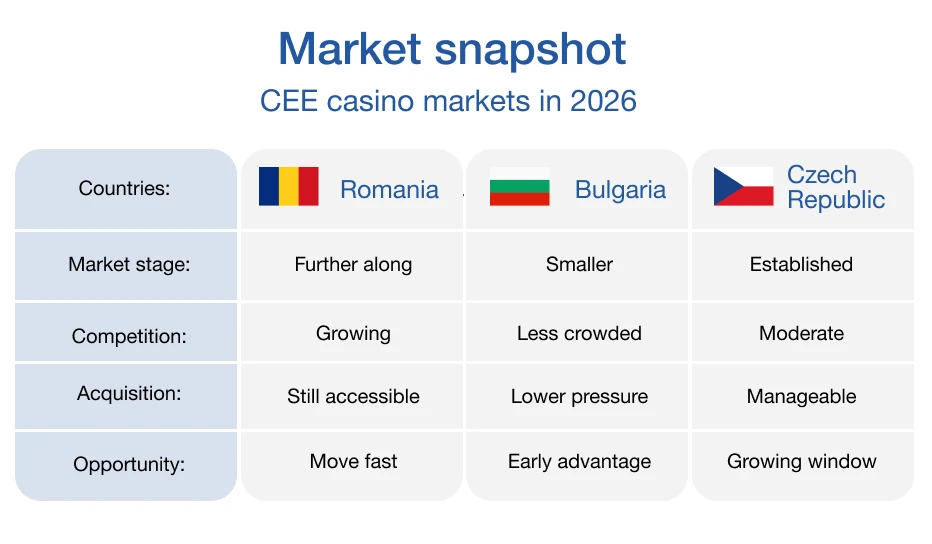
Romania continues to attract attention as one of the more commercially established online gambling markets in Central and Eastern Europe. The market already supports an active online casino audience, growing brand competition, and a regulatory environment that operators across Europe increasingly recognise as mature and credible.
What still differentiates Romania from many Western European jurisdictions, however, is the broader acquisition environment. Competition is increasing, but player acquisition conditions remain more accessible than in markets where affiliate networks, sponsorship visibility, and established operator dominance have already fully consolidated. For independent operators capable of localising effectively, Romania still offers realistic room to establish meaningful positioning.
Bulgaria
Bulgaria presents a different type of opportunity. The market is smaller, but that also contributes to its strategic appeal for challenger brands seeking to position early before competitive pressures intensify.
The commercial environment remains less crowded than in larger regulated European jurisdictions, creating space for operators willing to invest in localisation, familiar local payment methods, and long-term player retention rather than relying solely on scale-driven acquisition.
Czech Republic
The Czech Republic already operates within one of the region’s more mature regulatory environments, with increasingly serious operational expectations surrounding compliance, licensing, and responsible gambling standards.
For operators capable of meeting those expectations, the long-term positioning opportunity remains significant. The market combines an established gambling culture with regulated online demand, while still avoiding some of the extreme acquisition pressures now associated with more saturated Western European jurisdictions. Over time, that balance may become increasingly difficult to find elsewhere in regulated Europe.
The competitive conditions that disappear as markets mature
One reason experienced operators continue paying close attention to earlier phases of regulated market expansion is that commercial conditions don’t remain favourable indefinitely. Markets that initially appear accessible become more difficult to penetrate once acquisition channels mature, dominant brands gain stronger visibility, and player behaviour begins to consolidate around familiar operators.
This doesn’t happen through a single change. More often, a combination of competitive pressures changes the market over time:
- Affiliate consolidation: Early-stage affiliate environments are often more open, creating broader opportunities for challenger brands before larger operators dominate visibility and partnership inventory.
- Rising acquisition costs: As more operators compete for the same player base, acquisition costs across paid media and promotional channels increase significantly.
- SEO positioning: Operators that establish content authority and search visibility earlier in the market cycle usually retain advantages that later entrants find increasingly difficult to overcome.
- Player trust concentration: Over time, players become more familiar with established operators, payment experiences, and recognised brands, making loyalty harder to disrupt.
- Increasing CRM sophistication: As markets mature, new operators invest more heavily in segmentation, automation, lifecycle management, and retention infrastructure.
Typical changes as market competition intensifies
The commercial differences between earlier-stage regulated markets and more saturated European jurisdictions become increasingly visible over time.
| Competitive factor | Romania, Bulgaria, and the Czech Republic (Now) | Mature Western European markets |
|---|---|---|
| Affiliate competition | Less consolidated | Highly competitive |
| Acquisition costs | Comparatively manageable | Significantly higher |
| Brand visibility dominance | Still developing | Deeply entrenched |
| SEO competition | Growing | Highly saturated |
| Sponsorship competition | Moderate | Intensified |
| Payment trust concentration | Still evolving | Strongly established |
| Player loyalty disruption | More achievable | Increasingly difficult |
| CRM sophistication among newcomers | Developing | Highly advanced |
For operators evaluating markets such as Romania, Bulgaria, and the Czech Republic, timing is closely connected to how long those competitive conditions remain commercially accessible before the market environment begins to resemble more saturated parts of regulated Europe.
The localisation challenges operators underestimate
One mistake operators still make when evaluating expansion is assuming that regulation alone creates market readiness. In reality, many of the challenges that determine long-term success emerge after licensing, particularly once operators begin competing for player trust, retention, and local market familiarity.
Language is one example. Direct translation is rarely enough in regulated casino markets where onboarding, promotional tone, support interactions, and CRM communication increasingly influence player confidence and retention behaviour. The same applies to payment expectations. Familiar local payment experiences often become part of broader trust formation, particularly in markets where established operators already hold stronger brand recognition.
Operators also face growing operational expectations regarding certification, responsible gambling controls, AML processes, and KYC verification standards that increasingly align with wider European regulatory standards. These are not lightly regulated expansion territories operating below Western European standards. In many cases, expectations are converging quickly.
For example, a mid-sized operator entering Romania through a fast-launch platform model may still be able to establish local affiliate relationships, payment familiarity, and regional visibility before larger operators significantly intensify acquisition activity. But those advantages become harder to secure as competitive pressure and acquisition costs accelerate across the market.
Where speed-to-market becomes a competitive advantage
The strategic value of entering the Romanian, Bulgarian, and Czech Republic markets right now is closely tied to timing. That changes how operators evaluate traditional build-versus-buy decisions.
Under normal conditions, some operators may prefer the longer-term control associated with building infrastructure internally. But in markets that have not yet reached full competitive saturation, spending 12 to 18 months building platforms, integrating payment systems, securing certification, and preparing localisation infrastructure can significantly reduce the commercial advantage that made the opportunity attractive in the first place.
That is one reason white-label and turnkey casino models are increasingly strategic timing decisions rather than simple cost considerations. For operators seeking earlier entry into the regulated Eastern and Central European (ECE) markets, the ability to shorten launch timelines while maintaining commercial flexibility can be a meaningful competitive advantage.
Agreegain’s white-label and turnkey solutions are designed for operators that want to move quickly and avoid entering a market with a generic product. Speed-to-market matters, but so does the flexibility to adapt branding, payment flows, promotional structure, localisation strategy, and player experience to the expectations of individual ECE markets.
With the right solutions and infrastructure, operators retain the commercial flexibility needed to position in markets such as Romania, Bulgaria, and the Czech Republic, without sacrificing localisation depth and brand identity for faster deployment.
Popular blog posts