

Crash games in LATAM: Where you can and can’t launch
Updated 6 Nov 2026•Published 6 Nov 2026
Key takeaways
- Presence isn’t permission: Run every title through market, provider, game, and supply checks before you integrate it.
- Peru demands registered suppliers: Confirm that MINCETUR has registered both the game program and the provider.
- Colombia offers the clearest route: Coljuegos-authorized operators can launch both certified titles.
- Mexico needs your own permit: Check your SEGOB permit coverage and track the reform and AML changes.
- Argentina splits by province: Assess each province and CABA as a separate market.
- Chile and Brazil stay closed: Keep both off the launch plan until the law changes.
You want Aviatrix and Spribe’s Aviator across your LATAM casinos. Both are established crash titles with a presence in the region, so how difficult can it be to make that happen?
Well, as it turns out, it can be challenging because there isn’t one universal answer for LATAM.
Finding out that a provider operates in a country is only the first step. It doesn’t necessarily mean your casino can launch the game there. Your license can matter, but so can the game’s approval, the provider’s status, and even which part of a country you operate in.
Altogether, that makes a LATAM launch plan for these crash games a bit less straightforward than it might first appear. In other words, the country only gives you part of the answer. The more important question is what has to be true before you can actually make the game go live.
So where can Aviatrix and Aviator actually launch across LATAM, and what could stop them in each market? Let’s take a closer look.
Why crash games matter in LATAM
There is a good reason why operators want crash games in their portfolios across LATAM. They are simple to understand. A multiplier rises, the player decides when to cash out, and waiting too long means risking the bet when the game crashes.
That simplicity works particularly well on mobile. Rounds are short, there are few rules to learn, and players make decisions throughout rather than simply waiting for an outcome. It is easy to see why titles such as Aviatrix and Aviator have attracted attention across the region.
But demand is only one side of the decision. Before adding either title to a market, operators still need to establish whether they can actually launch it there.
Disclaimer
This information is not intended to be legal advice and is solely extracted from open sources. It should not be relied upon as a substitute for professional legal advice, and Agreegain does not accept any liability for its use.
What decides where these games can launch?
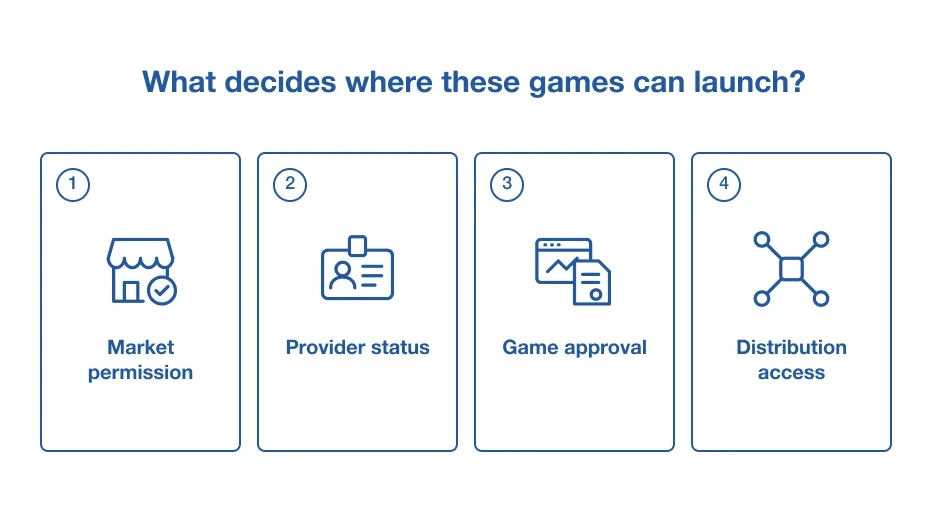
So, what can actually stand in the way of launching a live crash game? Depending on the market, there are several things to check:
- Is online casino permitted in the market?
Provider availability means little if the jurisdiction does not currently provide a legal route for commercial online casinos. - Does the provider have the required status?
Some markets place specific requirements on game suppliers, which can determine whether locally authorized operators can offer their content. - Is the game itself approved?
Individual titles may require certification, registration, or official approval, so an accepted provider does not necessarily mean its entire catalog can go live. - Will the provider supply it in that market?
Local regulation may permit the game, while the provider still applies its own territorial, licensing, or commercial conditions to distribution.
Not every LATAM market applies these checks in the same way, or even at the same level. Put Aviatrix and Aviator through them country by country, and the differences become apparent.
Where can you launch Aviatrix and Aviator in LATAM?
Those checks produce very different answers once we start moving across the region. So, let’s look at what they mean for six of LATAM’s main casino markets.
Peru
Peru is a good place to start because both games already have a route into the market. Aviatrix identifies Peru as a jurisdiction where it is licensed or certified, while locally authorized Peruvian operators already offer Aviator.
But being available in Peru is not the same as being ready to launch with any operator. MINCETUR separately regulates technological platforms and requires individual game programs to be approved and registered.
Suppliers connected to an operator’s platform must also be registered with MINCETUR, and operators cannot work with providers whose registration is missing, expired, or revoked.
So Peru is not a market to cross off the list. It is a market where operators must confirm that the specific game and route they intend to use have the necessary approvals before integration begins.
Colombia
Colombia gives us a clearer answer. Both games have established routes into its regulated online casino market. Aviatrix secured certification for Colombia, while Spribe lists Colombian certification for Aviator among its licenses and certificates.
That still doesn’t make either game universally available. Colombia restricts legal online gambling to operators and websites authorized by Coljuegos, with technical requirements applying to the content they offer.
For an authorized Colombian operator, then, both Aviatrix and Aviator have a regulatory route to launch. The remaining job is to confirm that the game, provider, and intended integration meet the requirements for that operation.
Mexico
Aviatrix has a clear route into the market: In August 2026, it announced a partnership with Playdoit that will bring the game to Playdoit.mx through the Finnplay platform. Aviator is also available through Mexican-facing operators, although Spribe does not currently identify Mexico among the individual jurisdictions listed on its public certification page.
For operators, that makes the local permission behind the casino particularly important. Mexico’s gambling authority, the DGJS, maintains records of authorized permit holders and websites, and gambling operations require the appropriate SEGOB permission.
So, another operator offering the game is useful evidence of market presence, but it is not by itself an answer for your own operation.
The framework itself is also moving. Mexico’s gambling sector still operates under the Federal Law on Games and Draws of 1947, and SEGOB has prepared a proposal to update it, while new anti-money laundering rules for the sector take effect on November 30, 2026. Any launch plan should be checked against the rules in force on the go-live date.
Argentina
Argentina needs to be looked at a little differently because the answer depends on where you intend to operate. There is no single national online gambling license. Regulation resides with individual provinces and the Autonomous City of Buenos Aires, each with its own rules and authorized operators.
So asking whether Aviatrix or Aviator can launch in Argentina is too broad. An operator needs to look at the specific jurisdiction it intends to enter. Buenos Aires Province, for example, licenses online gambling separately, while CABA maintains its own list of authorized online operators.
A national layer may also be added. In May 2026, the federal government sent the Senate a bill on problem gambling and online games of chance, while an earlier bill passed by the Chamber of Deputies is still awaiting a Senate vote. Neither would replace provincial licensing, but both could affect advertising and player verification requirements.
In other words, Argentina needs to be addressed province by province, not as one single countrywide yes or no.
Chile
Chile is much more straightforward, but not in the way a content team might hope. The country currently has no regulated route for commercial online casino operators. Chile’s Superintendencia de Casinos de Juego states that the commercial operation of online betting platforms is illegal while new legislation remains under consideration.
That effectively stops the Aviatrix or Aviator launch question before provider availability becomes relevant. A game might technically support Chilean players, currency, or localization, but none of that creates permission to offer it.
A bill to regulate online betting platforms (Bulletin 14838-03) is progressing through the Senate, but until it is enacted, there is no license for operators to apply for.
For now, Chile is therefore a market to watch rather than one to add to the crash-game launch plan.
Brazil
Brazil arrives at a similar answer to Chile, but by a very different route. Both Aviatrix and Aviator had been available under the regulated betting framework, with Aviatrix among the games certified for the Brazilian market.
That position changed on September 25, 2026, when Provisional Measure 1,394 prohibited the operation, offering, intermediation, and advertising of fixed-odds betting, covering both sports betting and online casino games. New deposits were barred immediately, sites and apps had to go offline from October 6, and licenses granted under Law 14,790/2023 expire on October 25, 2026.
As a provisional measure, it has the force of law now but must be converted by Congress to remain in effect, and it is being challenged before the Supreme Federal Court. Until either process changes the position, there is no authorized route into the Brazilian market.
For a commercial team, the lesson goes beyond Brazil. Previous certification or an established market presence does not guarantee that a game remains launchable. Regulatory change can redraw the content plan just as quickly as a new approval can expand it.
| Market | Aviatrix | Aviator | What operators need to know |
|---|---|---|---|
| Peru | Route available | Route available | Game program, platform, and supplier registration with MINCETUR required |
| Colombia | Certified | Certified | Route through Coljuegos-authorized operators |
| Mexico | Partnership announced (Playdoit, Aug. 2026) | Offered by Mexican-facing operators | Confirm SEGOB permit coverage; reform proposal pending |
| Argentina | Depends on jurisdiction | Depends on jurisdiction | Assess each province/CABA separately |
| Chile | No regulated route | No regulated route | Online casino not permitted; bill in Senate |
| Brazil | No current route | No current route | MP 1,394 in force since Sept. 25, 2026; pending Congress and court review |
Build the right crash catalog for each market
The bigger point is that your LATAM crash catalog does not have to look the same everywhere. Peru, Colombia, and Mexico each bring different considerations, while Argentina may require decisions at jurisdiction rather than country level. Chile and Brazil currently stop the conversation much earlier.
So before deciding that Aviatrix, Aviator, or another crash title belongs across your entire LATAM operation, establish what is actually available in each market. Then build the catalog around those answers.
This is also where casino game aggregation can reduce the work. Rather than building and maintaining a separate integration with every provider, operators connected to Agreegain can access thousands of games through a single API. That already includes Aviatrix through Agreegain’s existing partnership with the crash-game provider.
The integration doesn’t replace local licensing or game approval, but it makes it much easier to build the right content mix once you know what each market allows.
Disclaimer
This information is not intended to be legal advice and is solely extracted from open sources. It should not be relied upon as a substitute for professional legal advice, and Agreegain does not accept any liability for its use.
The next step is turning those market-by-market decisions into a catalog that works across your operation.
Popular blog posts