
What is a turnkey online casino solution and how does it work?

Updated 14 Aug 2026•Published 14 Aug 2026
Key takeaways
- Turnkey sits between white-label and custom builds — the provider supplies core technology while the operator keeps control over branding, payments, CRM and strategy.
- Model choice sets your control level — white-label launches fastest with the least independence; API and custom builds maximize control at the highest cost and timeline.
- The standard stack covers nine components — platform, game aggregation, payments, player account management, back office, CRM, compliance, support tools and optional sportsbook.
- Compliance follows external standards — AML aligns with FATF frameworks and responsible gambling tools often follow GamCare guidance, whatever provider you choose.
- The biggest launch delays sit outside the platform — licensing reviews by authorities like the MGA or UKGC, payment onboarding and certification set the real pace.
- Preparation shortens the calendar — define markets early, prepare compliance documents in advance and select payment providers before setup begins.
- Judge the platform against month twelve — infrastructure that works at launch can struggle once acquisition, localization and expansion compound.
Launching an online casino may appear straightforward, but there are many moving parts an operator needs to consider. Beyond the website itself, operators also need payment systems, player account management, security tools, reporting systems, and the flexibility to grow as the business expands. Building all of that independently can become expensive, slow, and technically demanding for new market entrants. This is why turnkey casino solutions have become so popular. They provide access to established infrastructure and greater scalability without the need to build an entire platform from scratch.
What is a turnkey online casino solution?
A turnkey solution is a ready-made platform that provides operators with most of the infrastructure needed to launch and manage an online casino. Rather than building every element independently, operators work with a single provider that supplies the core technology, operational tools, and backend infrastructure needed to go live.
The term "turnkey" traditionally refers to a solution that is largely prepared for operational use, without the need to build every component separately. In the iGaming industry, this typically refers to a platform that has already been developed, tested, and prepared for commercial use before the operator even enters the market.
A useful way to think about it is the difference between moving into a fully furnished property and building a house from the ground up. Building independently means sourcing every component separately. A turnkey solution changes that process completely by giving operators access to an existing operational framework that can then be customized around their own brand and business strategy.
Different casino models compared?
There are a number of different casino launch models on the market that may appear similar on the surface. However, each model gives operators a very different level of control over infrastructure, operations, customization, and long-term scalability:
White label casino
White-label casino solutions are generally considered the fastest and simplest route into the market. In most cases, the provider supplies the platform, licensing structure, and much of the operational infrastructure under a shared environment. This reduces complexity for new operators and can significantly accelerate launch timelines. The trade-off is usually lower flexibility and less operational control, particularly when it comes to customization, integrations, and long-term platform independence.
Turnkey casino solutions
Turnkey casino solutions sit between white-label and fully independent platform development. Operators gain access to established infrastructure and backend systems while retaining greater flexibility over branding, payments, CRM tools, and operational strategy. The provider still supplies the core technology, but the operator typically has more room to customize and scale the business over time. For many growing brands, this balance between operational support and long-term flexibility is a major advantage.
API and custom-built platforms
API-based and custom-built casino platforms offer the highest level of control, but they also require the greatest technical involvement. Operators are often responsible for sourcing multiple providers, managing integrations, overseeing development, and maintaining the wider platform infrastructure internally. This approach can provide significant flexibility for large or highly specialized operators, although development timelines, operational complexity, and upfront costs are generally much higher compared to other models.
Casino launch models compared
| Feature | White label | Turnkey | API / Custom build |
|---|---|---|---|
| Launch speed | Fastest | Faster | Slowest |
| Typical initial investment | Lower | Moderate | Highest |
| Operational control | Lower | Medium to high | Highest |
| Technical involvement | Low | Moderate | High |
| Platform Flexibility | Limited | Greater flexibility | Fully customisable |
| Scalability | Moderate | High | Highest |
| Best Suited For | Fast market entry | Growing independent brands | Large or specialised operators |
What is usually included in a turnkey casino platform?
While turnkey platforms differ between providers, most are designed to supply the core infrastructure needed to launch, manage, support, and scale an online casino operation. Typically, they may come with the following features:
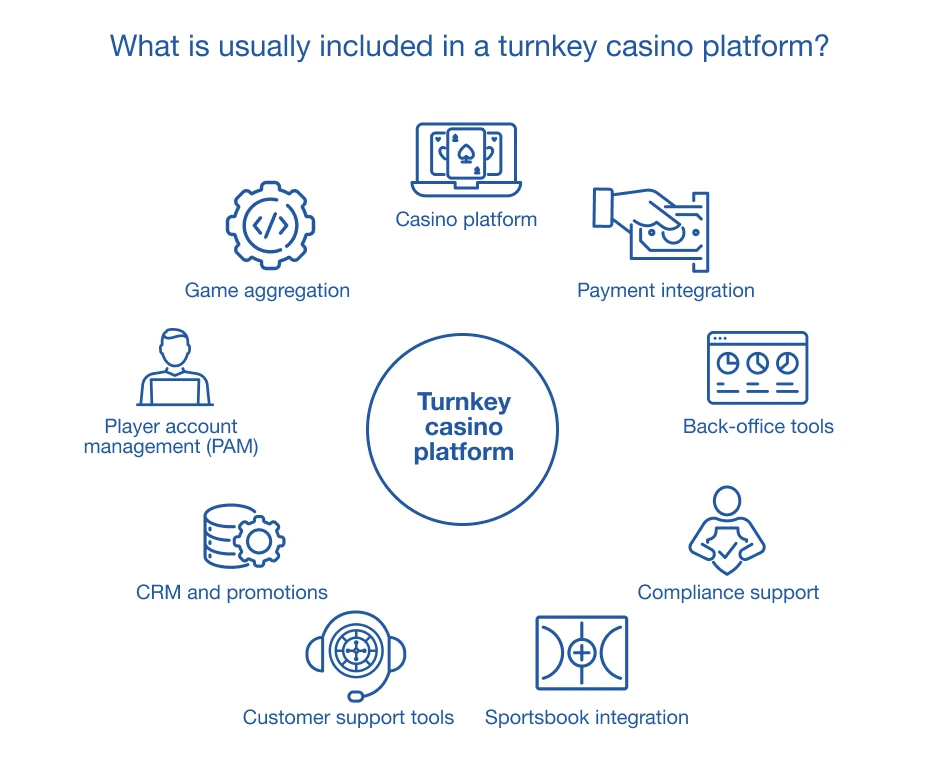
Platform components
Casino platform
The central infrastructure that powers the website, game lobby, player experience, wallet systems, and the wider operational environment behind the casino brand.
Game aggregation
Provides access to casino games from multiple studios through a single API integration, helping operators expand their content variety without managing separate providers.
Payment integration
Allows players to deposit and withdraw funds securely while reducing the operational complexity associated with integrating multiple payment providers independently.
Player account management (PAM)
Handles player registration, wallets, authentication, transaction history, and account controls needed to manage users across the platform securely.
Back-office tools
Gives operators visibility over player activity, transactions, bonuses, reporting, and operational performance through a centralised management environment.
CRM and promotional tools
Supports bonuses, free spins, retention campaigns, player segmentation, and engagement strategies designed to improve activity and long-term customer value.
Compliance support
Helps operators manage KYC, anti-money laundering procedures aligned with FATF standards, responsible gambling controls guided by bodies like GamCare, and security monitoring.
Customer Support Tools
Provides systems for managing player enquiries, account issues, technical support, and communication channels across the wider customer experience.
Sportsbook Integration (Optional)
Some turnkey providers also include sportsbook products, allowing operators to combine casino and sports betting within a single platform environment.
How long does it take to launch?
Launch timelines can vary considerably depending on licensing, payment approvals, localization requirements, and the complexity of the target market. In relatively straightforward scenarios, some operators may be ready to launch within several weeks. In more regulated or operationally complex markets, however, the process can take several months.
In practice, the biggest delays often happen outside the platform itself. Licensing approvals, payment provider onboarding, compliance procedures, and jurisdiction-specific certification requirements can all affect launch timelines depending on the market being targeted. Licensing through an authority such as the Malta Gaming Authority or the UK Gambling Commission, for example, carries its own documentation and review periods.
For operators looking to speed up the process, preparation can be just as important as platform selection. Defining target markets early, preparing compliance documentation in advance, carefully selecting payment providers, and having a clear branding and operational plan can all help reduce avoidable delays during the launch process.
How does the launch process work?
Although turnkey casino platforms simplify much of the technical workload, launching still involves several important stages:
- 1. Defining markets and business goals
Most operators begin by deciding which markets they plan to target and what type of casino business they want to build. This can influence licensing requirements, localization needs, payment methods, compliance obligations, and overall platform needs from the start.
- 2. Choosing a platform provider
Once operational goals and target jurisdictions are clear, operators can begin evaluating providers that align with those requirements. Factors such as platform flexibility, supported markets, payment integrations, scalability, game content, and long-term operational support are usually important considerations in the selection process.
- 3. Platform setup and branding
The platform is then customized to align with the operator's brand identity. This normally includes website design adjustments, localization settings, bonus structures, currencies, languages, and overall player experience configuration.
- 4. Payment and compliance integration
Payment systems, verification procedures, responsible gambling tools, and compliance workflows are then prepared for the target market. Depending on the jurisdiction, this stage can involve external approvals and additional operational checks.
- 5. Testing and certification
Before launch, the newly built platform undergoes testing to confirm that games, payments, registrations, reporting systems, and security features are functioning correctly. Certain regulated markets may also require formal certification or technical approval processes.
- 6. Going live
Once testing and approvals are complete, operators can move into the live launch phase. At this stage, the focus moves toward acquisition, marketing, retention, and ongoing operational management.
Building beyond the initial launch
For many operators, the real value of a turnkey platform only becomes apparent after launch. Early priorities often revolve around getting the business live, but operational demands tend to change quickly once player acquisition, localization, retention, and market expansion come into play. Infrastructure that works comfortably during launch preparation may behave very differently six or twelve months later as commercial requirements become more complex.
This is one of the reasons platform selection should never be viewed as a short-term technical decision. Areas such as scalability, operational flexibility, integration support, and long-term platform stability can have a significant influence on how easily a casino business evolves over time, particularly within competitive or regulated markets.