
What is a white-label casino solution and how does it work?
Updated 8 Sep 2026•Published 8 Sep 2026
Key takeaways
- White-label means launching on prepared foundations — the provider supplies technology, licensing, payments and operational tools, while players see only the operator's brand.
- Responsibilities split cleanly in two — the provider runs platform, content, payments, compliance and support; the operator runs brand, acquisition, promotions and growth.
- Operator control lives on the commercial side — branding, promotions, marketing, customer communications and business strategy stay fully in the operator's hands.
- Pricing has four moving parts — initial setup, ongoing platform fees, revenue share, plus the marketing and compliance budget that sits outside the contract.
- Ask what's included, not what it costs — services, support and commercial terms reveal the true investment better than any headline price.
- Treat white-label as a stage, not a destination — check before signing whether the provider offers a route to turnkey or API models as the business matures.
Launching an online casino involves far more than choosing a brand name and putting a website online. Behind every successful casino sits a complex network of technology, payment systems, player management tools, compliance processes, and licensing requirements.
Moreover, building and maintaining that infrastructure independently can be very costly and time-consuming, particularly for new market entrants.
This is why many businesses choose a white-label solution. Rather than developing everything from scratch, operators can launch a fully branded casino using established technology, games and operational infrastructure provided by an experienced supplier.
But what exactly does a white-label casino solution include, and how much control does the operator actually have? Understanding the answers to these questions is essential before making any launch decision.
What is a white-label casino?
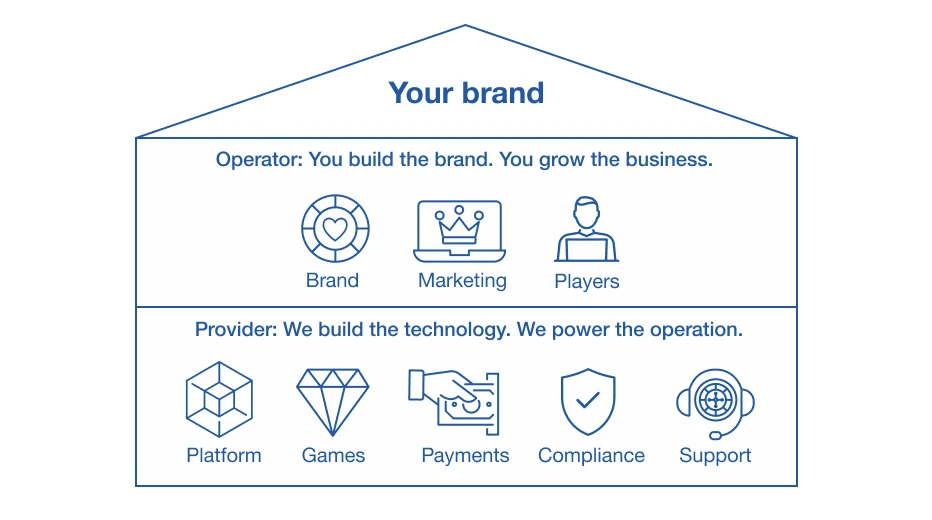
A white-label casino solution is a ready-made online casino platform that allows an investor or business to launch its own casino brand without building the underlying technology from scratch.
A useful way to think about it is building a house on foundations that have already been prepared. Instead of starting with an empty plot of land, the essential infrastructure is already in place. The foundations, plumbing, electrical systems, and core structures are there, and the utilities have been connected. You are left to focus on designing, furnishing, and developing the finished product.
A white-label casino works in much the same way. The provider supplies the technology, licensing framework, payment systems, and operational tools needed to run the casino, while the operator focuses on building the brand, attracting players, and growing the business.
To players, the casino appears as an independent brand. Behind the scenes, however, many of the systems that keep the operation running are supplied and maintained by the white-label casino provider.
This model allows operators to enter the market faster and with fewer challenges.
Knowing what a white-label casino is provides a base foundation. The next step is to understand how the partnership between the operator and the provider works in practice.
How does it work?
In practice, a white-label casino is a partnership between a casino operator (investor) and a technology provider. The provider supplies the systems needed to run the casino, while the operator focuses on building and growing the business.
The process typically begins with the operator selecting a white-label provider and creating a casino brand. This includes choosing a name, developing the website's look and feel, and defining how the business will be positioned in the market.
Once the brand is ready, the provider connects it to an existing casino platform and operational framework. This process allows the casino to offer games, accept player registrations, process payments, and meet regulatory requirements without the operator having to build those systems independently.
From that point onward, the two parties perform different but complementary roles. The provider maintains the technology, supports day-to-day operations, and ensures the platform continues to run smoothly. The operator focuses on attracting players, running promotions, building customer relationships, and growing revenue.
While players interact directly with the operator's brand, much of the infrastructure that powers the casino continues to be managed behind the scenes by the provider.
To better understand how this arrangement works, it helps to look at what is typically included in a white-label casino package.
What is usually included in the package?
One of the biggest misconceptions about white-label casinos is that the operator either controls everything or very little. In reality, responsibilities are shared equally between the operator and the provider, with each focusing on different aspects of the business. In white-label arrangements, the provider typically supplies and maintains the infrastructure needed to run the casino. The operator, meanwhile, focuses on building the brand and attracting players.
| Typically managed by the provider | Typically managed by the operator |
|---|---|
| Casino platform and technology | Casino brand |
| Game integrations and content | Marketing strategy |
| Payment infrastructure | Player acquisition |
| Licensing framework | Promotions and campaigns |
| Compliance and KYC systems | Customer engagement |
| Back-office tools and reporting | Brand positioning |
| Technical maintenance and support | Business growth |
This division of responsibilities is one of the main reasons white-label solutions remain popular. Operators gain access to proven technology and operational systems without the expense, effort and risk of building them independently, while still retaining control over the brand and business.
However, while operators have significant freedom over the commercial side of the business, some areas remain under the provider's control. Understanding where those boundaries exist is important when evaluating any white-label solution.
How much control does the operator have?
While a white-label provider provides much of the underlying infrastructure, operators still retain significant control over how their casino brand is positioned, marketed, and grown. In many ways, the operator remains responsible for the player experience and the business's commercial success.
- Branding
Operators have control over how their casino is presented to players. This essentially includes the brand name, logo, website design, color scheme, messaging, and overall identity. A strong brand helps differentiate the casino from competitors, even when the underlying technology stack is shared with other operators. - Promotions
Promotions play an important role in attracting and retaining players. Operators can usually decide which bonuses, loyalty programs, free spins campaigns, and special offers they want to run, thereby tailoring promotions to their target audience and business objectives. - Marketing
The responsibility for generating traffic generally sits with the operator. This includes activities such as search engine optimization (SEO), paid advertising, social media campaigns, affiliate marketing, sponsorships, and content marketing. The provider supplies the platform, but the operator drives player acquisition. - Customer communications
Operators typically control how they communicate with players throughout the customer journey. This may include email campaigns, promotional messages, loyalty initiatives, customer service policies, and broader engagement strategies designed to improve retention and player satisfaction. - Commercial strategy
Operators remain responsible for the overall direction of the business. Decisions relating to target markets, customer segments, growth priorities, marketing investment, and long-term business goals are made by the operator, not the provider.
While operators have considerable freedom in these areas, the level of flexibility can vary between providers. Some white-label solutions are designed primarily as standalone products, while others offer a clearer route toward greater ownership and control as the business grows.
For many operators, a white-label launch is only the beginning. As revenue increases and operational requirements become more sophisticated, businesses may choose to transition toward a turnkey solution or even a fully integrated API model. This allows operators and investors to assume greater control over technology, payments, licensing arrangements, and product development while continuing to build on the foundation established during the early stages of growth.
For this reason, operators should evaluate not only what a provider offers today, but also how well that solution can support their long-term ambitions.
How are white-label casino solutions priced?
There is no universal price for a white-label casino solution. Costs can vary considerably depending on the features required, target markets, regulatory requirements, and level of support provided. Rather than offering standard packages, many providers tailor pricing to each operator's specific needs.
Initial setup costs
Most white-label projects involve an initial setup phase. This typically includes configuring the casino brand, deploying the platform, setting up payment solutions, and integrating the services needed to support the launch. The complexity of the project often influences the amount of work required at this stage.
Ongoing platform fees
In addition to setup costs, operators usually pay ongoing fees for access to the platform and supporting services. These fees help cover platform maintenance, software updates, technical support, hosting, security, and the day-to-day operation of the infrastructure that powers the casino.
Revenue share arrangements
Many white-label providers also operate on a revenue-share model. Instead of charging only fixed fees, the provider receives a percentage of the casino's revenue. This approach allows providers to contribute to the long-term success of the operation while reducing the operator's upfront financial burden.
Additional costs to consider
Launching the platform is only one part of building a successful casino business. Operators should also budget for marketing, player acquisition, affiliate programs, local payment methods, and any market-specific compliance requirements applicable in target markets.
For this reason, the most important question is often not how much a white-label casino costs, but what is included in the package. Understanding the services, support, and commercial terms being offered will provide a much clearer picture of the overall investment required.
Why choose a white-label casino?
Choosing the right launch model is one of the most important decisions any operator will make. Whether you are exploring a white-label solution for the first time or comparing different market-entry options, understanding your requirements is the first step toward building a successful casino business.
Agreegain helps operators simplify the launch process by bringing together the essential components needed to enter the market efficiently and confidently.
Key benefits include:
- Launch a fully branded online casino in 4–8 weeks
- Access thousands of casino games from leading providers
- Add sports betting through a single integrated platform
- Offer slots, live casino, table games, virtuals, and sportsbook products from one account
- Integrated payment solutions for deposits and withdrawals
- Mobile-optimized player experiences across devices
- Built-in player account management and back-office tools
- Compliance and KYC systems to support regulated markets
- Flexible bonus and promotional capabilities
- Scalable infrastructure that grows alongside your business
- Ongoing support from experienced iGaming specialists
Whether your goal is to launch a new casino brand, expand into additional markets, or explore alternative market-entry strategies, Agreegain can help identify the solution that best matches your commercial objectives.