
How to start an online casino in Kenya in 2026: Licensing, mobile money and setup
Updated 13 Nov 2026•Published 13 Nov 2026
Key takeaways
- Ownership and capital rules tie up KES 200 million before you open.
- Platform decisions belong in the licence application, not after approval.
- M-Pesa wallet design decides whether deposits, withdrawals and reconciliation work at scale.
- Deposit-based excise creates a tax event before a player places a single bet.
- Real-time regulatory access links your platform directly to the GRA, KRA and FRC.
- Kenyan localisation reaches games, language, support and advertising, not just currency.
Kenya has many ingredients that make the online casino market interesting. Mobile money is used by more than 80% of adults, online gambling is already well established, and a new regulatory framework now provides a specific licensing route for online casino operators.
For operators and investors looking at African markets, that combination makes Kenya worth a closer look. Those comparing market-entry options across the region can also explore our guide to online casino licensing in South Africa, which explains what operators can legally launch there.
The licence is one part of that picture. Operators also need to understand the required capital, how tax applies, what their technology must support and, importantly, how a casino designed for Kenya works with the country’s mobile-money economy.
So what does it actually take to start an online casino in Kenya in 2026? This guide takes you through the process, from licensing and setup to payments and launch.
Disclaimer
This information is not intended as legal advice and has been compiled solely from publicly available sources. It should not be relied on as a substitute for professional legal advice, and Agreegain accepts no liability arising from its use.
8 Steps to prepare for an online casino launch in Kenya
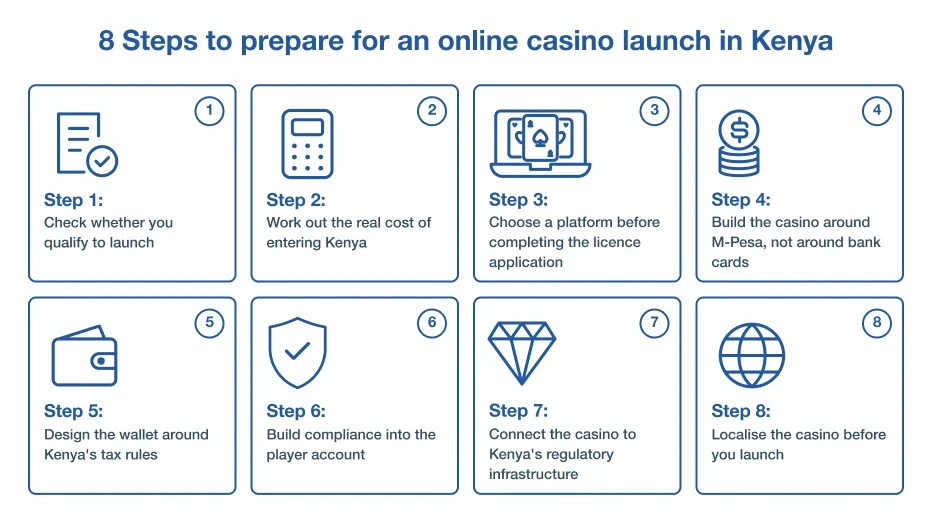
Launching in Kenya involves more than completing a licence application. Decisions about company structure, technology, payments, tax and compliance are closely connected, and several need to be made before an application is submitted. Here are eight steps to work through.
Step 1: Check whether you qualify to launch
Kenya now has a specific licensing route for online casinos under the Gambling Control Act 2025, administered by the Gambling Regulatory Authority (GRA). But before looking at platforms, games or marketing, it makes sense to check whether your business meets the basic entry requirements.
For most applicants, this means operating through a corporate body, maintaining an account with an authorised financial institution in Kenya and meeting a requirement for at least 30% Kenyan shareholding. The Act treats certain foreign-based operators differently, but this exemption applies only to operators that provide gambling services outside Kenya. It should not be assumed to provide a route around the local ownership rules for a casino targeting Kenyan players.
The financial threshold is also substantial:
| Requirement | Online casino |
|---|---|
| Application fee | KES 5 million (≈ €34,000)* |
| Licence fee | KES 50 million* |
| Annual operating fee | KES 5 million* |
| Minimum gambling capital | KES 100 million* |
| Security/bank guarantee | KES 100 million* |
| Licence term | 1 year |
| Regulator | Gambling Regulatory Authority |
The licence also does not make every supplier automatically eligible. Kenya separately regulates the provision of gambling software and platforms, so your technology provider must also meet the country's licensing requirements.
*The 2026 licence fees and capital requirements are being challenged in the High Court (Judicial Review E251 of 2026). In August 2026, the court allowed the GRA to collect the disputed licence fees while the case continues, on the regulator’s undertaking to refund them if the fees are found unlawful. Judgment was expected on 2 October 2026 but was not delivered; the court gave interested parties more time to respond and listed the matter for further directions. No judgment had been reported as of November 2026, so operators should confirm the current position before budgeting.
Step 2: Work out the real cost of entering Kenya
The KES 50 million online casino licence fee is a significant expense, but it should not be mistaken for the total cost of entering Kenya. The 2026 Licensing Regulations also prescribe an application fee and an annual operating fee, while an online casino must meet a KES 100 million minimum gambling capital requirement. The Gambling Control Act separately requires applicants to provide the prescribed security, which is KES 100 million (≈ €679,000) for online gambling.
These amounts should not simply be added together and treated as the cost of launching. Fees are expenses paid to obtain and maintain the licence. Minimum capital is money the business must have available to demonstrate financial capacity, while the security comes from an insurance bond or bank guarantee.
There are then the costs that depend on how the casino is built. These can include the platform, game testing and certification, payment integration, Kenyan data and hosting requirements, KYC and AML systems, regulatory and tax integrations, and local customer support.
Marketing carries its own regulatory cost too. The 2026 Licensing Regulations introduce a 6% approval fee on gambling advertising budgets, which operators need to include in acquisition planning from the start.
Platform costs also need checking separately. Kenya licenses gambling software and platform providers in their own right, with an application fee of KES 200,000 and an annual licence fee of KES 1 million, and operators must name a licensed supplier in their own application. Establish both the commercial cost and regulatory status of your chosen supplier before committing to a launch budget.
Step 3: Choose a platform before completing the licence application
It may seem logical to secure the licence first and choose the technology afterwards. In many instances, it is. In Kenya, however, some of those decisions need to happen much earlier.
The Gambling Control (Licensing) Regulations 2026 require an online casino applicant to provide details about how the proposed operation will work. That includes its platform and domain, where its servers will be located, the games it intends to offer, integrated payment systems and the controls used to verify players.
This means operators should assess potential platform providers against Kenyan requirements while preparing the application. The platform will need to support age, identity and location checks, responsible gambling controls and the country's data and hosting requirements. Kenya's Conduct of Gambling Operations Regulations also set technical requirements for online gambling systems, including integration with regulatory monitoring and self-exclusion systems.
There is a further consideration when choosing a supplier. Kenya regulates gambling software and platforms separately, so the provider must meet the applicable licensing requirements.
For an operator, the practical question is therefore not simply whether a platform can run an online casino. It is whether that platform can run the casino Kenya requires, including its games, player controls, regulatory connections, tax requirements and payment methods.
Step 4: Build the casino around M-Pesa, not around bank cards
Payments are one area where a casino built for Kenya can look very different from one designed primarily for European markets.
Mobile money was used by 82.3% of Kenyan adults in 2024, while 52.6% used it daily. M-Pesa is by far the largest service: the Communications Authority reported Safaricom with 92.3% of mobile-money subscriptions in late 2024. More recent figures put its share at 88.8% at the end of June 2026.
Taking deposits
Safaricom's Daraja platform provides APIs that let businesses connect M-Pesa directly to their web and mobile applications. For deposits, Customer-to-Business (C2B) integration can send payment confirmation back to the operator's system in real time. That confirmation then needs to be matched to the correct player and recorded accurately in the casino wallet.
Paying withdrawals
The flow must also work in reverse. Safaricom's Business-to-Customer (B2C) service supports payments from businesses to customers, while Daraja provides transaction-status tools. Safaricom specifically describes API integration as a way to automate both disbursement and reconciliation.
For a casino, however, moving the money is only part of the job. A deposit or withdrawal also needs to agree with the player account, casino ledger, tax treatment, AML controls and regulatory records.
That is why operators should design the wallet around M-Pesa from the start, rather than adding it as another payment option shortly before launch.
Step 5: Design the wallet around Kenya's tax rules
Beyond deposits and withdrawals, Kenya's tax system gives operators another reason to consider payments and the casino wallet together. Since July 2025, gaming excise has been charged at 5% of the amount deposited, rather than on each amount wagered. The Finance Act 2026 has since widened the definition, so the excise now applies to amounts deposited for gambling purposes whether or not the funds sit in a player's wallet. The Kenya Revenue Authority (KRA) requires betting and gaming operators to remit this excise within 24 hours after the day's transactions close. Its 2026 guidance specifically tells operators to review how their systems treat deposits and account for the tax. That means a deposit creates a tax event before the player places a wager.
| Player/business event | Tax or compliance consequence |
|---|---|
| Player deposits | 5% gaming excise |
| Player wagers | Transaction and wallet record |
| Casino generates gaming revenue | 15% gaming tax |
| Player receives winnings | Withholding tax under the Finance Act 2026, where the payout falls within the definition of winnings |
| Player withdraws | 5% withholding tax on withdrawals, plus payment, KYC, AML and reconciliation |
KRA defines gaming revenue as gross turnover less winnings paid to customers and charges gaming tax at 15%. Withholding tax is less straightforward. The Finance Act 2025 replaced withholding tax on winnings with a 5% charge on withdrawals, and the Finance Act 2026 has now reintroduced a 20% rate on winnings, defined as payouts from lotteries and prize competitions. Operators should confirm with a tax adviser how both rules apply to casino payouts.
The practical issue, therefore, is not simply calculating a tax bill. The platform needs reliable records of deposits, wagers, winnings and payments so that player balances, operator accounts and tax reporting remain consistent.
Significantly, a 5% tax on deposits does not automatically mean a KES 1,000 deposit becomes a KES 950 playable balance. Operators should establish the correct accounting treatment rather than making that assumption.
Step 6: Build compliance into the player account
Building for Kenya does not stop with payments and tax. Kenyan regulations place several requirements on how player accounts must work.
Under the Gambling Control (Conduct of Gambling Operations) Regulations 2026, an online operator must verify a player's identity, location and age before activating the account and accepting a deposit for gambling. The minimum gambling age is 18.
But verification does not end at registration. Online casinos also fall within Kenya's anti-money laundering framework. The Financial Reporting Centre's casino guidance requires customer due diligence and ongoing monitoring, with enhanced checks where higher risks are identified. This can include establishing the source of a player's funds.
Responsible gambling controls must also work through the player account. The 2026 regulations provide for daily, weekly and monthly deposit limits, loss and expenditure limits, session controls and reality checks. Players must also be able to temporarily self-exclude, while operators must connect with Kenya's national self-exclusion register.
Stake settings need attention too. The Gambling Control Act 2025 sets a KES 20 minimum for online gambling bets and provides for a player savings component, with the regulator determining how it operates.
For operators, these policies determine what the player account must verify, restrict, record and respond to throughout the customer relationship.
Step 7: Connect the casino to Kenya's regulatory infrastructure
Getting a licence does not mean the regulatory work is finished. In Kenya, the casino's technology must also connect with systems used to supervise the market.
The Gambling Control Act requires the GRA to monitor online gambling in real time, while the 2026 Conduct Regulations require online platforms to give the regulator real-time access through a secure API. Platforms must also be able to integrate with the GRA's Central Monitoring System, the national self-exclusion register and other recognised government systems.
Those requirements also affect the underlying infrastructure. Player data must be encrypted in transit and at rest, and stored and processed on servers in Kenya (Regulation 42(2)) unless the GRA grants a prior written exemption or authorisation. Platforms must also demonstrate appropriate security, redundancy and business-continuity measures.
Other connections sit alongside the GRA. The Kenya Revenue Authority has integrated betting and gaming companies into its tax system, providing real-time access to sector data. Online casinos are also reporting institutions under Kenya's anti-money laundering framework and must register with the Financial Reporting Centre through goAML. Operators processing player data must also consider registration and ongoing obligations with the Office of the Data Protection Commissioner.
For an operator, launching therefore involves more than receiving a licence certificate. The casino has to become part of Kenya's regulatory infrastructure.
Step 8: Localise the casino before you launch
By this point, it should be clear that localisation in Kenya starts well before deciding how the casino looks to the player. But those customer-facing decisions still matter. The casino needs to work naturally in Kenyan shillings, while the mobile experience deserves particular attention in a market where 82.3% of adults use mobile money. Stake settings should also reflect Kenya's rules, including the KES 20 minimum online bet discussed earlier.
The same review should extend to the casino games available, their technical compliance and certification, how clearly the casino communicates in English and Swahili, and whether customer support is set up for Kenyan players. Deposits may receive much of the attention during integration, but withdrawals need to work just as effectively across the player account, M-Pesa and the operator's verification processes.
Promotions and marketing need localising too. Kenya's 2026 advertising rules, published as Legal Notices 113–115 and including the Gambling Control (Advertising) Regulations, require regulatory approval and restrict areas including celebrity endorsements, testimonials and calls to action, alongside requirements for responsible gambling messaging.
The result is a much broader localisation exercise than changing the currency and adding M-Pesa. A casino built for another market cannot necessarily be switched into Kenyan mode. The product, player journey and marketing all need to work within the way Kenya's market is structured.
What should you have ready before applying for a Kenyan online casino licence?
Before applying, operators should be able to work through a checklist like this:
- Corporate structure: Confirm the applicant entity, ownership structure and whether the 30% Kenyan shareholding requirement applies.
- Capital: Prepare for the KES 100 million minimum gambling capital requirement and the KES 100 million security, alongside the applicable licence fees.
- Banking: Establish the required account with an authorised financial institution in Kenya.
- Platform: Choose a provider that meets GRA licensing, monitoring, player-control and technical requirements.
- Games: Determine which games, suppliers and technical certifications meet Kenyan requirements.
- Payments: Define how M-Pesa deposits and withdrawals will connect with the casino wallet and reconciliation process.
- Tax: Map the 5% deposit excise, 15% gaming tax and 20% withholding tax on winnings into the appropriate systems and records.
- Players: Build identity, age and location verification, AML/CDD and responsible gambling controls into the account.
- Data: Establish how you will meet Kenyan hosting, security and ODPC obligations.
- Regulatory connections: Map the casino's required connections and reporting processes for the GRA, KRA and FRC.
Do not wait until the licence is granted to answer these questions. Many of these decisions determine what goes into the licence application and determine whether the casino will be ready to operate once approval arrives.
Frequently asked questions
Build for Kenya before you launch in Kenya
Kenya's licensing requirements create a significant financial hurdle, but they are relatively easy to define. The more complex question is what happens once a Kenyan player makes a deposit. From that point, M-Pesa, tax, the casino wallet, KYC and AML controls, responsible gambling, regulatory monitoring and withdrawals all become connected.
Each places requirements on the technology running the casino. If you only consider those requirements after the licensing process begins, localisation can quickly become a redevelopment project.
This is why entering a regulated market such as Kenya is partly a platform decision. Agreegain combines a configurable casino platform with game aggregation, payment and integration capabilities, giving operators infrastructure they can adapt to the specific requirements of individual regulated markets.
For Kenya, that adaptability needs to extend far beyond changing basic settings.
Disclaimer
This information is not intended as legal advice and has been compiled solely from publicly available sources. It should not be relied on as a substitute for professional legal advice, and Agreegain accepts no liability arising from its use.
Popular blog posts