

Online casino licensing in South Africa: What operators can legally launch in 2026
Updated 16 Oct 2026•Published 16 Oct 2026
Key takeaways
- South Africa produced R74.5 billion in GGR in 2024/25, up from R59.3 billion a year earlier, with online betting alone contributing R44.46 billion.
- No general online casino licence exists, and the NGB reads Section 11 of the National Gambling Act as barring conventional interactive games.
- An offshore licence gives you no route in — the NGB now runs a verified-operator register to expose illegal sites.
- The 2025 Supreme Court of Appeal ruling closed casino-style contingency betting in Gauteng, but its national reach remains contested.
- RGS certification has stopped after the NRCS confirmed SANS 1718-4:2018 does not cover remote gambling servers.
- Treasury's proposed 20% national gambling tax would stack on provincial levies rather than replace them.
- Keep products and suppliers independently configurable so future authorisation means adding a vertical, not rebuilding a platform.
South Africa offers online casino operators a market that appears ready in almost every respect. Gambling is firmly established, players are comfortable betting online, mobile access is widespread, and the country has a sophisticated banking and payments system. There is just one rather important complication in this equation. South Africa does not currently issue a general online casino licence.
For international operators, that changes the usual market-entry mentality. The licences available locally do not allow operators to switch on slots, RNG table games and the rest of a conventional casino catalogue
That said, sitting on the sidelines until the law changes may not be the best answer either. The real opportunity is in understanding what can be done legally today, what cannot, and which decisions made now could make a future South African casino launch considerably easier.
The important point is that regulation does not need to arrive before the planning begins. Operators can already assess provincial routes, potential partnerships, and the technology needed to separate what is allowed today from what may become possible tomorrow. The more prepared your gaming business is, the less there is to rebuild when the market changes.
Disclaimer
This information is not intended to be legal advice and is solely extracted from open sources. It should not be relied upon as a substitute for professional legal advice, and Agreegain does not accept any liability for its use.
Why South Africa remains an attractive iGaming market
The regulatory uncertainty surrounding online casinos has done little to dampen South Africans’ appetite for gambling. According to the National Gambling Board (NGB), the industry generated R74.5 billion in GGR in financial year 2024/25, up from R59.3 billion the year before — growth of about 26%, with betting responsible for 69.8% of the total. Online betting alone generated R44.46 billion — close to 60% of all gambling GGR in the country, and about 86% of betting revenue. South Africans are not gradually moving online; they are already there.
The underlying conditions are equally interesting. Statistics South Africa found that 75.6% of households accessed the internet through mobile devices in 2024, while the South African Reserve Bank reports continued growth in electronic and real-time payments. Gambling itself is hardly a niche activity. NGB research put national participation at 65.7% in 2023, up from 30.6% in 2017.
For prospective casino operators, these figures point to a market where much of the groundwork for digital gambling has already been laid. And restrictions on online casinos should not be mistaken for a lack of demand. The commercial case is obvious. The harder question is what an online casino operator can offer under today's rules.
For a broader regional perspective, watch our overview of Africa’s online casino landscape.
Can you legally launch an online casino in South Africa?
South Africa does not currently issue a general online casino licence. Under Section 11 of the National Gambling Act, interactive games cannot be offered unless the Act or another national law specifically authorises them. The NGB continues to interpret this as prohibiting conventional online casino gaming, including products such as online slots and RNG table games.
That, however, does not mean all forms of online gambling are prohibited. South Africa has a large legal online betting industry, but it operates through a different regulatory route.
What is legal online today?
Online betting is permitted when it is offered by a bookmaker licensed in South Africa. Unlike in markets with a single national remote-gambling licence, operator licensing is mainly handled through the country's nine Provincial Licensing Authorities (PLAs). Licensed bookmakers can take bets on horseracing, sports and other lawful events, with the precise licensing and operating requirements determined at provincial level.
For operators approaching South Africa from overseas, this changes how they approach market entry. Obtaining a provincial bookmaker licence does not provide blanket permission to add a conventional casino catalogue alongside a sportsbook. Equally, holding a licence from Malta, Curaçao or another overseas jurisdiction does not provide an alternative route into South Africa.
The NGB states plainly that South Africans cannot gamble with international operators from within the country, and in April 2026 it launched a public verification portal listing every operator holding a valid South African licence, developed with the Provincial Licensing Authorities and hosted on its own site.
Why some casino-style games complicate the answer
The position becomes less straightforward when casino-style products are offered not as interactive games, but as bets on the outcome of an event.
This distinction has developed because South African bookmaking legislation allows bookmakers to take bets on events or occurrences with uncertain outcomes. In practice, Western Cape and Mpumalanga have historically permitted casino-style products under betting licences, including certain live-dealer products treated as events rather than conventional interactive casino games. The NGB itself has previously acknowledged that these two provinces permitted casino-style games within their betting sectors.
That should not, however, be interpreted as those provinces having legalised online casino.
The national regulator has become increasingly critical of bookmakers offering casino-style games under the contingency (event) model. Its 2024/25 annual reporting says some products being presented as events are interactive in nature, with players actively initiating gameplay, and therefore fall outside what the NGB considers legitimate betting.
The position became more complex following the Supreme Court of Appeal judgment in Portapa (Pty) Limited t/a Supabets and Others v Casino Association of South Africa and Another [2025] ZASCA 158, handed down on 21 October 2025. The court interpreted "sporting event" in section 55 of the Gauteng Gambling Act 4 of 1995, held that bookmakers licensed in that province are limited to bets on sporting events, that roulette does not fall within that definition, and that reading the provincial statute this way does not conflict with section 4 of the National Gambling Act. On that basis, offering fixed-odds bets on the outcome of a casino game without a casino licence is unlawful in Gauteng.
It is worth noting what the case was actually about: live roulette streamed from a Lithuanian casino into Gauteng betting shops, with fixed-odds bets taken on each spin. The dispute was over how the product is classified, not over the channel it reaches players through, which is why the reasoning is being read across to online offerings.
What the judgment means beyond Gauteng is contested. The NGB, in a media release issued on 19 October 2025, welcomed the ruling as confirmation that casino games cannot be classified as events or occurrences for contingency betting, stated that the implications extend to all bookmakers nationally, and called on bookmakers offering casino-style games this way to stop. The South African Bookmakers' Association disputed that reading publicly, stating that the judgment neither rules nor implies that licensed bookmakers throughout South Africa are barred from offering betting on roulette or any other casino game, and arguing it turns on the specific wording of the Gauteng statute and does not automatically bind bookmakers licensed in provinces whose legislation defines permitted contingencies differently.
For an operator, the practical consequence is not that the answer is unknown, but that it is province-specific and currently unsettled. A product permitted under one provincial interpretation may be treated differently under another, and the national regulator's position is broader than what the court actually decided.
A separate dispute has also emerged around Remote Gambling Servers (RGS). In February 2026, the NGB issued a directive stating that RGS deployed to facilitate interactive or remote gambling do not constitute lawful gambling systems under the existing framework. The South African Bookmakers' Association has challenged both the NGB's interpretation and its authority to issue such a directive, arguing that lawful bookmaker products should not automatically be treated as prohibited interactive gambling simply because they involve remote gaming technology.
The directive was accompanied by a technical development with more immediate practical effect. The National Regulator for Compulsory Specifications (NRCS) confirmed that South African National Standard SANS 1718-4:2018 applies only to Wagering and Record Keeping Systems and not to RGS, and has ceased issuing and renewing letters of certification for remote gambling servers, with previously issued letters lapsing on expiry. Provincial Licensing Authorities were instructed to align their practices accordingly.
This matters more than the interpretive dispute itself. Whatever the eventual legal outcome, the certification route that operators would need in order to have such systems approved is currently closed, which makes it a technical constraint on deployment rather than a question of legal opinion.
For an operator assessing South Africa, the important lesson is therefore not that live casino is either universally legal or universally prohibited. It is that the boundary between lawful contingency betting and prohibited interactive casino gaming remains an area of regulatory dispute, and a provincial approval should not be mistaken for a general online casino licence.
What operators can legally offer in South Africa today
The distinction between betting and online casino can become complicated once provincial rules and casino-style betting products enter the picture. For operators assessing the market, the current position can be summarised as follows:
| Product or route | Current position |
|---|---|
| Online sports and horseracing betting | Legal through a South African-licensed bookmaker. |
| Conventional online slots | No general online casino licence currently exists. |
| RNG blackjack, roulette and other casino tables | No general online casino licence currently exists. |
| Certain live-dealer / casino-style contingency bets | Historically permitted in some provincial contexts, but subject to increasing regulatory challenges. |
| Offshore casino targeting South African players | Not a lawful alternative to South African licensing. |
| Future remote-gambling licence | Proposed through legislative reform, but not currently available. |
A provincial approval for a contingency product is not a substitute for casino authorisation, and it should not be modelled as one. The regulator has asked bookmakers offering these products to stop, and the question of how far the Gauteng judgment reaches is live.
The tax position is also changing
Licensing is not the only variable moving. National Treasury has proposed a 20% national gambling tax applying to gross gaming revenue from online betting and interactive play, with public submissions closing on 27 February 2026. Treasury has estimated the measure could raise in the region of R10 billion a year, and has framed it as addressing both revenue and the social impact of rising gambling participation.
The proposal sits on top of the provincial levies an operator already carries, rather than replacing them. Provincial GGR taxes currently run between 6% and 9%, so a 20% national levy would take the combined rate to somewhere between 26% and 29% of gross gaming revenue. That is a material change to any market-entry model, not a rounding adjustment. A commercial case built on current provincial tax rates alone may look materially different if a national GGR levy is introduced, and the effect falls hardest on exactly the online segment that has driven the market's growth.
As with the licensing framework, the outcome is not yet settled. The point for an operator is that South Africa's regulatory position and its tax position are being reconsidered at the same time, and a model that assumes either will remain unchanged is fragile. Both should be stress-tested before capital is committed.
Disclaimer
This information is not intended to be legal advice and is solely extracted from open sources. It should not be relied upon as a substitute for professional legal advice, and Agreegain does not accept any liability for its use.
Which routes are open to an online casino operator in 2026?
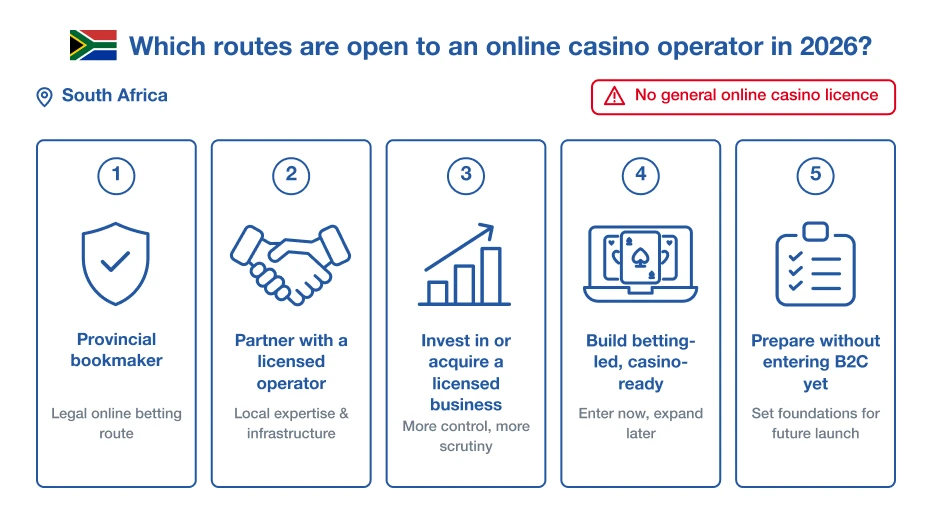
With no general online casino licence available, market entry starts with deciding what kind of South African presence makes commercial sense. For an international casino operator, the options range from entering the existing regulated betting market to establishing the foundations for a future casino launch. Each comes with different levels of commitment, regulatory exposure and immediate commercial opportunity.
1. Enter through a provincial bookmaker
An operator can pursue a bookmaker licence through a Provincial Licensing Authority and establish a legal online betting business. Depending on the province and specific approvals, this may include certain products beyond conventional sports betting. A bookmaker licence is not an online casino licence, however, so slots and RNG casino games cannot simply be added. Provincial choice matters too, as licensing processes, product interpretations, costs and regulatory approaches differ across South Africa.
2. Partner with an existing licensed operator
Rather than establishing a regulated operation from scratch, an international business could explore a commercial partnership with an existing South African licensee. This can provide local market knowledge, established infrastructure, and experience with provincial regulation, while allowing each party to contribute different capabilities.
It should not be viewed as a way around the rules, as the licensed entity remains responsible for operating within its permissions, while changes to products, systems, ownership or control may require regulatory approval.
3. Invest in or acquire a licensed business
For operators seeking greater control, investing in or acquiring an existing licensed business is another possible route. This differs from a commercial partnership because it places corporate ownership and regulatory suitability directly under scrutiny. Existing licences should not be treated as freely transferable assets. Changes in ownership or control can require approval, while B-BBEE (Broad-Based Black Economic Empowerment), beneficial ownership and fit-and-proper considerations may affect how a transaction can be arranged.
4. Build a betting-led operation with casino expansion in mind
For operators with both sportsbook and casino capabilities, South Africa can potentially be approached through the product that already has a legal route. A locally licensed betting operation can establish payments, compliance processes, customer relationships and operational experience while casino products remain separated. The important architectural requirement is that today's permitted offering does not decide tomorrow's product. If casino regulation eventually arrives, expansion should involve adding an authorised vertical rather than replacing infrastructure built solely around sportsbook.
5. Prepare for casino regulation without entering B2C yet
For a casino-first operator with little interest in sportsbook, waiting to launch does not have to mean doing nothing. Corporate structuring, potential partnerships, payment providers, compliance processes, supplier relationships and platform configuration can all be investigated before conventional casino gaming becomes licensable. This route generates no immediate B2C casino revenue, but it can remove work from a future launch.
Build for the market South Africa may become
For casino operators, South Africa's regulatory uncertainty raises a practical question about technology: How much of the platform would need to change if the rules changed? Building around today's permitted products alone may solve an immediate problem while making tomorrow's expansion unnecessarily difficult.
Separate products rather than hard-code the casino
Sportsbook, permitted contingency betting, slots, RNG tables, and live casino should be manageable separately. The same applies to individual game suppliers and content feeds. If a product cannot be offered in a particular jurisdiction, operators should be able to turn it off without changing the underlying platform. Similarly, operators should be able to add newly authorised content without rebuilding the existing operation.
Make compliance configurable by jurisdiction
Product availability is only part of the equation. KYC processes, player accounts, responsible gambling controls, payment methods, limits, reporting, supplier availability and even front-end content may need to change according to local requirements. These should be configuration decisions rather than development projects wherever possible.
What the Remote Gambling Bill tells operators
South Africa's proposed Remote Gambling Bill (B11-2024) provides some indication of what a future regulated market could demand. The proposal envisages remote operator and supplier licensing alongside requirements covering player accounts, identity and age verification, gambling equipment and software, with provincial authorities retaining an important licensing role.
There is no guarantee that this proposal will become law in its current form. But it demonstrates why preparing for regulation means more than keeping a casino catalogue ready to switch on. With flexible architecture, regulatory change becomes largely a matter of reconfiguration and approval.
A practical online casino entry plan for South Africa
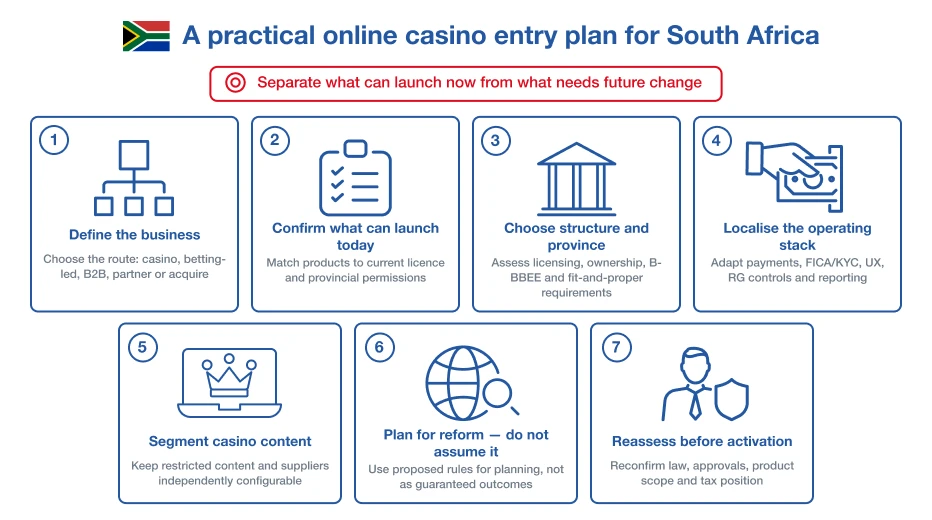
There is no single route into South Africa that will suit every casino operator. However, you can put the decisions into a logical order that separates what is possible now from what requires further change.
- 1. Define the business you want to operate
Decide whether the immediate objective is casino, betting with future casino expansion, a B2B presence, partnership, acquisition, or another practical route into the market. - 2. Establish what can legally launch today
Identify which products the chosen licence and province currently permit, and keep conventional interactive casino content outside the South African offering wherever it remains prohibited. - 3. Select the appropriate provincial and corporate structure
Carefully assess licence availability, provincial requirements, B-BBEE, ownership, fit-and-proper checks, and commercial considerations before committing to a corporate structure or local operating model. - 4. Localise the operating stack
Adapt payments, FICA and KYC processes, mobile UX, responsible gambling controls and reporting to South African requirements rather than simply importing another market's existing setup. - 5. Segment casino content and suppliers
Keep slots, RNG tables, live casino and individual suppliers independently configurable so restricted content can remain unavailable without limiting products that can operate legally. - 6. Prepare for, rather than assume, regulatory reform
Use proposed requirements as planning signals, but do not build around an assumption that B11-2024 will pass or that its final provisions remain unchanged. - 7. Reassess before activation
Before activating any new product, reconfirm legislation, provincial interpretations, product permissions, technical approvals and taxation — including the status of the proposed national gambling tax — particularly while South Africa's regulatory position continues to develop.
Download the South Africa online casino market-entry readiness checklist
Inside:
- What can legally launch today, by product and by provincial route
- The corporate and provincial questions to settle before committing to a structure — licence availability, B-BBEE, ownership, fit-and-proper
- Which parts of the operating stack need localising, from FICA and KYC to payments and responsible gambling controls
- A pre-activation re-check list covering legislation, provincial interpretation, technical approvals and tax status
- The architecture decisions that determine whether future authorisation means adding a vertical or rebuilding a platform
This article is general commercial commentary and does not constitute legal advice. South Africa's position on online casino gaming is actively disputed and changing; operators should obtain advice from qualified South African gambling counsel before making commercial decisions.
Prepare for South Africa now
For online casino operators, waiting for regulation and preparing for it are two very different strategies. A conventional casino cannot simply be switched on under an overseas licence, but that does not prevent operators from making decisions today about corporate structure, payments, compliance, suppliers and technology that could shorten the route to market later.
There is also the question of what can operate in the meantime. For businesses pursuing a betting-led entry, Altenar's sportsbook technology can provide the foundation for a locally permitted sports betting operation, while sister company Agreegain provides the casino platform, aggregation and content-management capabilities needed to support a broader iGaming offering where those products are legally available. The two businesses are designed to work together across sportsbook and casino environments.
For South Africa, that level of flexibility is essential for international operators in 2026. The objective is not to build around today's restrictions, but to operate within them while retaining the ability to adapt when the market changes.