

Is your casino platform making market expansion more expensive?
Updated 30 Oct 2026•Published 30 Oct 2026
Key takeaways
- Market support means little until you know how the platform handles rule changes after launch.
- Count settings, not markets, because every difference between jurisdictions becomes either a configuration or a development project.
- Hidden dependencies inflate simple changes when games, suppliers, tax logic or registration flows serve several markets at once.
- Real regulatory shifts expose platforms, as PAGCOR's supplier rules and the UK's new duty rates show.
- Scenario questions beat feature lists, so ask providers to show what they would have needed to change.
- Configurable architecture cuts expansion costs by letting each new market reuse decisions you already made.
“Germany, Brazil, Ontario? Yes, we support those markets.” If you're choosing a casino platform with plans to expand, that's exactly the answer you want to hear from a software provider. It suggests you can cross one major concern off the list. The technology is ready, and when the business is ready for the next market, the platform will be too.
But what does the term ‘support’ actually mean? It may mean the platform can meet that market's requirements today. That matters, of course, but it tells you surprisingly little about how expensive supporting that market could become. Regulated markets evolve. Payment rules change, new player-protection requirements emerge, supplier restrictions are introduced, and tax treatment is revised. The possibilities are endless.
Now the platform has to change too, and this is where two operators using different technology can have very different experiences. One makes the necessary changes and gets on with business. The other discovers that something which sounded like a simple adjustment needs developers, testing and a release.
Suffice it to say, you don't want to discover which operator you are when a regulatory deadline is already running. So, before taking a long list of supported markets as evidence that a casino platform is ready for your expansion plans, there are some more revealing questions worth asking. Combined, they tell you far more about what your second, fifth or tenth market could really cost.
Where does configuration end and development begin?
So, what separates those two operators we previously alluded to? You may be surprised to learn that, more often than not, it's something remarkably simple, like whether the platform lets you change a market-specific rule.
Take a payment method that is no longer permitted in one jurisdiction, for instance. If payments can be managed separately for each market, the operator may be able to disable it without touching anything else. If that capability wasn't built into the platform, the same request will ultimately turn into a development request.
Multiply that across everything that differs between regulated markets, which includes KYC, player limits, games, suppliers, taxes, reporting and responsible-gambling controls, etc., and the significance is evident. Each requirement is either something the platform is already designed to configure, or something that needs additional work when the scenario occurs.
That gives us a much more useful way to assess a casino platform. Rather than counting how many markets it supports, find out how many differences between those markets are settings and how many become development projects.
8 things that can turn your next market into a development project
So where should you look for that difference? Start with the parts of the platform most likely to encounter a different rule when you cross a border. The following eight areas give prospective platform buyers a useful starting point.
| Area | What you need to know? |
|---|---|
| Products | Can individual verticals be enabled or disabled by jurisdiction? |
| Games and suppliers | Can suppliers or individual titles be restricted in one market without affecting another? |
| KYC | Can verification requirements, providers and journeys differ by jurisdiction? |
| Responsible gambling | Can controls and interventions be applied independently in each market? |
| Player limits | Can different limits be configured at jurisdiction level? |
| Payments | Can individual payment methods and providers be enabled or restricted by market? |
| Tax | Can tax rates and calculation rules differ without changing core wallet or accounting logic? |
| Regulatory reporting | Can reporting accommodate different regulatory data and formatting requirements? |
Products:
A market may permit sports betting but restrict particular casino products, or vice versa. You need control over each vertical without changing the wider offering.
Games and suppliers:
Approval can differ at supplier and game level. Check whether you can remove one title or an entire supplier in a single jurisdiction.
KYC:
Verification isn't identical everywhere. Different documents, checks, providers, or points in the registration journey may apply to different players. In Ontario, for example, it isn't enough to know who the player is. Operators also need to confirm the player is physically located in the province at the time of play, which means identity checks and geolocation have to work together.
Responsible gambling:
Player-protection requirements can dictate different controls and interventions. Those rules need to work locally rather than forcing the same approach across every market.
Player limits:
Deposit, wagering and other applicable limits may differ. Germany is a good example. Online slots are capped at a €1 stake per spin with a minimum five-second interval between spins, while a default €1,000 monthly deposit limit applies across all licensed operators and is monitored centrally through the LUGAS system. Changing one jurisdiction's limits shouldn't mean altering the rules applied elsewhere.
Payments:
A payment method available in one country may be restricted in another. In Brazil, licensed operators can accept deposits through Pix, bank transfers and debit cards, but credit cards, cryptocurrencies and cash are not permitted. Market-level controls allow that difference without rebuilding the payments setup.
Tax:
Different rates are only part of the problem. Jurisdictions can also tax different activities or calculate liabilities differently, creating problems when tax logic cannot adapt by market.
Regulatory reporting:
Regulators don't necessarily ask for the same information in the same way. Reporting needs to accommodate those differences without becoming a custom build each time.
Go back to the three markets we started with. Germany, Brazil and Ontario each ask something different of the same platform: stake and deposit limits in one, payment restrictions in another, and player location in the third. A provider can truthfully say it supports all three. The more useful question is whether each of those differences sits in a jurisdiction-level setting, or in logic that every market shares.
None of this means every future regulatory requirement should be reduced to a setting. Some changes will legitimately need development. The real risk is discovering too late that what looked like a simple change actually requires development.
When a simple platform change becomes anything but simple
Before assuming a change will be straightforward, you will need to know what it is connected to.
Suppose you need to remove a game from one market, for instance. That game may also be tied to bonus eligibility or other product rules. A change to tax treatment might reach into wallet or accounting logic. Disabling a supplier becomes more complicated if the same feed serves several jurisdictions. Even a new identity check can become a larger project if the same registration process is used across multiple markets.
These connections are not always so easy to spot. Everything works as expected until someone needs one part of the platform to behave differently. Only when the change is needed does the operator discover what else it affects.
Regulatory reporting can create the same problem. A reporting system designed around one regulator's requirements may work perfectly for years, but adding another jurisdiction with different data or formatting requirements can expose just how much of that original structure was fixed in place.
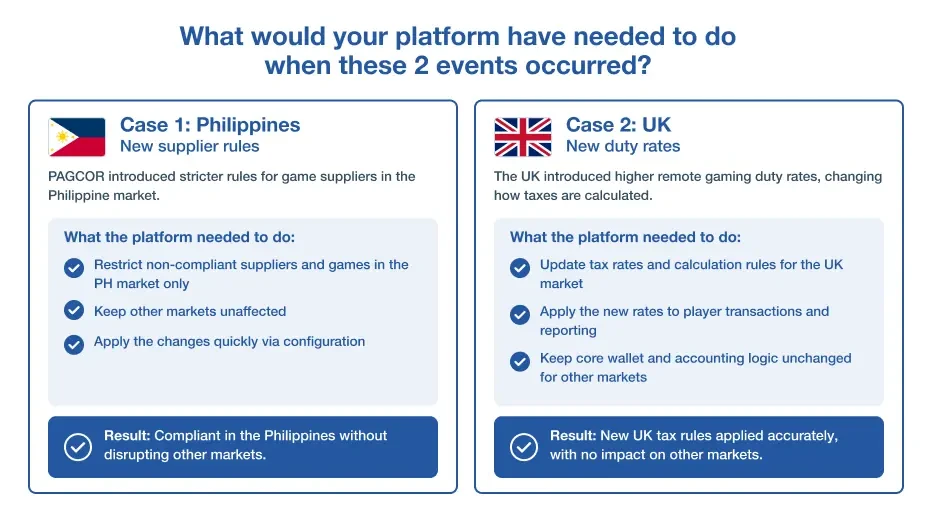
What would your platform have needed to do when these 2 events occurred?
Case study 1: Philippines
What happens when supplier requirements become demanding?
PAGCOR has progressively tightened the rules governing the technology and content suppliers serving its regulated electronic gaming market. A revised framework introduced in September 2024 required foreign, non-accredited content providers with previously approved content to become accredited or work through an accredited reseller if they wanted that content to remain available.
The changes didn’t stop there. Transition guidelines for existing B2B providers followed in October 2025, and in May 2026, PAGCOR issued another memorandum covering compliance with accreditation applications for contracted B2B providers.
Put yourself in the operator's position as those requirements change. You already have games and suppliers connected to a live platform. If one of those suppliers can no longer meet the requirements for serving that market, how difficult is it to remove its content? More importantly, can you remove it from the Philippines without removing it anywhere else?
Case study 2: UK
What happens when the tax structure changes?
UK operators faced a very different test in April 2026 when Remote Gaming Duty jumped from 21% to 40%. Even that wasn't simply a matter of replacing one number with another. From April 2027, a new 25% remote betting rate is due to apply, while remote bets on UK horseracing remain taxed at 15%.
So let's imagine your platform was designed around a relatively simple assumption about how UK gambling taxes were calculated. Can it now apply different treatment by product and effective date, while keeping the underlying wallet and accounting processes working as intended?
These are very different regulatory developments, but they make useful platform tests. When talking to a prospective provider, you can turn them into a simple challenge by asking, ‘Show us what we would have needed to change.’
The examples above also suggest a different way to approach platform demonstrations. You already know that the platform works in the markets the provider supports today. Spend some of that meeting time finding out what happens when those markets change.
Rather than asking broadly about flexibility or configurability, put specific situations to the provider and find out where your control ends and their development work begins. These five questions are a good place to start:
Five questions to ask before choosing your casino platform
When configuration becomes a commercial advantage
None of this suggests regulation can somehow be made inexpensive. What the right platform architecture can change is how much development work each new requirement creates.
Agreegain approaches this through configurable technology that gives operators control over market-specific requirements without treating every difference as a new development project. Products, content, payments and other operational rules can be managed around the needs of individual markets, while its modular architecture and API capabilities allow additional services and integrations to be incorporated as requirements develop.
For an operator with expansion plans, that advantage becomes increasingly valuable. Opening market five shouldn't mean rebuilding decisions already solved for markets one through to four. Nor should adapting an existing market automatically leave you waiting for space on a development schedule.
Because the worst time to discover the limits of your platform is when a regulator has already provided a deadline. Migrating technology is a substantial undertaking under normal circumstances, but doing it while simultaneously implementing new regulatory requirements adds another level of cost and complexity.
Don't just ask which markets a casino platform supports. Find out how easily the platform can adapt when the rules change.
Popular blog posts