

What operators can customise on a white-label platform in 2026 – and what they can’t
Updated 15 Sept 2026•Published 15 Sept 2026
Key takeaways
- The front end flexes, the back office doesn't — branding and design offer high control, while reporting, segmentation and integrations follow the provider's rules.
- Control shrinks by layer — high on the front end, moderate in the back office, minimal across licensing, compliance and core infrastructure.
- The bonus engine is usually the first ceiling — standard campaigns run fine, but complex rules and automated rewards need provider-led development.
- The dangerous limits stay invisible until you scale — CRM automation depth, raw data access, reporting flexibility and API availability decide retention and marketing efficiency.
- Compliance restrictions are regulatory, not commercial — they cut flexibility but lift a substantial operational burden off the operator.
- A blocked requirement signals a model change — needs beyond white-label scope point to turnkey or a full API solution, not to a weak platform.
In 2026, it is fair to say that pretty much all white-label casino providers promote features such as custom branding, dedicated domains, and the ability to launch under your own identity. While these claims are generally accurate, they can sometimes create the impression that every aspect of the platform is fully customisable. This simply is not the case.
The front-end of a white-label casino, including branding, design elements, promotional content, and game presentation, is usually highly flexible. It is the back office, however, where operators are more likely to encounter the biggest limitations. Areas such as reporting, player segmentation, bonus configuration, integrations, and data access are typically influenced by the provider's infrastructure and licensing framework.
Identifying what can be customised and what remains fixed helps prevent costly misunderstandings later as the business develops and ensures the chosen platform aligns with both current requirements and long-term business goals.
The three levels of customisation
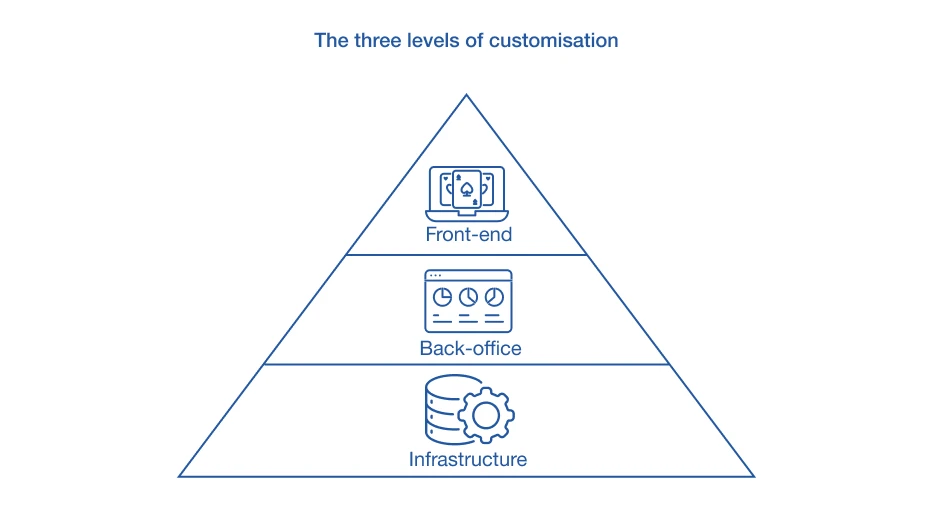
When operators evaluate a white-label platform, it helps to think about customisation in three distinct levels. Each level offers a different degree of control and flexibility.
The front-end is the part players see and interact with every day. This includes branding, design, content, promotions, and the overall user experience. In most white-label solutions, operators have a high degree of control over these elements.
The back-office remains behind the scenes and includes functionality such as bonus management, player segmentation, reporting, and CRM tools. While there is often flexibility in these areas, customisation tends to be more structured and provider-dependent.
Finally, the underlying infrastructure, including licensing, compliance frameworks, and core platform architecture, is typically managed by the provider and offers the least scope for operator control.
| Platform layer | Typical level of control for operators |
|---|---|
| Front-End | High |
| Back-Office | Moderate to Limited |
| Infrastructure | Little |
Customisation across the platform
The word customisation can sometimes be used as though every feature carries the same importance. In practice, that is not the case. Changing a logo or homepage layout is very different from changing how player data is managed, how promotions are automated, or how reports are generated.
The overview below shows the typical level of control operators can expect across different parts of a modern white-label casino platform, and why it matters.
| Platform layer | White-label control level |
|---|---|
| Brand & design | High |
| Game lobby | High |
| Bonuses | Medium |
| CRM | Medium |
| Reporting & data | Medium-low |
| Payments & integrations | Medium-low |
| RG and compliance | Low |
Front-end & brand
This is typically the most flexible part of a white-label platform. Operators usually control their domain, logo, colours, navigation structure, promotional content, and many of the pages players interact with. Some providers also allow significant adjustments to layouts and user journeys. The provider generally retains control over the underlying platform architecture and certain user interface frameworks because these are shared across multiple brands. These limits exist to maintain platform stability and consistency. For most operators, the operational impact of these restrictions is minimal. The ability to create a distinct brand experience remains strong, making front-end customisation one of the white-label model's strongest advantages.
Game lobby & content
White-label operators typically have considerable control over how games are presented to players. This normally includes selecting from the provider's available game catalogue, creating featured game sections, organising categories, and highlighting specific titles or suppliers within the lobby. However, the provider usually controls which game studios and content are available in the first place. These limitations are linked to commercial agreements, licensing requirements, and the technical integrations already built into the platform. For most operators, this is not a major restriction, particularly during the early stages of growth. The ability to customise the game lobby remains high, although operators seeking access to specific suppliers or game content may eventually require a more flexible platform model.
Bonus engine & promotions
Bonus tools are usually flexible enough to support the promotions most operators use every day. Deposit bonuses, free spins, cashback offers, and other standard campaigns can be configured without difficulty. The boundaries tend to emerge when operators want more complex promotions or highly customised bonus rules. Because the bonus engine resides within the provider's shared platform infrastructure, certain campaign types, eligibility conditions, or automated reward systems may not be available without additional development work. This is often the first meaningful customisation ceiling operators encounter. While it may not affect day-to-day operations initially, promotional flexibility becomes increasingly important as competition grows and retention strategies become more sophisticated. In some cases, achieving that level of control may require provider-led development or a move to a turnkey solution.
Player segmentation & CRM
Some white-label platforms allow operators to create basic player segments and target campaigns to specific groups. This is often enough to support standard retention activities, promotional offers, and reactivation campaigns. The limitations usually appear when operators want more advanced automation or highly customised player journeys. Features such as complex behavioural triggers, multi-step retention workflows, or deeply personalised campaigns may depend on the provider's CRM capabilities and configuration options.
Reporting & data
Most white-label platforms provide standard reports, dashboards, and export tools that cover the day-to-day needs of most operators. However, access to underlying data and third-party business intelligence is typically more restricted. These limitations arise because reporting systems are typically built on the provider's shared infrastructure and data architecture. This is one of the most commonly overlooked areas of platform evaluation, since the biggest customisation limitations are often invisible until operators begin scaling and need more advanced analytics.
Payments & integrations
Most white-label platforms give operators access to a range of approved payment service providers and local payment methods. This is often sufficient for launching in a target market and providing players with familiar deposit and withdrawal options. Limitations appear when operators want to onboard a specific payment provider, connect third-party tools, or gain direct access to platform APIs. Because payments, security, and technical integrations are closely linked to the provider's infrastructure and compliance obligations, these changes invariably require provider approval and support. For many operators, these limitations are a reasonable trade-off for faster market entry. However, businesses with complex integration requirements or highly specific payment strategies may eventually need a platform model that offers greater technical control.
Compliance & responsible gambling
Compliance is one of the least customisable areas of a white-label platform. Operators may be able to configure certain settings, player limits, and responsible gambling tools, but the provider typically controls the underlying compliance framework. This includes areas such as regulatory procedures, player verification requirements, monitoring systems, and certification standards. These elements are closely tied to the provider's licence, regulatory obligations, and approved operating processes. Unlike branding or promotions, many restrictions in this area are not commercial decisions but regulatory necessities. While this can reduce flexibility, it also removes a significant operational burden from the operator.
The limits that can hurt business goals
Not all customisation limits have the same impact on the business. A missing colour option, a fixed menu layout, or a small design restriction is quite unlikely to affect profitability. Consequently, most operators can build a strong brand within the front-end flexibility already available on modern white-label platforms.
The more significant limitations tend to hide in the background. Areas that deserve particular attention include:
- Advanced CRM triggers and automation
- Player segmentation depth
- Reporting flexibility
- Access to raw data and exports
- Third-party integrations and API access
These capabilities can directly impact retention, marketing efficiency, player value, and operational decision-making. They influence how effectively an operator can understand player behaviour, personalise campaigns, and optimise performance over time.
For this reason, experienced operators often focus less on how the homepage looks and more on how the platform supports the business after launch. The most important customisations are not typically visual. They are operational, and they become more important as the business grows.
You can also watch our video on how white-label licensing works.
White-label: limited, or the wrong model altogether?
Not every limitation is a problem. In many cases, what an operator sees as a restriction is simply a trade-off that comes with a faster and more cost-effective route to market. The key question is whether the platform supports the operator's business goals today and in the future. If the requirement falls outside the scope of a white-label model, it may not indicate a weak platform. It may simply show that a different delivery model is more appropriate.
| Operator priority | Best fit |
|---|---|
| Fast launch, lower costs, reduced regulatory burden | White-label |
| Custom reporting, advanced CRM automation, extensive integrations, and greater ownership of data | Turnkey |
| Maximum operational control across every aspect of the business | Full API Solution |
White-label options are great for some, but there is no single platform that's right for every operator. That's why Agreegain offers multiple delivery models designed for different stages of business growth.