

The reality of 24/7 casino platform support and what operators need to know now
Updated 28 Aug 2026•Published 28 Aug 2026
Key takeaways
- "24/7 support" has no standard definition — for some providers it means round-the-clock engineers; for others, only that a ticket gets acknowledged at any hour.
- Judge resolution time, not response time — two providers can both reply in two minutes on a Saturday night, while only one has an engineer working within fifteen.
- A single incident owner beats escalation chains — every handoff between support tiers adds delay, miscommunication and repeated explanations.
- Engineers must be reachable at 3 AM — a support desk that collects information overnight while developers work office hours is not 24/7 support.
- Proactive monitoring cuts downtime — continuous watch over payments, infrastructure and integrations catches issues before operators or players notice.
- Test support at procurement, not during an outage — once a live incident exposes the gaps, switching providers is no longer a practical option.
A casino can lose revenue in many ways, but some of the most damaging incidents are also the most common. Deposits stop processing. Withdrawals begin failing. Players find themselves unable to access games that were working minutes earlier. The problem is that none of these issues need to last long to affect customer satisfaction and revenue.
Of course, you report the issue and receive a response almost immediately. Yet hours later, the problem is still there.
This is where many operators discover that ‘24/7 technical support’ does not always mean what they assumed it meant. While some providers maintain genuine round-the-clock operational support, others simply guarantee that somebody will acknowledge a ticket straight away.
But the real difference is not measured by how fast someone responds, but by how quickly normal operations are restored. And when service interruptions occur during peak activity, that distinction can become very expensive.
Response time is not the same as resolution time
One particular challenge when it comes to evaluating casino platform providers is that the term ‘24/7 support’ isn’t defined consistently across companies. In many cases, it simply means that support requests can be submitted and acknowledged at any time of day. That may sound reassuring, but an acknowledgement is not a solution. An operator experiencing a critical issue at midnight may receive an immediate response confirming that the ticket has been received, only to discover that the people capable of investigating and resolving the problem are unavailable until normal business hours resume.
For this reason, operators need to pay close attention to the distinction between response time and resolution time. Consider a technical failure on a Saturday evening. Provider A acknowledges the issue within two minutes but advises that the engineering team will investigate on Monday morning. Provider B also responds within two minutes, but an engineer begins actively working on the issue within fifteen. The point is that both providers can legitimately claim to offer 24/7 support. Yet from the operator's perspective, the experience is entirely different. One has provided reassurance, while the other has provided a solution.
For casino operators, the difference matters because technical incidents do not operate according to business hours. Revenue-generating activity, customer engagement, and operational responsibilities continue around the clock. The value of support is therefore not determined by how quickly someone responds to a ticket, but by how quickly normal operations can be restored. When evaluating providers, operators should look beyond response-time commitments and understand the resources, processes, and accountability that underpin them.
What quality 24/7 casino platform support looks like
If response time alone does not define support quality, what does? Ultimately, genuine 24/7 support should not be just about having somebody available to answer a ticket at any hour. It is about having the processes, technical resources, and accountability required to investigate and resolve problems whenever they occur. While providers may use similar language in sales materials and service agreements, the day-to-day reality can be very different. For operators conducting due diligence, the following areas often provide the clearest insight into the quality of a provider's support operation.
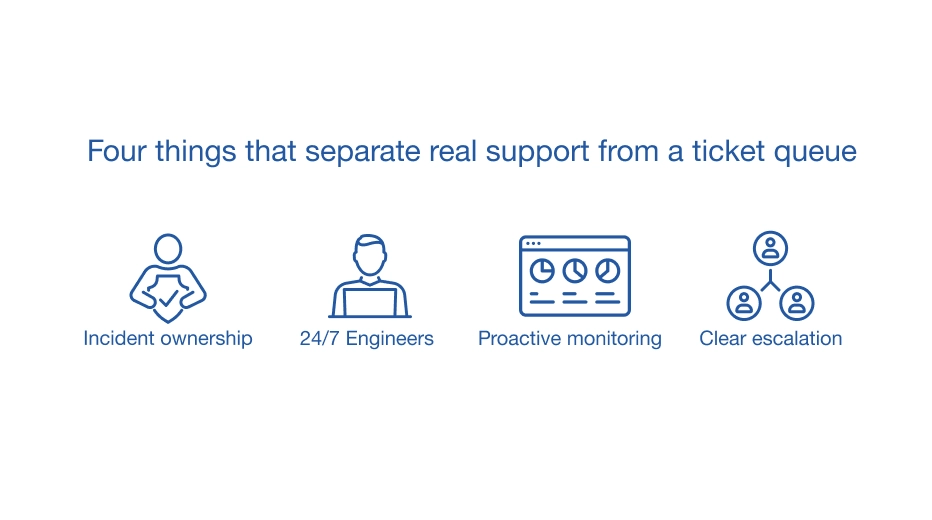
1. Incident ownership, not endless escalation
One of the most frustrating aspects of a live incident is being passed back and forth between multiple support teams while trying to explain the same problem over and over. Each handoff introduces delays, creates opportunities for miscommunication, and slows the investigation process. Effective support models reduce this by assigning a single incident owner who remains accountable from the moment the issue is reported until it is resolved.
Consider a situation in which withdrawal failures begin during peak traffic. One provider may move the issue through several support tiers before it reaches the right technical team. Another may assign an incident manager who coordinates developers, infrastructure specialists, and third-party vendors while keeping the operator informed throughout the process. The SLA may appear similar on paper, but the experience is very different. Clear ownership creates accountability, improves communication, and helps ensure that resolving the issue remains the priority.
2. Around-the-clock engineering teams
Many providers offer 24/7 support desks, but that does not necessarily mean technical specialists are available around the clock. In some cases, support agents can collect information and acknowledge incidents, while the teams responsible for fixing problems only become available during normal working hours.
Real 24/7 support requires access to people who can diagnose and resolve issues whenever they occur. Depending on the nature of the incident, this may include developers, infrastructure engineers, payment specialists, or integration teams. This becomes particularly important when problems affect core operations. A high-priority outage occurring on a weekend or public holiday does not become less important simply because it falls outside office hours. Operators should therefore understand not only who answers support requests, but also who is available to work on incidents when immediate intervention is required.
3. Proactive monitoring instead of reactive ticketing
The strongest support teams do not wait for operators to discover every problem on their own. Modern casino platforms generate large volumes of operational data that can be monitored continuously for signs of abnormal behaviour. This includes payment processing performance, platform infrastructure, third-party integrations, transaction flows, and other essential services that contribute to the player experience.
When monitoring systems are configured effectively, support teams can often identify emerging issues before they develop into major incidents. This allows investigations to begin earlier and, in some cases, enables corrective action before operators or players become aware of a problem. While no monitoring strategy can prevent every incident, proactive detection can significantly reduce the severity and the amount of downtime. It also demonstrates a support model focused on operational continuity rather than simply responding to tickets after a disruption has already occurred.
4. Defined resolution targets and clear accountability
Support quality is often determined by what happens after an incident has been identified. Efficient and responsible providers establish clear procedures for classifying incidents based on severity, assigning responsibility, and escalating issues when necessary. This structure helps ensure that the most business-critical problems receive the attention they require without unnecessary delays.
Equally important is transparency. Operators should understand who is responsible for resolving an issue, how progress is being tracked, and when updates can be expected. Defined resolution targets provide the basis for prioritisation, while documented escalation steps help prevent incidents from stalling between teams. During high-pressure situations, uncertainty can be almost as damaging as the technical problem itself. Clear accountability and consistent communication give operators confidence that incidents are being actively managed and moved towards resolution.
Most issues in support only become apparent after a live incident has already occurred. By that stage, changing providers is not a practical option. For this reason, operators should evaluate support capabilities during the procurement process rather than treating them as a secondary consideration. The following questions can help reveal whether a provider's support operation is designed to resolve incidents efficiently or simply manage support tickets.
The questions below can help operators determine whether a provider is equipped to resolve incidents efficiently or simply manage support tickets.
Questions every operator should ask before signing a contract
Support should be part of the partnership, not a premium add-on
As casino operations grow, support becomes far more than a technical function. New payment methods are added. Additional game providers are integrated. New jurisdictions introduce fresh compliance and reporting requirements. Each adds a new level of complexity and creates new dependencies that must be monitored, maintained, and supported.
This is why experienced operators do not view technical support as a separate service attached to a platform contract. Instead, they view it as an essential part of the provider relationship. Technology may power the operation, but expertise, accountability, and operational support help keep it running smoothly when challenges arise.
Popular blog posts