How to choose a casino platform provider: 10 key questions to ask
Updated 14 Jul 2026•Published 14 Jul 2026
Key takeaways
- Migration complexity makes your first platform choice effectively permanent — choose as if you cannot switch.
- Regulated-market readiness must be built in from day one; retrofitting compliance is slow and expensive.
- Total cost of ownership runs far beyond licensing fees — get the full pricing structure in writing.
- Retention tooling that segments players turns promotions into strategy instead of spend.
Launching an online casino can look deceptively simple from the outside. Modern platforms promise quick deployment, game providers offer thousands of titles, and payment solutions appear readily available. Yet behind every successful online casino operation lies a complex array of technology, integrations, and tools that must work harmoniously together.
Unless you plan to build an online casino from scratch, it is the casino platform provider that brings these components together into a single operational environment.
For investors and entrepreneurs interested in developing a new online casino project, choosing the right platform provider is, therefore, one of the most important decisions you will make. The questions asked at this stage often determine how easily the business launches, how efficiently it operates, and how successfully it expands over time. This guide outlines the key questions operators should ask when evaluating platform providers, and why those questions matter.
Why platform selection is the most important decision in an online casino project
For anyone launching an online casino, the decision about which platform to use is far more than a technical detail. It is the operational foundation of the entire business. Every core function of the casino, from game delivery and player account management to payments, compliance monitoring, and reporting, runs through the platform infrastructure.
Because of this central role, the choice of provider greatly influences how efficiently the operation runs from day one and how easily it can grow in the future. While game content, marketing strategy, and branding attract players, it’s the platform itself that allows those elements to function reliably at scale.
Ultimately, a poorly structured platform can introduce further complications. Payment integrations may become unstable, and downtime during peak traffic periods can damage player trust. Over time, these weaknesses can limit growth and create ongoing operational issues.
But changing providers after launch is also much more complex than many new investors realise. Once a casino begins accumulating active player accounts, balances, bonus states, and transaction histories, migrating those records into another system becomes a major technical project.
For this reason, selecting the right platform provider at the beginning of an iGaming project is one of the most impactful decisions an operator will make. Before committing to a provider, investors should carefully evaluate the capabilities, flexibility, and long-term suitability of the platform under consideration.
What investors often underestimate in early planning
The early stages of planning an online casino often focus on visible elements such as game content, branding, and marketing strategy. Yes, these areas are important, but they are not often the key factors that determine whether a platform can operate effectively and reliably once the casino goes live. Many new operators discover that the real challenges appear in the infrastructure supporting payments, compliance, and operational oversight.
One common mistake is placing too much emphasis on the number of game providers available while overlooking the systems that keep the casino running. While a diverse game portfolio helps attract players, the ability to manage transactions securely, monitor player behaviour, and maintain regulatory reporting standards is what sustains a casino over time.
Payment infrastructure is another area that investors frequently underestimate. Integrating with reliable payment providers, supporting local payment methods in target markets, and maintaining fraud-prevention measures all require careful coordination between the platform and external financial systems.
Compliance obligations can also be more demanding than expected. Licensing frameworks typically require detailed reporting, responsible gaming controls, and transaction monitoring capabilities.
In addition, operational tools such as analytics dashboards, reporting systems, and player activity tracking are sometimes overlooked during early planning. Yet these tools play a major role in understanding player behaviour, refining marketing strategies, and managing risk. Investors who evaluate these elements from the outset are far better positioned to build a stable and scalable casino operation.
10 questions that can help identify the right casino platform provider
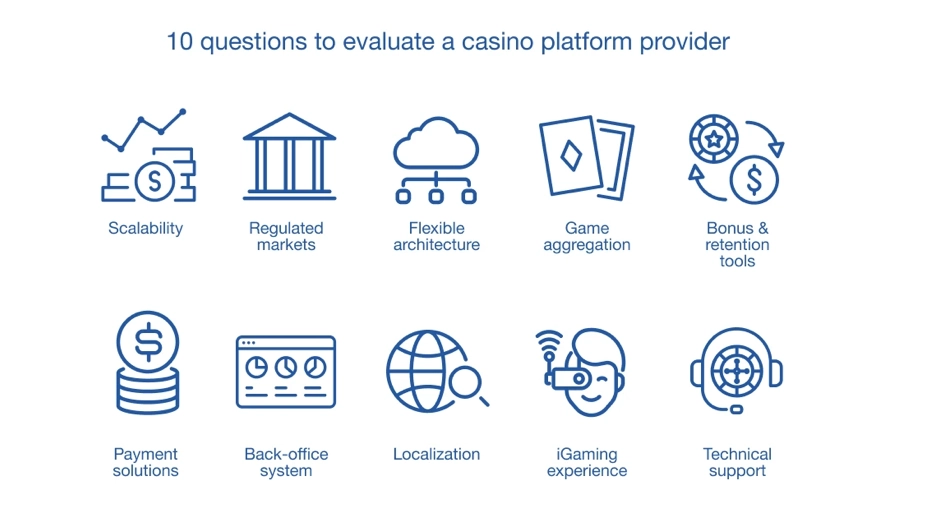
Choosing a casino platform provider involves more than reviewing product features or marketing presentations. Experienced operators approach this decision as a due diligence exercise on technology, examining how the platform will support operations not only at launch but throughout the life of the business.
The following questions highlight some of the most important areas investors and operators should explore when evaluating potential platform partners. Each one reflects a practical aspect of running a real-money online casino, from infrastructure and compliance to payments, operational tools, and long-term scalability.
1. Is the platform designed for scalability?
It is scalability that ultimately determines whether an online casino can grow without running into technical limitations as player activity increases. Many platforms will perform well during the early stages of a project, when traffic levels are relatively modest. However, as marketing campaigns succeed and player numbers rise, systems that were not built to scale can begin to struggle under increased demand.
This can become particularly noticeable during large promotional campaigns, like jackpot tournaments, for instance, or major sporting events, when thousands of players may be active simultaneously. Platforms that lack the capacity to handle sudden traffic increases may experience slower performance, transaction delays, or temporary service interruptions.
In competitive markets, even short disruptions can affect player confidence and retention, as users will not hesitate to switch to another casino if the experience becomes unreliable.
A scalable platform is built with infrastructure that can support rising player volumes without sacrificing stability. This typically involves modern hosting environments, load-balancing systems, and database structures designed to manage high levels of concurrent activity. For operators planning long-term growth, scalability is not simply a technical preference. It is a requirement that supports reliable operations as the business expands.
2. Does the platform support regulated markets?
For operators planning long-term growth, the ability to operate in regulated markets is an essential consideration when selecting a casino platform provider. Licensing frameworks in jurisdictions such as the UK, Malta, or various European and Latin American markets require platforms to support specific compliance functions, including player verification, responsible gaming controls, transaction monitoring, and detailed regulatory reporting.
If a platform has not been designed with these requirements in mind, adapting it later can be costly and time-consuming. Operators may need to introduce new tools, rebuild reporting systems, or restructure internal processes to satisfy licensing authorities.
Platforms already experienced in regulated environments typically include built-in compliance features that support audit trails, responsible gaming measures, and reporting obligations for various worldwide jurisdictions. Ultimately, for investors evaluating long-term expansion opportunities, choosing a platform that meets regulatory expectations from the start can significantly simplify future entry into chosen markets.
3. How flexible is the platform architecture?
Flexibility determines how easily an online casino can adapt as the business evolves. Markets change quickly, new technology appears, game providers release new content, and regulatory institutions introduce new requirements. A platform built with a rigid structure can make these adjustments slow, expensive, or technically complicated.
Modern casino platforms are typically built using modular designs and open integrations that allow operators to connect third-party services, suppliers and tools without disrupting existing systems. Such flexibility allows operators to introduce new features, expand into additional markets, or adapt operational processes without needing major redevelopment.
For investors, platform flexibility directly affects long-term growth potential. A system that allows operators to integrate new tools and services as opportunities arise provides far greater operational freedom than a closed environment that restricts development and integration options.
4. How strong is the platform’s game aggregation network?
Game content remains one of the primary drivers of player engagement in online casinos, which makes the strength of a platform’s aggregation network an important consideration. Aggregation refers to a platform's ability to integrate and manage games from multiple software providers within a single system.
A strong aggregation network gives operators access to a diverse portfolio of slots, table games, live dealer products, and emerging formats without requiring separate integrations for each supplier. This simplifies operations while allowing casinos to offer a broader selection of content to players.
Operators should also consider how quickly new game providers can be added and how effectively the platform manages performance data for each title. Platforms that support efficient content integration and monitoring make it easier for operators to refine their game portfolios over time and respond to player preferences as they evolve.
5. How advanced are the bonus and retention tools?
Attracting players to an online casino is only the first step. Long-term success depends on how effectively operators can retain those players and encourage continued engagement. Bonus and retention tools play a central role in this process, allowing operators to design promotions that reward activity while maintaining control over marketing costs.
Modern casino platforms typically include systems that allow operators to configure a wide range of incentives, such as welcome offers, free spins, cashback campaigns, and loyalty rewards. However, the real value of these tools lies in their ability to target specific player groups rather than applying the same promotions across the entire customer base.
Platforms with advanced retention capabilities allow operators to segment players based on behaviour, activity levels, and transaction history. This makes it possible to tailor incentives more precisely, improving player engagement while avoiding excessive promotional spending. The bottom line for operators seeking sustainable growth is that these tools help transform promotional campaigns into structured retention strategies rather than short-term marketing incentives.
Want to learn how different generations respond to casino design, promotions, and user experiences? Watch our video on generational design in online casinos.
6. What payment infrastructure is supported?
Payments are fundamentally one of the most important components of any online casino operation. Players expect deposits and withdrawals to be processed quickly and securely, using methods familiar to their region. A platform’s payment infrastructure, therefore, plays a central role in the player experience.
Operators should evaluate how many payment providers are integrated into the platform and whether local payment methods can be supported in the markets they plan to target. Credit cards, digital wallets, bank transfers, and alternative payment methods may all be important depending on regional preferences.
It is also important to consider how the platform manages transaction monitoring and fraud prevention. Reliable payment systems help reduce failed transactions and security risks while ensuring that player balances and withdrawals are processed accurately. For operators entering competitive markets, a stable, flexible payment infrastructure can significantly affect player satisfaction and retention.
7. How powerful is the back-office system?
While players interact with the front end of an online casino, the back-office system is where operators manage the business. This environment controls player administration, financial monitoring and reporting, risk management, and many operational decisions that influence daily performance.
A capable back-office system allows operators to monitor player activity, review transaction data, manage bonuses, and track key performance indicators in real time. Further to this, dashboard and reporting tools help teams understand how games, promotions, and payment systems are performing across the platform.
Detailed player activity tracking is also important for identifying unusual behaviour, managing risk, and maintaining compliance with regulatory requirements. Platforms that provide flexible reporting tools and customisable dashboards give operators greater visibility over their operations. For growing casinos, strong back-office capabilities make it easier to manage increasing volumes of player activity while maintaining control over operational processes.
8. What localisation capabilities are available?
In the modern iGaming industry, localisation plays an important role when an online casino operates across multiple markets. Player preferences, payment habits, language requirements, and regulatory expectations can vary significantly between jurisdictions. A platform that supports localisation allows operators to adapt the casino experience to different regions without rebuilding core systems.
This typically includes the ability to offer multiple languages, currencies, and region-specific payment methods, as well as adjusting promotional settings to suit the preferences of local audiences. In some markets, localisation also extends to compliance features, such as jurisdiction-specific responsible gaming settings or reporting requirements.
Platforms that support flexible localisation make it easier for operators to expand into new territories while maintaining a consistent operational environment. Instead of launching separate systems for each market, operators can manage regional variations within a single platform, which simplifies operations and reduces technical complexity as the business grows.
9. How proven is the provider in real-money iGaming?
It should come as no surprise to anyone to learn that experience in real-money iGaming can make a significant difference when selecting a platform provider. Operating a live gambling platform involves far more than software development. It requires an understanding of regulatory requirements, payment processing, player behaviour, fraud prevention, and the operational realities of running an online casino platform in competitive markets.
Providers with established industry experience, therefore, are far more likely to have already addressed many of the technical and compliance challenges that arise during daily operations. Their platforms have been tested under real player traffic, integrated with multiple payment providers, and adapted to regulatory environments across different jurisdictions.
Operators should also consider the provider’s track record in terms of partnerships, market presence, and successful deployments. A provider currently powering ambitious live casino brands demonstrates that the underlying technology and operational processes have been proven in real-world conditions.
10. What level of technical support can operators expect?
Technical support matters in any online business, but it becomes even more important for online casino platforms where uninterrupted 24/7 operations are essential. Even well-designed systems occasionally require adjustments, troubleshooting, or updates as new integrations, content, or technologies are introduced. When issues arise, the speed and quality of support provided by the platform vendor can directly affect operational continuity.
Operators should understand which support structure is available, including whether assistance is available around the clock and whether a dedicated account manager will be assigned to their project. Clear communication channels and defined response times help ensure that technical problems can be resolved quickly when they occur.
Reliable support becomes particularly important as a casino grows and handles larger volumes of player activity. Providers that offer structured support teams and ongoing technical guidance can help operators maintain platform stability while continuing to expand their services and integrations.
Strategic considerations beyond platform features
While the previous questions focus primarily on platform functionality, experienced operators tend to look beyond individual features when evaluating a long-term technology partner. A casino platform will influence far more than day-to-day operations. It affects how a business manages costs, how easily it can adapt to new markets, and how much control the operator retains as the company grows.
For investors planning a new online casino project, understanding these broader implications is just as important as reviewing technical capabilities. The following strategic considerations highlight several factors that are often overlooked during early platform discussions but can have a significant impact on long-term operational success.
Understanding the total cost of ownership
The headline price of a casino platform does not necessarily reflect the full operational cost of running it, since platform licensing fees are only one component of a bigger picture.
Operators must also consider revenue share arrangements with game providers, payment processing fees, compliance costs, hosting infrastructure, and ongoing support or development services. Marketing tools, CRM systems, and fraud-prevention services may also incur additional expenses.
Understanding the complete pricing structure helps investors avoid unpleasant surprises once the platform is live. Providers that offer transparent pricing and clear explanations allow operators to build more accurate financial projections before launch.
Speed to market and launch timelines
Time-to-market is another factor that can influence the success of a new iGaming project, but the key issue for investors is often predictability rather than speed alone. Launching a casino platform requires a period of development, configuration, and integration before the business can begin generating revenue. During this stage, operational costs continue to accumulate while the platform remains in preparation.
Platform deployment timelines can vary widely depending on the provider’s infrastructure, integration process, and licensing requirements. If the launch schedule extends beyond the original estimate, investors may face additional development costs and a longer period before the project begins generating returns.
For this reason, operators should ask providers to outline a realistic deployment schedule and identify the stages involved, including platform configuration, content integration, payment setup, and testing. Clear timelines help investors plan budgets more accurately and reduce the risk of unexpected delays during the launch phase.
Choosing the right platform model
Not all casino platforms offer the same level of operational control. Understanding the differences between common platform models is important when defining a long-term strategy.
White-label casino platforms typically allow operators to launch quickly with minimal technical involvement, but they may limit control over branding, payments, or licensing arrangements. Turnkey casino platforms, on the other hand, offer greater independence, allowing operators to run their own brand while relying on a provider’s infrastructure and integrations. Fully-owned platform solutions go further to provide the highest level of control, but require larger technical teams and development resources.
From the start, however, operators should also consider how easily their business model can evolve. Many projects begin with simpler arrangements before moving toward more independent structures as the operation grows. Choosing a provider that allows operators to transition between models without rebuilding the entire platform can help avoid costly restructuring later.
Data ownership and player insights
Player data is one of the most valuable assets an online casino can develop over time. Access to behavioural insights, transaction histories, and engagement metrics allows operators to optimise content, refine marketing strategies, and improve retention.
For this reason, investors should clearly understand how data is stored and who ultimately controls access to it. Some platforms maintain strict control over data environments, which can limit the operator’s ability to analyse or export player information. Others provide more flexible data access through reporting tools, APIs, and analytics dashboards.
Clarifying data ownership early in the partnership helps operators maintain strategic control over one of the most important resources in digital gaming operations.
Platform migration risks
Once a platform is live and has accumulated active players, switching providers becomes a complex operational process that requires careful planning.
Migration often involves transferring player accounts, balances, wallet systems, bonus states, and historical activity records into a new infrastructure. Database compatibility issues can create additional complications, particularly when platforms store data differently. Operators must also consider potential downtime, which can affect player trust and revenue if not handled carefully.
Because of these challenges, selecting the right platform from the outset is essential. Many established operators treat their platform provider as a long-term strategic partner rather than a short-term technology vendor.
Casino platform comparison and evaluation PDF guide
Selecting a casino platform provider typically involves multiple discussions with different vendors, each presenting their technology, integrations, and commercial structure in different ways. For investors and operators evaluating several options, it can quickly become difficult to compare platforms on a consistent basis.
To help organise this process, we have prepared a practical casino platform checklist to help you review and assess options during provider discussions. The checklist contains more than 30 evaluation points covering key areas.
Download the casino platform checklist
The foundation behind successful online casinos
An online casino may appear to players as a collection of games and promotions, but behind the interface lies a platform architecture that powers the entire operation. Today’s online casino platform software, when built well, is designed to bring together the core operational components required to run a live gaming environment, including content integration and payments, compliance tools, and player management systems.
Platforms built with modular architectures allow operators to add new integrations, services, and regulatory configurations without rebuilding core infrastructure. This flexibility becomes especially valuable as the business grows, enabling operators to expand into new markets or introduce additional capabilities without disrupting existing operations.
Content availability is another key factor. Platforms connected to large aggregation networks provide operators with access to a wide range of casino games from multiple software providers within a single environment. Alongside content delivery, integrated payment connections and transaction monitoring tools help ensure that deposits, withdrawals, and player balances are handled efficiently and securely.
When these capabilities and operational systems are unified, operators can focus less on technical complexity and more on developing the casino business.
Understanding the technology behind successful casinos is important, but seeing it in action provides even greater clarity.
Popular blog posts