
What is a casino game aggregator and how does it work

Updated 3 Jul 2026•Published 3 Jul 2026
Key takeaways
- Single API integration removes the need to connect to each game studio separately — one integration point covers the entire provider network and significantly reduces ongoing technical maintenance.
- Wallet and compliance coordination sit inside the aggregation layer — these are not peripheral features but core infrastructure that affect day-to-day operations across every connected provider.
- Certification support from bodies like eCOGRA and GLI is part of how aggregators reduce regulatory workload, particularly for operators managing multiple licensed markets simultaneously.
- Commercial model selection requires evaluating operational capability alongside price — lower upfront costs can generate higher long-term workload if integration quality and support depth are weaker.
- Scalability is the real evaluation criterion — infrastructure that handles a small provider network smoothly may not support efficient multi-market expansion without creating operational drag.
Few casino operators still build content portfolios provider by provider. As competition increased and game libraries expanded, many operators have moved towards aggregation to reduce workload and simplify platform management.
But aggregation is no longer simply about accessing larger game libraries. For many operators, the structure and quality of an aggregator now influence efficiency, market expansion, and the ability to manage growing technical complexity across multiple providers and jurisdictions.
What is a casino game aggregator?
A casino game aggregator acts as a central connection layer between an online casino and multiple game providers. Instead of integrating each studio separately, operators connect to the aggregator once, which then distributes content from numerous suppliers through a single system.
This allows operators to access a wide range of content, including slots, live dealer games, table games, crash titles, instant-win games, jackpots, and other casino products, without managing dozens of independent integrations simultaneously.
At a technical level, the aggregator exists on a level between the operator platform and the game providers, helping coordinate various operational processes connected to an online casino. This is why game aggregator software has become increasingly common among both new and established operators looking to scale efficiently.
Not all aggregators operate in the same way, however. Some primarily distribute content, while others provide deeper infrastructure support involving compliance management, localisation, promotional tools, reporting systems, and operational standardisation across providers.
How does a casino aggregator work?
Behind the front-end casino lobby, aggregators coordinate a large amount of technical and operational activity simultaneously. From game distribution and content management to wallet communication and compliance handling, modern aggregation systems simplify processes that would otherwise require multiple independent integrations.
Single API integration
One of the main advantages of aggregation is that operators integrate once rather than connecting separately to every game studio. Through a single online casino API integration, the aggregator distributes provider content across the casino platform, reducing integration workload while making it easier to expand game portfolios over time.
Content delivery and game management
A modern iGaming aggregator platform helps operators manage how games are launched, displayed, localised, and restricted across different markets. The underlying game aggregator software coordinates APIs, content delivery, lobby visibility, jurisdiction controls, and provider availability, allowing operators to manage large game libraries far more efficiently from a central environment.
Wallet and player transactions
Aggregators also help coordinate player balance management between the casino platform and connected providers. Depending on the infrastructure model, operators may use single-wallet or transfer-wallet systems. Aggregators often simplify balance synchronisation, transaction reporting, and bonus interaction management across multiple providers operating simultaneously inside the same casino environment.
Certification and compliance handling
iGaming aggregation platforms can also reduce some of the operational complexity connected to certification and regulatory management. RNG approvals, RTP variations, jurisdiction-specific restrictions, provider licensing requirements, and content permissions often need ongoing coordination. Independent test houses such as eCOGRA and GLI (Gaming Laboratories International) handle much of the RNG and RTP certification operators rely on, and many aggregators help standardise parts of this process, particularly for operators expanding across multiple regulated markets.
Why casino operators use casino game aggregators
The initial appeal of a casino game aggregator is straightforward: faster access to larger game portfolios without the need to manage dozens of individual provider integrations. But as casino platforms grow, the operational advantages can become far more significant than the volume of content itself.
One of the biggest commercial benefits is faster time-to-market. Rather than negotiating, integrating, testing, and maintaining every provider independently, operators can launch broader casino offerings through a single aggregation. This also helps reduce internal development pressure and lowers ongoing technical coordination across multiple studios.
Over time, many operators realise that the greatest value of an iGaming aggregator platform lies in simplifying the ongoing management of providers, content, compliance, and platform administration at scale. Aggregators help simplify market expansion, centralise content administration, and reduce duplication by managing reporting structures, localisation settings, provider permissions, and compliance requirements separately across different suppliers.
Aggregation also supports more scalable portfolio growth. As operators add new providers, expand into additional jurisdictions, or adjust content strategies over time, a centralised aggregation environment is usually easier to manage than maintaining large numbers of direct integrations independently.
The main components inside an aggregator
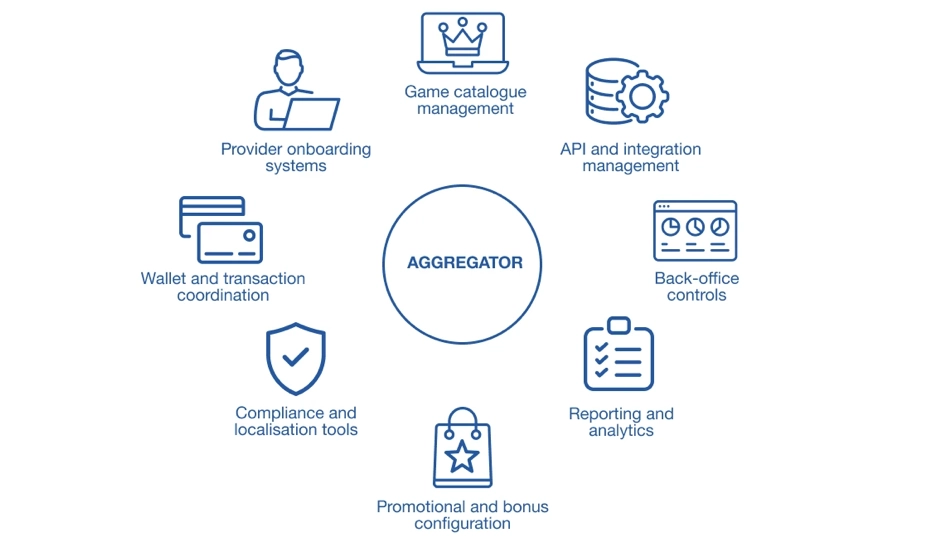
Modern aggregation systems operate as central management environments that help coordinate content delivery, provider infrastructure, operational administration, compliance handling, and commercial configuration across multiple suppliers simultaneously.
Game catalogue management
Controls how games are organised, displayed, categorised, filtered, and managed across the casino environment. This usually includes provider visibility, regional availability, content sorting, lobby positioning, and the ability to activate or remove games across different jurisdictions.
API and integration management
Handles the technical coordination between the operator platform and connected game providers. This includes API communication, content routing, provider connectivity, update management, and ongoing integration maintenance across multiple suppliers operating through the same aggregation environment.
Back-office controls
Provides operators with a centralised environment for managing provider settings, permissions, operational configurations, and content administration. Back-office tools often simplify day-to-day platform management by reducing the need to coordinate directly with multiple suppliers one at a time.
Reporting and analytics
Aggregation platforms typically come with reporting tools that help operators monitor game activity, provider performance, player engagement, transaction data, and operational trends. Centralised reporting can make large content portfolios easier to analyse and manage across different markets and providers.
Promotional and bonus configuration
Many aggregators support promotional tools connected to tournaments, jackpots, free spins, leaderboard campaigns, and provider-specific bonus features. These systems help operators manage promotional activity across multiple suppliers through a more unified operational environment.
Compliance and localisation tools
Aggregation platforms frequently help operators manage jurisdiction-specific restrictions, RTP configurations, certification requirements, localisation settings, and content permissions. This can simplify parts of regulatory management, particularly for operators expanding across several regulated markets at the same time.
Wallet and transaction coordination
Many aggregation systems help coordinate player balance communication, transaction reporting, and wallet interaction between operators and providers. Depending on the infrastructure model, this may involve single-wallet or transfer-wallet functionality across multiple connected game studios.
Provider onboarding systems
As operators expand their content portfolios, onboarding systems help simplify the process of adding, configuring, testing, and managing new providers. This can significantly reduce operational workload compared to maintaining separate integrations.
Commercial models and pricing
Aggregation providers do not all operate under the same commercial model. Pricing can vary depending on provider relationships, content access, platform services, commercial scale, and the level of included infrastructure support. Operators weighing these arrangements often compare them against wider monetisation approaches such as CPA, revenue share, and hybrid deals.
| Commercial model | How it typically works | Common considerations |
|---|---|---|
| Revenue Share | The aggregator receives a percentage of gaming revenue generated through connected providers. | Lower upfront cost but ongoing revenue participation over time. |
| Flat Platform Fee | Operators pay a fixed recurring fee for access to the aggregation platform and connected services. | More predictable operational costs for some operators. |
| Hybrid Model | Combines fixed platform fees with revenue share agreements. | Often used for broader infrastructure or managed service arrangements. |
| Provider-Based Commission Structures | Commercial terms vary depending on agreements between aggregators and individual game providers. | Costs and commercial flexibility may differ across content suppliers. |
| Custom Enterprise Agreements | Larger operators may negotiate bespoke commercial arrangements based on scale, markets, or operational requirements. | Commercial flexibility often increases at higher volume levels. |
Commercial terms should be evaluated alongside the operational capabilities included within the aggregation. Lower-cost models may appear attractive initially, but differences in integration quality, provider onboarding efficiency, reporting depth, compliance support, and operational capability can significantly affect long-term platform management as operations scale up.
Choosing the right casino aggregator
Selecting a casino aggregator should be more than comparing the number of games. As online casino operations grow, the quality of the aggregation will influence operational efficiency, platform flexibility, compliance management, and the ease of future expansion across providers and jurisdictions.
Integration quality remains one of the most important considerations. Poorly structured integrations can create additional workload that accumulates over time, particularly when onboarding new providers or supporting multiple regulated markets.
Operators should also evaluate how efficiently an aggregator handles localisation and promotional configuration. Some platforms primarily distribute games, while others provide broader operational environments designed to simplify day-to-day administration.
Scalability matters as well. Infrastructure that functions well with a small provider network may become more difficult to manage as operational complexity increases. This is why many operators now evaluate aggregation platforms not only for content access but also for their ability to support long-term operational growth with efficiency.
As aggregation infrastructure becomes more important, many operators are expanding their evaluation. Agreegain's downloadable Casino Aggregation Evaluation Checklist explores key technical, commercial, and scalability considerations involved in selecting an aggregation partner.
Schedule a demonstration to see how Agreegain's game aggregator software helps operators manage larger provider portfolios, reduce operational complexity, and simplify multi-market administration through centralised aggregation infrastructure.
Popular blog posts