

Running an online casino in Mexico at 50% tax: The unit economics operators get wrong
Updated 18 Sept 2026•Published 18 Sept 2026
Key takeaways
- The 50% rate took effect on 1 January 2026 under a decree published in the DOF on 7 November 2025. For permit-holding operators it applies after qualifying prizes, so the base tracks GGR rather than turnover — but not every operator sits on that base.
- A 2024 federal court decision supports deducting prizes before the rate applies, though it addressed the pre-reform 30% rate.
- IEPS is one layer of a stacked burden that also includes corporate income tax (ISR) plus state and municipal levies.
- Non-resident operators owe the tax where the player sits, and face temporary blocking of their digital service for non-compliance
- Industry bodies estimate that a majority of Mexico's online gambling offer sits outside the legal framework, so licensed operators compete against rivals who remit nothing.
- Treat the cost of a bonus as a range until qualified Mexican counsel confirms how bonus-funded play enters the calculation.
- Rebuild affiliate terms and payback benchmarks for Mexico rather than importing them from Brazil or Colombia.
The commercial case for entering Mexico has looked decidedly different since 1 January 2026, when the rate of Mexico's Special Tax on Production and Services (IEPS) on betting and prize draws rose from 30% to 50%. The increase was introduced by the decree amending the IEPS Law published in the evening edition of the Diario Oficial de la Federación on 7 November 2025, which reformed the first paragraph of Article 2, section II, subsection B) of the Law. This prompted many businesses to reassess whether the market still fits their commercial objectives. On paper, the arithmetic appears straightforward. A higher tax rate simply means lower margins. In practice, the impact runs much deeper than that. It changes the economics of customer acquisition, bonus strategy, affiliate agreements, and the time required to recover marketing investment.
This isn't an article about whether operators should enter Mexico. It's about understanding which commercial assumptions still work under the new tax regime, which ones deserve reconsideration, and why looking beyond aggregate GGR often provides a much clearer picture of how the business is really performing.
Disclaimer
This information is not intended to be legal advice and is solely extracted from open sources. It should not be relied upon as a substitute for professional legal advice, and Agreegain does not accept any liability for its use.
Why a 50% tax hike changes more than profitability
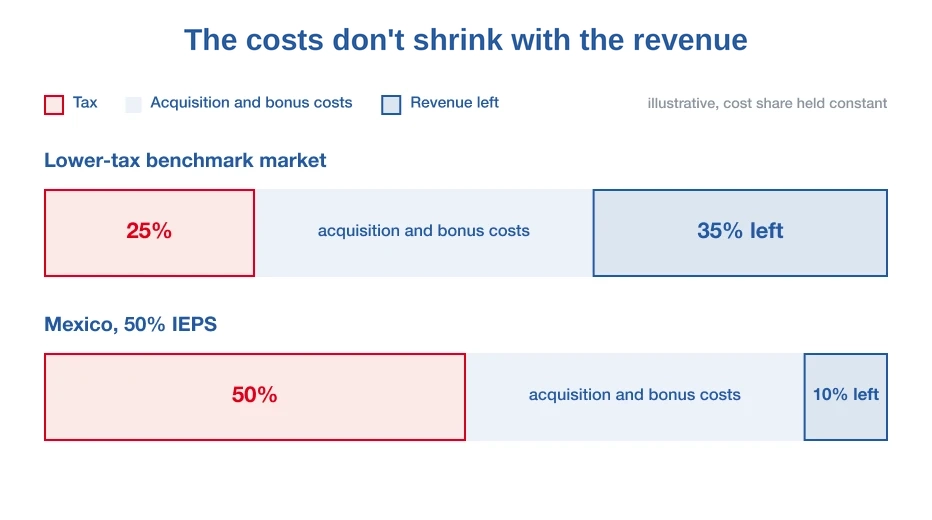
When building a financial model for Mexico, it is natural to look to other parts of Latin America for reference points. Markets such as Brazil and Colombia can provide useful benchmarks for acquisition costs, bonus strategies, affiliate agreements and player value. The problem comes when those benchmarks are carried across without accounting for Mexico's very different tax position.
A 50% IEPS rate doesn't affect every part of the business equally. Acquisition costs do not automatically fall because taxes have increased. Affiliates still expect commercially attractive terms, and players still respond to bonuses and promotions. What changes is the amount of revenue left to absorb those costs. A bonus strategy or affiliate agreement that makes commercial sense elsewhere may therefore be much harder to justify in Mexico.
This also changes how operators should think about growth. Increasing player volumes may look positive at GGR level. But still, that growth becomes much less valuable if the cost of acquiring and retaining those players rises faster than their post-tax contribution.
There is also a competitive dimension that does not appear in any tax calculation. AIEJA, Mexico's association of permit holders and operators, has estimated that around 60% of the online gambling offer available in Mexico sits outside the legal framework. Other industry figures have put it closer to half. Either way, licensed operators are not competing on level terms. The compliant side of that comparison has just become 20 percentage points more expensive.
The concern is not confined to industry commentary. Tax lawyers at Lazcano y Avedillo warned that raising the rate could cost the SAT in the region of MXN 12 billion — roughly USD 650 million — as licensed operators withdraw and players migrate towards unregulated platforms. The Ministry of Finance took the opposite view when the measure was proposed, projecting MXN 5,024 million in additional revenue for 2026.
For operators, the practical consequence is that bonus generosity, pricing and product quality are being judged by players against alternatives that carry no tax burden at all. Assumptions about conversion and retention drawn from markets with a smaller grey channel are likely to prove optimistic in Mexico. The important question is therefore not simply how much tax is paid, but which commercial assumptions remain realistic once that tax is applied.
Understanding what is actually taxed
Before looking at how the 50% IEPS rate affects the unit economics of an online casino, there is an important misconception to clear up. The tax is sometimes described as though operators simply hand over 50% of everything players wager. That is not how the calculation works.
Mexico's 50% IEPS is not applied to every peso wagered. In simple terms, operators can deduct qualifying prizes paid to players before the tax rate is applied. For example, if players wager MXN 100 and the operator pays MXN 96 back in prizes, the amount left is MXN 4. The 50% IEPS would then be calculated against that remaining amount, producing MXN 2 of tax before considering any other permitted adjustments.
MXN 100 wager means MXN 96 paid back = MXN 4 remaining. 50% tax = MXN 2.
Article 18 of Mexico's IEPS Law therefore works much more like a tax on the amount retained after qualifying prizes are deducted than a tax on total betting turnover. The rate itself sits in Article 2, section II, subsection B), while the deductions that shape the base sit in Article 18. The November 2025 decree amended both, so operators working from an older consolidated text will be reading the wrong version.
The order of that calculation was litigated. A 2024 decision of the Segundo Tribunal Colegiado en Materia Administrativa del Tercer Circuito held that the rate applies once the authorised amounts have been subtracted, rather than to the gross figure with the deductions taken afterwards. Two qualifications matter. The decision concerned the 30% rate in force in 2015, so it addresses the pre-reform wording. And the reasoning itself accepts that the Law does not state the precise moment at which the rate is to be applied, relying instead on the Supreme Court's earlier jurisprudence 1a./J. 128/2009 on how the base of this contribution must be constructed. It is an isolated thesis on an earlier version of the provision rather than a settled point.
For permit-holding operators, then, the taxable base is much closer to GGR than turnover, although the precise deductions that can be claimed still matter. That logic does not travel to everyone the tax now reaches. The same decree added a provision covering online games and draws offered from abroad by providers without an establishment in Mexico, and for those services the taxable value is the total received from players with no deduction at all. A non-resident digital provider facing the same 50% headline rate can therefore be facing a very different effective burden, which is why the licensing position has to be settled before any of this arithmetic is useful.
The 50% rate is not the whole tax burden
Understanding the IEPS base correctly solves only part of the modelling problem, because IEPS is not the only tax an operator carries in Mexico. Operators also pay corporate income tax (ISR) on net profit, while states and municipalities apply their own levies, and some jurisdictions add a consumption tax on gambling activity on top of that. The 50% headline figure therefore describes one layer of a stacked burden rather than the total cost of operating.
This matters for any model built on regional comparisons. A payback calculation that treats IEPS as the sole tax line will understate the true cost of a Mexican player, and the gap widens as the business becomes profitable — precisely the point at which income tax begins to bite. Operators should establish the full stack for their specific corporate structure and target states before benchmarking Mexico against Brazil or Colombia.
Who the 50% rate now applies to
The 2026 reform also addressed a question that had previously left room for interpretation: which operators fall within scope. Digital betting and gaming are now taxed at 50% whether the provider is resident in Mexico or offering services from abroad through the internet or a digital intermediation platform. Those provisions were added by the same November 2025 decree, which inserted three further paragraphs into Article 2, section II, subsection B) and added new Articles 18-B and 20-A to the Law. Non-residents without a permanent establishment in Mexico are liable where the recipient of the digital service is located in Mexican territory, which is the point Article 18-B fixes.
The obligations attached to that are cross-referenced rather than set out in full: the second paragraph of Article 2, section II, subsection B) directs foreign providers and intermediation platforms to Articles 5-A BIS and 20-A of the IEPS Law, and Article 20-A in turn requires non-resident providers to comply with Article 18-D, sections I, VI and VII of the VAT Law — registration in the RFC, appointment of a legal representative with a domicile in Mexico, and an advanced electronic signature. Article 20-A also requires monthly reporting to the SAT on the number of services supplied to recipients in Mexico and the number of those recipients, monthly calculation and payment of the tax on consideration actually collected, filed by the 17th of the following month.
Non-compliance carries a sanction with no equivalent in most markets. The fourth paragraph of subsection B), and the closing paragraphs of Article 20-A, provide for temporary blocking of access to the provider's digital service, applied under Articles 18-H BIS to 18-H QUINTUS of the VAT Law. Article 20-A also confirms that meeting these obligations does not by itself create a permanent establishment in Mexico.
One drafting point is worth flagging rather than resolving. Articles 5-A BIS and 20-A are written by reference to subsection D) — the videogame provisions — while subsection B) directs betting providers to comply with them "as applicable". How that cross-reference operates in practice is a question for Mexican counsel, not something a commercial model should assume away.
For a model that treats market entry as a marketing and content decision, these are new line items rather than administrative details. Registration, local representation and the reporting capability required to remit correctly all sit inside the cost of serving a Mexican player, and they arrive before the first peso of GGR does.
Once the taxable base is understood correctly, the commercial questions become considerably more interesting.
Disclaimer
This information is not intended to be legal advice and is solely extracted from open sources. It should not be relied upon as a substitute for professional legal advice, and Agreegain does not accept any liability for its use.
The tax question sits inside a licensing question
One assumption sits underneath everything above and deserves stating plainly: that an operator can be licensed in Mexico at all.
Mexico does not issue a standalone online gambling licence. Permits are granted by the Dirección General de Juegos y Sorteos within SEGOB under the Federal Law of Games and Draws of 1947 and its 2004 Regulations, and online activity is treated as an extension of an existing land-based permit rather than as a separate category. Article 85 of the 2004 Regulations allows a permitted establishment to capture bets by internet, telephone or electronic means with a control system approved by SEGOB. That article carries most of the weight of the online regime.
New permits have not been issued for some years, and no application window or fee schedule for one is published. A November 2023 decree amending the Regulations also removed the "operador" route that previously allowed a company to operate under another entity's permit, with effect as existing permits expire. In practice the routes available are commercial arrangements with existing permit holders, for as long as their permits run. A comprehensive new gaming law has been discussed for several years but has not been enacted; the 1947 law and the 2004 Regulations as amended in 2023 remain the framework.
This changes how the tax question should be read. The 50% rate applies to non-resident providers serving players in Mexico whether or not they hold a permit, so IEPS and licensing are now two separate questions rather than one. Being within the scope of a tax is not authorisation, and the two should not be conflated in either direction. An operator can be fully within the scope of the tax while having no clear route to a permit, and the reporting and registration obligations described above arrive regardless. Anyone modelling Mexican unit economics should establish their licensing position first, with Mexican counsel, because it determines which of the two Article 18 bases applies to them — and that single point moves the model more than any assumption about acquisition cost.
Mexico is an outlier in that the permit route itself is closed. In markets that are actively issuing licences, the bar is moving in a different direction — our video The Responsible Gambling check deciding licence approval in 2026 looks at how responsible gambling standards are becoming a gating factor in licence approval.
How the 50% tax changes bonus economics
Bonuses are one of the first areas where Mexico's tax rules can complicate an otherwise straightforward financial model. Operators routinely use welcome offers, free spins and other promotions to acquire and retain players, but calculating their true cost under the 50% IEPS system requires more than simply adding promotional spend to the P&L.
The key question is how bonus-funded play should be treated for tax purposes. Article 18 bases the calculation for permit holders on amounts effectively received from participants. A bonus provided by the operator is not money received from the player, which raises an important question about how bonus-funded wagers, and any prizes subsequently generated from them, should enter the calculation.
For operators, there are three possible outcomes to model:
- Bonus-funded wagers fall outside the taxable amounts received. This could reduce the tax impact associated with promotional play.
- Prizes generated from bonus play receive different treatment. This could significantly change the effective cost of the same promotion.
- Only some amounts qualify for deduction. The final cost depends on exactly how the promotion operates and how each transaction is recorded.
Public guidance does not provide a sufficiently clear answer to settle these scenarios. None of the three outcomes above should be treated as the likely position; they are the range an operator needs to model against. This is one area where specific advice from qualified Mexican tax counsel is necessary before bonus assumptions enter a forecast.
Until that position is confirmed, the cost of a bonus in Mexico should be viewed as a range rather than a fixed number. And that range may be wide enough to change whether an acquisition campaign is commercially feasible.
The commercial assumptions that deserve rethinking
Once operators calculate performance after the 50% IEPS rate, several commercial assumptions begin to look different. The question is not whether these approaches still work, but whether they continue to deliver an acceptable return.
| Commercial area | Common modelling assumption | What changes in Mexico |
|---|---|---|
| Acquisition quality | Player volume supports growth | Post-tax contribution matters more than volume alone. |
| Bonus strategy | Promotions support acquisition and retention | True cost depends partly on tax treatment |
| Affiliate deals | Established revenue-share terms can be reused | Post-tax contribution may support different terms |
| Payback period | Regional benchmarks provide a useful guide | Higher taxes can extend recovery periods |
| Cash flow | Operating performance broadly tracks cash generation | Tax deductions can carry forward between months |
| Reporting | GGR provides a useful view of performance | Post-tax contribution becomes more important |
- Bonus strategy.
As discussed previously, the cost of promotional play needs to be modelled carefully under the Mexican tax regime. The important commercial point is that bonuses should be assessed on the contribution they ultimately generate, rather than acquisition volume alone. - Affiliate agreements.
Revenue-share percentages that work elsewhere may become difficult to sustain when Mexico's higher tax burden is added. Operators, therefore, need to model whether affiliate commissions are calculated against GGR or revenue after tax, and what contribution remains after that. - Payback periods.
If less revenue remains after tax to recover acquisition costs, the time required for a player to become profitable can increase. That makes imported CAC and payback benchmarks less useful unless they are recalculated for Mexico. - Cash flow.
A high-payout month does not necessarily produce an immediate tax benefit in cash. Where permitted deductions exceed the month's activity value, Article 18 allows the excess to carry forward into subsequent months rather than generating a refund. - Reporting.
Aggregate GGR can still look healthy while individual acquisition channels perform poorly after tax, bonuses and affiliate costs are included. Measuring contribution by acquisition channel and player group gives operators an earlier indication of where the economics are changing.
What operators need visibility into
The higher tax rate ultimately changes what operators need to know about commercial performance. Aggregate GGR remains an important measure, but on its own, it cannot show whether the players generating that revenue are still delivering an acceptable return after accounting for the costs of acquiring and retaining them.
Operators, therefore, need visibility beyond the headline number, in areas including:
- Contribution after tax: How much player revenue remains after the applicable IEPS has been accounted for?
- Contribution after bonuses: Are promotions generating enough additional player value to justify their true cost?
- Contribution after affiliate costs: Which acquisition partners continue to deliver players at commercially sustainable terms?
- Performance by player group: How do players acquired through different campaigns, channels, or periods perform once their associated costs are included?
- Market-specific reporting: Can Mexican tax calculations and commercial performance be measured separately from activity in other jurisdictions?
At a 50% IEPS rate, acquiring more players does not necessarily translate into better commercial performance. What matters is understanding which players, channels and promotional strategies continue to generate an acceptable return after the major costs are taken into account.
The sooner operators can see those differences, the sooner they can adjust acquisition spend, bonus strategy and commercial agreements accordingly.
Better reporting matters more at higher tax rates
Identifying those differences early depends on having reporting systems capable of showing them. That’s to say, it is one thing to know that contribution after tax, bonuses and acquisition costs should be measured. But it is another altogether to have that information available quickly enough to influence commercial decisions.
This is where better reporting and analysis become particularly important in a high-tax market such as Mexico. Operators need to understand not only how much revenue the casino generated, but where that revenue came from, what it cost to generate and how much value remains once tax and other major commercial costs are taken into account.
That requires visibility at several levels. Operators need to trace transactions and qualifying deductions accurately, separate Mexican tax calculations from those of other jurisdictions, and reconcile platform data with the figures ultimately reported for tax purposes. Mexico requires operators of games with bets and draws to run a central betting system, a cash-control system, and a channel that feeds that data to the SAT online and in real time.
Commercially, the same data should help operators identify which acquisition channels, player groups, and promotions are generating an acceptable return after tax. This becomes increasingly important as businesses expand across jurisdictions with different tax rates and reporting requirements.
Advanced reporting, therefore, serves two purposes. It demonstrates what happened for regulatory and tax purposes, while giving operators the visibility to decide what should happen next. At 50%, the real question is whether operators have enough visibility to recognise when a channel, promotion, or commercial agreement isn't working, and enough time to change it if needed.
Frequently asked questions
Disclaimer
This information is not intended to be legal advice and is solely extracted from open sources. It should not be relied upon as a substitute for professional legal advice, and Agreegain does not accept any liability for its use.
Popular blog posts