

When your competitors have the same 12,000 games, the difference is the first screen
Updated 17 Nov 2026•Published 17 Nov 2026
Key takeaways
- Aggregation levels the catalogue, so your competitors can offer the same games you do.
- Position inflates performance, because games in prime spots collect exposure that looks like popularity.
- Measure what happens after exposure by checking whether players open, play and return to a game.
- Every lobby rule needs an owner who can explain the sort order, categories, ‘New’ rules and demotions.
- Newness needs an expiry date, or a temporary boost turns into a permanent advantage.
- Personalisation still needs a brief, since operators must define goals, exposure rules and commercial priorities.
- Lobby control beats catalogue size when teams can change visibility without a development queue.
‘We have more than twelve thousand casino games.’ That claim sounds impressive, doesn’t it? And it is, until you realise your competitors have access to much the same catalogue.
And that, in a nutshell, is the awkward consequence of casino game aggregation. It has given operators access to extraordinary amounts of content, but it has also made large parts of the casino catalogue remarkably easy for competitors to replicate.
The player, meanwhile, isn't choosing between 12,000 games. Not at first, at least, and often not at all. They are choosing between the handful you decided to put in front of them.
Which brings us to the conversation that really matters. The library is bought. The lobby is already built. And if space on that first screen is so valuable, every game occupying it should have a good answer to one simple question. Why are you here?
And that is a question worth examining, because the difference between a catalogue of thousands of games and a casino that makes good use of those games could be much bigger than it looks.
The catalogue got bigger, but the shop window didn't
There is an obvious upside to having 12,000 games. More choice means more chances to have something a player wants to play. But it also creates a practical problem. You simply cannot give 12,000 games equal attention.
The catalogue may have grown enormously, but the screen hasn't. You can still only put so many games in front of a player at once, especially on mobile.
So somebody has to choose. Put one game in a prime position, and thousands of others miss out. Give an entire row to new releases, and that space cannot be used for something else. Keep last month's strongest performers at the top, and newer games may never get seen.
Ultimately, this means aggregation hasn't really removed game selection from being the operator's job. Getting the right games into the casino still matters. But once they are there, another job begins, and that is deciding which ones get the best chance of being played.
With many thousands of games competing for a relatively small shop window, those decisions deserve rather more thought because the value of a large catalogue increasingly depends on how intelligently you decide what gets seen.
Don't confuse visibility with popularity
So how do you decide what gets seen? Performance would seem an obvious place to start. If a game attracts players and generates revenue, giving it a prominent position makes commercial sense. Likewise, if something isn't performing, moving it down the lobby seems equally reasonable.
Except there is a complication with this approach. The position itself can influence the very performance you are measuring. Imagine, if you will, two games. One is positioned near the top of the lobby, and the other is several rows down. The first attracts more players and generates more revenue. It looks like the obvious game to keep promoting.
But how much of that difference came from the games themselves, and how much came from the opportunities players had to see them?
This can easily become a loop. A game performs well because it receives plenty of exposure. That performance earns it another month in a prominent position, which gives it more exposure and produces more evidence that it belongs there.
None of this, of course, means the game isn't genuinely popular. It means the numbers need context. Where the data allows it, operators can look beyond what a game generated and ask what happened after players were given the chance to see it. Did they open it? Did they play? Did they come back to it?
Without this kind of probing, yesterday's merchandising decisions can become today's evidence for keeping everything exactly where it is.
4 lobby decisions you should never run on autopilot
 copy.webp)
Every casino lobby has an order, categories and rules about what appears where. That doesn't necessarily mean anyone is actively managing them. A surprisingly useful test is to ask who made these four decisions, why, and when they were last reconsidered.
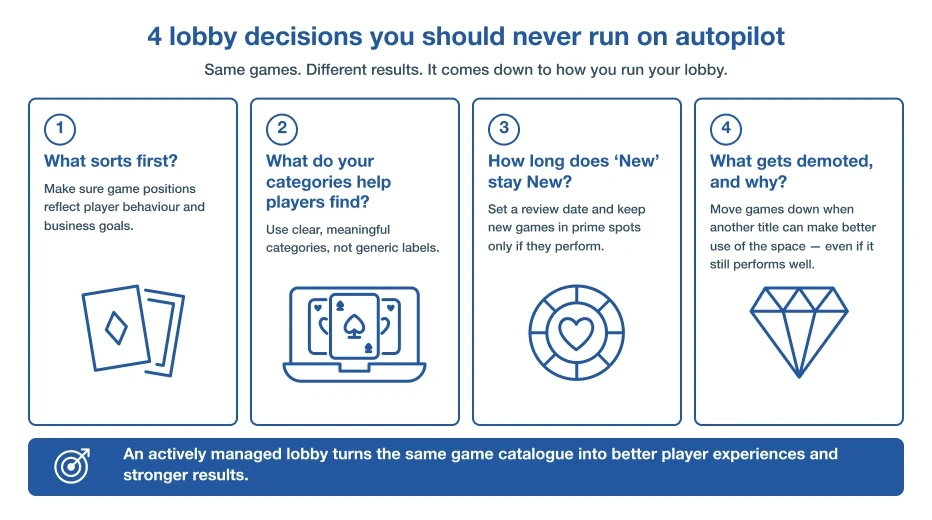
What sorts first?
Something has to occupy positions one, five and twenty-five. But the important question is what earned each game its place.
Perhaps the order follows revenue, recent player activity or new releases. Maybe different players see different games. Commercial priorities may also drive certain positions. All of those can be legitimate reasons.
However, if the answer comes down to ‘that's how the lobby is set up,’ the lobby may not be reflecting player behaviour or commercial priorities. It may simply be reflecting its own history. If nobody can explain why a player sees Game A before Game B, the lobby may reflect yesterday's priorities rather than today's.
What do your categories help players find?
Categories have another job beyond keeping a game library tidy. They should make choosing from them easier. That is worth remembering when a lobby fills up with rows labelled Popular, Featured and Recommended. There is nothing inherently wrong with any of those options. The question is whether they tell the player something useful.
Popular according to whom? Featured for what reason? And if Recommended shows broadly the same games to everyone, what exactly is the recommendation based on?
A useful category reduces the size of the decision. It takes a huge catalogue and gives the player a smaller selection with something meaningful in common. Without that purpose, categories can end up organising the lobby without doing much to help the player navigate it.
How long does ‘New’ stay New?
A new game has one obvious reason to receive extra visibility. Players haven't had much chance to discover it yet, so giving it a prominent position creates that chance.
But newness has an expiry date. At some point, the game has had its introduction and needs another reason to keep the space. Perhaps players are choosing it, returning to it or generating enough value to justify continued exposure. Perhaps they aren't.
The important part is deciding when that judgement happens. If promoted positions have no clear review point, a temporary opportunity can turn into a permanent advantage.
The category ‘New’, therefore, should get a game through the door. What happens thereafter should depend on what the operator learns once it is there.
What gets demoted, and why?
Giving a game more visibility is straightforward. Knowing when to take that visibility away, however, can be harder. A game does not have to perform badly to lose a prominent position. It only has to be a weaker use of that space than something else. That is a different test, and an important one when thousands of titles are competing for limited visibility.
So what triggers the change? Falling engagement? Weak performance after receiving plenty of exposure? A newer game proving more effective in the same position? Or simply evidence that the space could work harder elsewhere?
Without some basis for making that call, the lobby naturally accumulates yesterday's winners. So the question should not only be, ‘Is this game still performing?’ It should also be, ‘Has it still earned this particular position?’
Personalisation doesn't make merchandising obsolete
At this point, many might think personalisation solves much of the problem. If the lobby can learn what each player likes, why spend so much time deciding what belongs where?
Personalisation answers a different question. It can help decide which games are more relevant to a particular player. But the operator still needs to decide what the casino is trying to achieve. How much exposure should new content receive? What counts as good performance? When should a game lose prominence? Which commercial priorities should influence what appears?
Those decisions can inform automated merchandising just as easily as manual merchandising. The point is not to choose between an algorithm and a product team. It is to give whatever is making the selection a clear job to do. Personalisation can decide who sees what. However, it doesn't remove the need to decide what is worth showing, or why. This is an important consideration.
Give someone the keys to the lobby
It is important to remember that none of this requires the lobby to become a daily game of musical chairs. But it does require somebody to ask whether it is still doing its job.
That means reviewing what moved up, what moved down, what players responded to and which games are still occupying valuable positions largely because nobody has challenged them. The right schedule will differ between operators, but the important part is that there is one.
There is a catch, though. Giving someone responsibility for the lobby achieves little if changing it means joining a development queue every time. Relevant teams need enough control to act on what they learn, such as changing game visibility and positioning, adjusting how content is presented and using performance information to decide what to do next.
This is the thinking behind Agreegain's Casino module, which brings game management, configurable discovery and reporting into the same operating environment.
The games may be the same, but the casino experience doesn't have to be. And perhaps that is the real advantage hiding inside those 12,000 games. Not having more than everybody else, but getting better at deciding what deserves to be seen.
A large catalogue is only the starting point.
Popular blog posts