

Casino performance monitoring 2026: The metrics that predict player churn before it happens
Updated 25 Sep 2026•Published 25 Sep 2026
Key takeaways
- Performance issues precede churn—slow lobbies, laggy launches, and payment delays shape player behavior weeks or months before retention metrics move.
- Uptime alone hides the problem: a platform can meet every SLA while players abandon slow, error-prone sessions.
- Real User Monitoring tracks what players actually experience, from load times and latency to failed and abandoned actions.
- Six metrics act as early warnings: lobby load time, game launch latency, session completion rate, cashier performance, the withdrawal-to-deposit ratio, and bonus dependency.
- Session completion is the most honest KPI because it measures whether players finished what they intended—not whether they spent.
- Question your platform provider directly—the answers reveal whether you get availability reports or genuine operational visibility.
Player churn is usually viewed as a marketing or CRM concern, but that very assumption can overlook an important reality. Long before retention starts to decline, small changes in platform performance may already be influencing player behavior. A casino lobby that loads more slowly, games that take longer to launch, and intermittent delays during deposits and withdrawals can all introduce issues that discourage players from continuing their sessions. These issues may seem insignificant. But collectively, they can strongly influence how players experience a casino and whether they choose to stay and return.
The core problem is that many operators track commercial outcomes far more closely than platform performance metrics. By the time changes in retention, session frequency, or player lifetime value become obvious, the underlying performance issues may have been affecting player behavior for weeks or even months.
Understanding which platform metrics act as early-warning indicators allows operators to spot emerging problems sooner and make informed decisions before player churn gains momentum.
The hidden link between performance and player churn
So what makes platform performance so difficult to identify as the underlying cause of player churn? The answer, in fact, lies in how churn is investigated.
When player retention starts to decline, attention naturally turns to the areas most closely associated with engagement. Marketing teams review campaign performance, CRM teams refine player journeys, and product teams evaluate game content and promotional activity. These are, of course, all sensible places to look, but they focus on the outcomes of player behavior rather than the experience that shaped those outcomes in the first place.
In reality, the player experience begins the moment a player opens the casino lobby. Every interaction that follows, from browsing games and launching titles to making deposits and navigating between pages, contributes to their overall perception of the platform. None of these interactions needs to fail outright to influence behavior. Small delays and occasional interruptions can be enough to affect confidence and reduce session engagement.
For this reason, platform performance should be seen as more than an infrastructure concern. It is an operational indicator that can influence interaction, session completion, and, ultimately, player retention. When these signals go unmeasured, operators risk allocating budgets to the visible symptoms of churn while the underlying performance issues continue unchecked.
What traditional platform monitoring doesn't reveal
In 2026, traditional infrastructure monitoring focuses on whether systems remain operational by measuring:
- Uptime
- Server health
- Platform availability
- Service Level Agreements (SLAs)
These metrics are essential, but they reveal little about the quality of the player experience. The fact is that a platform can achieve excellent uptime while players still encounter slow lobby loading, delayed game launches, or interrupted payment journeys.
Real User Monitoring (RUM) fills this measurement gap by tracking how players actually experience the platform, including:
- Lobby and game load times
- Response times and latency
- Failed or abandoned actions
- Session completion rates
By monitoring player experience alongside infrastructure performance, operators can identify performance issues much earlier. Rather than waiting for declining retention or increasing support requests to expose problems, they gain earlier visibility into the issues that often influence player behavior first.
The platform metrics that predict player churn
While no single metric can explain player churn, these indicators together provide a much clearer picture of how players experience a casino platform. Continuous monitoring gives operators the ability to identify emerging performance issues before they affect retention, engagement, and revenue.
| Platform metric | Why it matters | Business impact |
|---|---|---|
| Lobby load time | Defines the player's first impression of the platform. | Slower loading can increase abandonment before gameplay begins. |
| Game launch latency | Measures how quickly players reach their chosen game. | Delays can reduce engagement and shorten playing sessions. |
| Session completion rate | Reflects whether players complete their intended journey. | Falling completion rates may indicate a decline in player experience. |
| Cashier performance | Affects deposits, withdrawals, and transaction confidence. | Payment delays or failures can undermine trust and impact revenue. |
| Withdrawal-to-deposit ratio | Highlights changes in the relationship between money leaving and returning. | A sustained change from established behavior may indicate declining engagement. |
| Bonus and promotional dependency | Shows how strongly player activity depends on bonuses and incentives. | A sharp decline after promotions end may indicate weak underlying engagement. |
Lobby load time
The casino lobby is often the player's first interaction with the platform. Slow loading times create a poor first impression and increase the likelihood that players will abandon their journey before exploring games or placing a wager. Even small delays can influence engagement, particularly on mobile devices, where expectations for speed continue to rise.
The relationship between mobile load speed and abandonment is well established beyond iGaming. Google's 2016 analysis of mobile websites found that 53% of visits were abandoned when pages took longer than three seconds to load. Sites loading in five seconds rather than 19 seconds also recorded 35% lower bounce rates and 70% longer average sessions. While these figures are not casino-specific benchmarks, they illustrate why lobby load time should be treated as an engagement metric rather than simply a technical one.
Game launch latency
Players expect games to open almost instantly after they make a selection. Longer launch times interrupt momentum and introduce unnecessary waiting at the point where engagement should be highest. Consistent latency across multiple game launches can gradually shorten sessions and degrade the overall player experience.
This is where Real User Monitoring (RUM) becomes particularly useful. Rather than measuring system availability alone, RUM captures performance from the end user's perspective, helping operators identify the delays players actually encounter as they move through the platform and launch content.
Session completion rate
Session completion is one of the clearest indicators of whether players successfully experience the platform as intended. Declining completion rates may signal growing performance issues before changes become visible in traditional retention metrics, which makes this an important early-warning indicator.
Cashier performance
Deposits and withdrawals are among the most trust-sensitive interactions on any casino platform. Slow transaction processing or failed payment attempts can create uncertainty at the moments that matter most. Reliable cashier performance supports both player confidence and long-term commercial performance.
The wider payments industry shows how quickly failures can affect user behavior. Testlio reports that global payment failure rates average between 5% and 10%, while 40% of consumers abandon a purchase following a failed payment and 33% do not attempt the transaction again. Although these are not iGaming-specific benchmarks, they demonstrate why operators should monitor payment failures and processing performance as commercial indicators rather than purely technical issues.
Withdrawal-to-deposit ratio
A change in the relationship between withdrawals and subsequent deposits can provide an additional behavioral signal. If a player withdraws their balance and does not return to deposit or play at their usual frequency, it may indicate declining engagement or a shift of their gambling activity elsewhere. However, withdrawals alone should not be treated as evidence of churn. The more useful signal is a sustained change from the player's established behavior.
Bonus and promotional dependency
Promotional activity can also reveal players whose engagement depends heavily on incentives. If activity repeatedly rises during deposit bonuses, free-spin campaigns, or other promotions and falls quickly once they end, the underlying level of engagement may be relatively weak. Tracking post-promotion behavior can therefore help operators distinguish between players who remain engaged after an incentive and those whose activity depends primarily on continued promotional stimulation.
Why session completion may be the most honest KPI
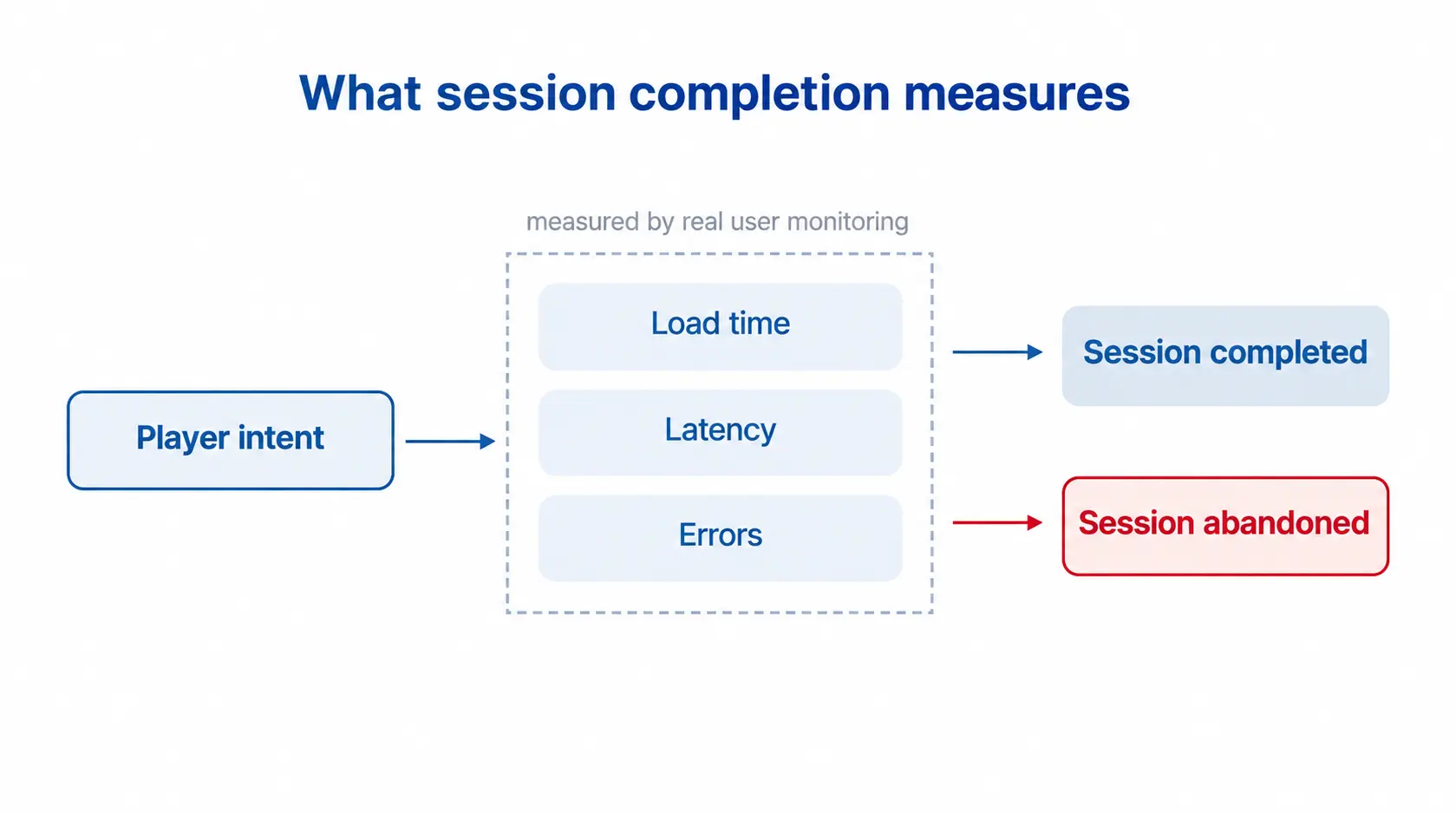
Operators naturally monitor commercial performance through metrics such as GGR, deposits, player retention, and average revenue per user (ARPU). While each provides valuable insight, they primarily measure the outcome of player behavior rather than the quality of the experience that shaped it in the first place.
Session completion offers a different perspective. Rather than asking whether players generated revenue, it asks whether they were able to complete the experience they intended. Nielsen Norman Group identifies task success (or task completion) as one of the most meaningful usability metrics because it measures whether users can successfully achieve their intended goal. If users consistently fail to complete that goal, it is usually a sign that something in the experience is preventing them from doing so.
The same principle applies to casino platforms. When session completion begins to decline, it suggests that something in the player experience is creating unnecessary obstacles. Real User Monitoring (RUM) extends this concept by measuring how real users interact with the platform and correlating page load times, latency, errors, and completed sessions with business outcomes.
Questions every operator should be asking their platform provider
In conclusion, platform performance is too important to measure by uptime alone. Whether you are evaluating a new casino platform or reviewing your current one, the quality of your monitoring capabilities may determine how quickly you identify performance issues and, in turn, how much impact they have on player retention.
When discussing performance monitoring with your platform provider, consider asking the following questions:
- Do you monitor real player sessions or only infrastructure performance?
- Which platform metrics do you track continuously, and how are performance thresholds defined?
- Can performance be monitored by game provider, device type, and geographic region?
- Do you measure lobby load times, game launch latency, and payment performance separately?
- How are failed transactions, game launch errors, and interrupted sessions identified and reported?
- Are performance alerts generated before players begin reporting issues?
- What operational reporting is available to help investigate recurring performance problems?
The answers will quickly reveal whether your platform simply reports system availability or provides the operational visibility needed to identify emerging issues before they begin affecting player experience.
In an increasingly competitive market, that difference can influence far more than technical performance. It can determine long-term player retention and commercial performance.
If your platform reports uptime but not player experience, you may be missing the earliest warning signs of churn.
Popular blog posts






.webp)