

The branding mistake hurting many new casino launches
Updated 4 Sep 2026•Published 4 Sep 2026
Key takeaways
- Branding drives operations — onboarding, payments, CRM, VIP management, and support all express the brand long before players notice the visuals.
- Late branding costs a year — operators who delay identity spend the next 12 months buying recognition through bonuses and acquisition.
- Audience defines the operational checklist — VIP, casual mobile, crypto, and hybrid audiences each demand a different platform structure.
- Consistency beats launch momentum — platforms built for a specific player profile retain better than those mirroring competitors.
- White-label infrastructure frees strategic focus — outsourcing the technical load buys time to build identity before player perception forms.
In 2026, launching an online casino brand has never been easier from a technical perspective. Building one that players actually remember, however, is becoming much harder.
Many operators believe they have a brand because they chose a logo, a color scheme, and a domain name, and what often launches is infrastructure with a visual identity attached to it. But there's a difference between this and true branding in iGaming. The platform works, the games are live, the payment gateway functions, and acquisition campaigns begin. Yet within months, the casino starts to feel interchangeable with dozens of other iGaming platforms competing for the same players.
That is the misunderstanding. Branding in iGaming is not a design detail to be added later. In fact, it plays a central role in determining operational priorities across the business. Product selection, onboarding flows, payment experience, CRM strategy, VIP management, bonus structure, support style, and even acquisition channels all influence how players experience a casino long before they consciously recognize its visual identity.
The problem is that many operators make those decisions independently of one another. A casino targeting high-value players, for instance, may still rely on generic onboarding journeys, standard bonus models, and support systems that feel outsourced. Over time, those inconsistencies become noticeable to players.
Most casino brands are not forgotten because the technology failed. They are forgotten because nothing about the experience feels distinct enough to remember. That's to say, there is a lack of consistency between the brand positioning and the actual player experience.
That creates an increasingly difficult problem in today's market. Competition is higher, acquisition costs continue to rise, and player attention spans are shorter than ever. Operators can no longer rely on launch momentum alone to build recognition. The casinos that last are usually the ones that define the brand first, then build the platform around it. This is where brand-first thinking is different from traditional launch strategy.
The mistake many operators make at launch
Many casino launches follow the same predictable sequence. The platform is usually selected first, followed by suppliers, payment providers, bonuses, and affiliate deals. Branding enters the conversation much later, typically once the operational framework is already in place.
The logic behind this is understandable. Once the launch process is underway, the pressure to move quickly increases. Development costs accumulate, supplier integrations are underway, and every delay feels tied directly to lost revenue. Infrastructure becomes urgent, while branding is often pushed into the background as something to address later.
So ultimately, the problem is that by the time operators begin thinking seriously about identity, many of the decisions defining the player experience have already been decided.
That is why so many new casinos end up looking and behaving the same. The same lobby designs, the same onboarding processes, and the same bonuses. Even when visual branding differs, the overall experience will often not feel distinct enough to create a lasting memory.
In due course, this creates another problem. Operators that delay branding strategy may then spend the next 12 months trying to construct identity through promotions, larger bonuses, and increasingly aggressive acquisition campaigns rather than building a player experience that feels genuinely unique.
What does brand-first in iGaming actually mean?
Brand-first thinking in iGaming is sometimes misunderstood because operators tend to associate branding with presentation. Typically, the strongest casino brands are built from the ground up by aligning the platform experience around a specific type of player from the start. This matters.
A casino targeting high-value VIP players, for example, cannot rely on the same operational approach as a broad mass-market platform. Support interactions need to feel personal rather than outsourced. Withdrawal speed becomes part of the premium experience. Game selection often focuses on curated content rather than endless volume, while loyalty structures, CRM communication, and even interface communication begin reflecting a more exclusive environment.
The same applies at the opposite end of the market. A casino targeting casual mobile-first users may prioritize simplicity over feature depth. Complex onboarding reduces engagement. Bonuses need to feel immediately understandable, and session flow matters more than complicated functionality.
This is where branding begins to move beyond visual identity and into operational strategy. The brand influences which suppliers fit the platform, how promotions are structured, what type of CRM communication feels most appropriate, and what kind of experience players expect once they register.
Ultimately, players are far more likely to remember platforms where the operational experience consistently supports the positioning the brand is trying to create.
Brand positions and their operational priorities
Once a casino defines the type of player it wants to attract, the platform’s operational structure should evolve to support the expectations associated with that brand.
| Brand positioning & target audience | Operational priorities |
|---|---|
| High-value VIP players | Fast withdrawals, personalised VIP support, curated game portfolio, premium UX, and more personalised CRM communication. |
| Casual mobile-first users | Fast onboarding, lightweight UX, simple navigation, shorter session design, smooth payment processing. |
| Crypto-focused players | Wallet flexibility, rapid transactions, privacy-first approach, volatility-friendly promotions, and simplified verification. |
| Entertainment-led casino brand | Strong gamification, social features, tournament structures, dynamic promotions, and content variety. |
| Trust and compliance-focused brand | Transparent terms, visible responsible gambling tools, reliable support, stable payments, consistent communication. |
| Sportsbook-casino hybrid audience | Unified wallet, unified player journeys across products, real-time promotions, and integrated player experience. |
Two operator launches, 2 different outcomes
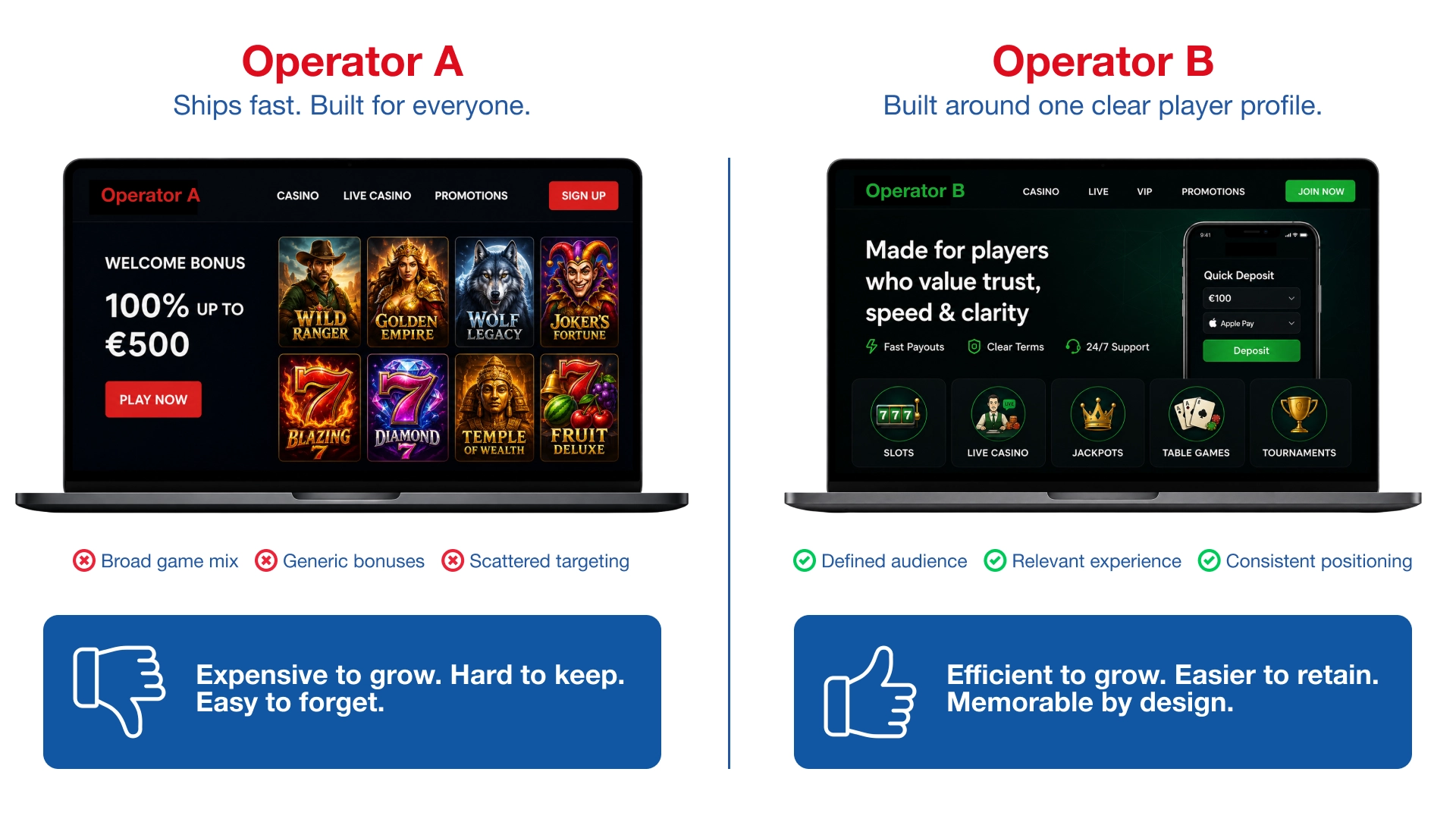
The impact of this idea becomes much easier to see when comparing how different operators approach launch strategy from the beginning. Consider two operators entering the market with similar budgets, similar supplier access, and similar launch timelines.
Operator A moves quickly. The platform goes live with a broad mix of games, standard bonuses, multiple audience targets, and a structure closely resembling several established competitors already active in the target market. Branding is treated largely as presentation: visual identity, homepage styling, and promotional messaging added to an otherwise standard platform experience.
Initially, acquisition performs reasonably well. But over time, differentiation becomes difficult. Retention weakens, bonus dependency increases, and marketing costs begin rising as the casino struggles to create a recognizable identity beyond promotions and acquisition campaigns.
Operator B, on the other hand, takes a different approach. Before launch, the target audience is clearly defined. Suppliers, onboarding structure, CRM communication, VIP management, payment flows, and user experience decisions are aligned around that specific player profile from the beginning.
The result is not necessarily a more visually impressive casino. The difference is that the platform feels intentionally built for a specific audience. Players understand what the platform represents, what type of experience to expect, and who the brand is built for.
That foresight and consistency are often what create long-term memorability in a crowded iGaming market.
Why white-label makes brand-first launches possible
One of the biggest challenges for new operators is that infrastructure decisions quickly consume both time and attention. Building backend systems, managing integrations, configuring payment infrastructure, handling compliance requirements, and coordinating multiple suppliers can easily dominate the early stages of a launch.
At the same time, positioning a new casino brand properly requires strategic focus. Most startups cannot realistically spend 18 months building online casino infrastructure while simultaneously refining player targeting, acquisition and retention strategy, and platform identity. Eventually, one side usually begins taking priority over the other.
This is where white-label infrastructure becomes strategically important for many operators.
Rather than treating branding as an afterthought, a white-label casino model allows operators to spend more time aligning the player experience from the start. Decisions around onboarding, CRM messaging, bonus incentives, payments, game selection, and user experience can be approached through the lens of the audience the casino is trying to attract, instead of becoming secondary to technical delivery pressures.
That matters because player perception usually forms early. If the operational experience feels disconnected, generic, or inconsistent at launch, correcting that positioning later becomes far more challenging and expensive.
For many operators, the real advantage of white-label infrastructure is not simply speed. It is the ability to focus resources on building a recognizable platform identity and a supporting marketing position before operational complexity begins to pull attention elsewhere.
You can see more on the licensing side of the model in our video: White Label Casinos licensing explained.
Build a casino brand that players will remember
In 2026, launching an online casino is much more than a technical challenge. The market is already saturated with platforms offering similar game lounges, bonuses, and near-identical player engagement strategies. What increasingly separates successful operators is the ability to create a platform experience that feels intentionally built for a specific audience from the get-go.
This is where Agreegain's casino solutions can play an important role. By reducing the operational pressure associated with infrastructure, integrations, payments, and platform management, operators can focus more attention on player experience, marketing, and brand development.
For investors planning a new launch, speed still matters. But increasingly, so does having the time and operational flexibility to build a platform experience that supports a strong and clear brand identity from day one.
Popular blog posts





.webp)