

What happens to affiliate revenue share when AI answers the question first
Updated 27 Oct 2026•Published 27 Oct 2026
Key takeaways
- AI removes the click, not the influence — a publisher can shape a player’s decision and appear nowhere in your referral data.
- Google click rates halve when an AI summary appears, dropping from 15% of visits to 8%, with cited links clicked on about 1%.
- Revenue share outlasts acquisition performance, so a partner can top your revenue report while sending fewer new players each quarter.
- AI pressure lands on future growth and CPA rather than on recurring revenue from players already acquired.
- Some affiliates gain influence as traffic falls, because AI answers still draw on comparison sites, reviews and specialist publishers.
- Split revenue by acquisition date before you judge any partner, and read visibility, referrals and player value side by side.
- Reprice partners on partner-level evidence, never on a channel-wide reading of declining affiliate traffic.
Imagine your second-largest affiliate loses a third of its new-player referrals, yet its revenue barely moves. Would your reporting tell you that something important had changed?
There is nothing contradictory about that. Players referred months or years ago can continue generating revenue long after onboarding. What becomes harder to establish is whether the affiliate responsible for that revenue is still equally effective at finding the next generation of players.
AI search adds another complication. Players can now research and compare operators without following the normal route from search result to affiliate page to tracked referral. And the websites that helped inform that decision may still have influence, even when they never receive the click.
Ultimately, this creates a practical question. If AI changes how players discover gambling brands, how do you know whether an affiliate has become less valuable, or simply harder to measure?
The answer may not be high on your list of priorities right now. But getting it wrong can mean reducing investment in a partner that still influences acquisition, or continuing to pay premium terms to one whose best acquisition years are behind it.
AI can remove the referral, but not the influence
The change is already happening in search behavior. A Pew Research Center study of almost 69,000 Google searches found that users clicked a traditional search result on 8% of visits when an AI summary appeared, compared with 15% when one did not. Links cited within the AI summaries attracted clicks on just 1% of visits.
For affiliates, fewer clicks create an obvious problem, but they do not tell us whether the publisher has stopped influencing the player’s decision. An AI answer can draw information from third-party websites and present it before the player visits any of them. A comparison or review site could therefore contribute to what a player learns about an operator without appearing anywhere in the subsequent referral path.
For the operator, this makes falling referral traffic harder to interpret. It could mean an affiliate is influencing fewer players. It could also mean some of that influence is happening without a tracked referral.
Revenue can outlast acquisition performance
Revenue share makes this change particularly easy to miss. An affiliate that recruited valuable players several years ago can continue earning from their activity today, regardless of how many new players it is currently sending.
This is an established feature of how revenue share works. In its 2025 Annual Report, Better Collective explains that once a player has been acquired, subsequent changes in search behavior do not directly affect its existing recurring revenue-share base. Where AI-driven search could have an impact, it says, is on future revenue-share growth and CPA. In plain English, if an affiliate brought you a player in the past, that player can keep generating revenue for the affiliate even if AI later changes how new players find gambling sites.
For a closer look at how these payment structures differ, watch our video on CPA, revenue share and hybrid affiliate models.
For operators, that creates an important difference between revenue already built into an affiliate relationship and that relationship’s acquisition performance today. A partner can remain near the top of an affiliate revenue report while bringing in progressively fewer new customers. As we explored in the article The four numbers your acquisition report is missing, separating the value created by different acquisition sources and player groups can provide a much clearer picture of current performance.
AI could make some affiliates more valuable, not less
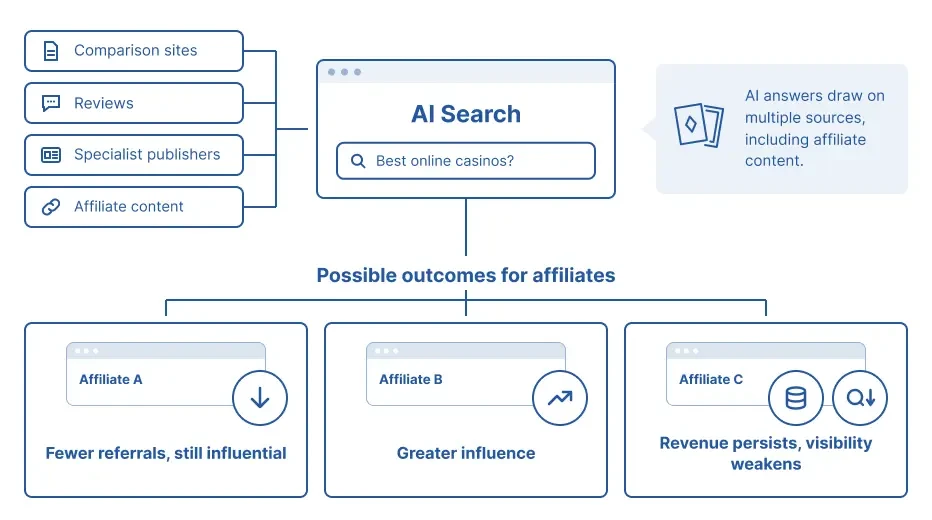
So far, we have considered what AI could take away from the traditional affiliate journey. But in today’s environment, it could also change which affiliates have the greatest influence. Fewer clicks do not necessarily translate into less value for every affiliate. AI systems still need information to construct their answers, and comparison sites, reviews and specialist publishers can form part of that supply of information.
The effect, however, is unlikely to be evenly distributed. Research into AI citation patterns shows considerable differences in which sources AI platforms cite, and those sources can also change over time. For gambling affiliates, that creates the possibility of very different outcomes. A publisher could lose referral traffic while remaining influential in AI-assisted discovery. Another could retain substantial revenue from players acquired historically while becoming less visible to new players through both conventional search and AI.
Operators therefore need to avoid treating declining affiliate traffic as a market-wide verdict on the channel. The more useful question is whether individual partners are gaining, retaining or losing their ability to influence new-player discovery.
What should operators measure instead?
If AI affects different affiliates in different ways, operators need to be able to see which relationships are changing and how. Falling referrals may be a warning sign for one partner and only part of the story for another. The following questions can help separate declining performance from changing discovery patterns, while keeping the commercial value of each relationship in view.
| Question | What to examine |
|---|---|
| Is the affiliate still bringing in new players? | New-player volumes and how they are changing over time |
| Are those new players still valuable? | Conversion, NGR, retention and value of recently acquired players |
| Where is its current revenue coming from? | Revenue or NGR separated by when players were originally acquired |
| Is the affiliate still visible during player discovery? | Traditional search visibility, relevant AI mentions and citations, and referral traffic |
| Are players reaching the operator differently? | Changes in affiliate referrals, AI referrals, branded organic search and direct traffic |
| How does its performance compare with similar affiliates? | Whether changes are specific to that partner or visible across comparable publishers |
| Do the current commercial terms still make sense? | Current acquisition contribution against CPA, revenue-share, hybrid and other future acquisition costs |
You cannot reprice what you cannot see
With a clearer picture of what each affiliate is acquiring, earning and contributing to discovery, operators can start making more informed commercial decisions. An affiliate that continues to acquire valuable players and remains prominent in discovery may justify greater investment. One showing fewer referrals but continued exposure may warrant further investigation before its terms change. Where historical revenue remains strong but new acquisition has weakened, the case for reviewing future acquisition terms becomes much stronger.
The important point is that these decisions depend on being able to separate what is happening within each relationship. Agreegain’s reporting and analytics give operators the ability to examine acquisition, player behavior and financial performance at a more granular level, providing evidence for those commercial decisions.
Of course, it cannot yet reveal every influence behind an AI-assisted player journey. But it can help operators identify when the economics of an acquisition channel are changing, giving them a better basis for deciding where future affiliate investment should go.
Popular blog posts